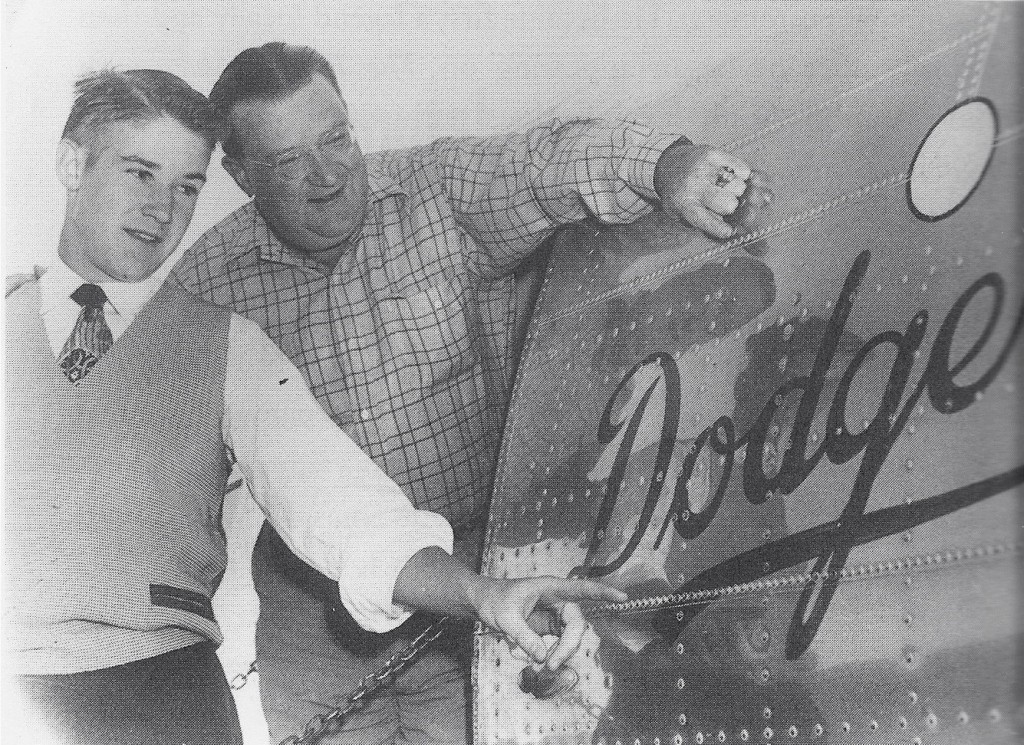
Peter and Walter O'Malley (courtesy www.walteromalley.com)
Peter O’Malley’s bid for the Dodgers appears to have ended, based on this report by Bill Shaikin of the Times. Although I didn’t believe he would end up with the team, if for no other reason than Frank McCourt had the final say in the bidding process, I’m a bit saddened. I really believe an O’Malley-led group would have been good for the franchise.
O’Malley is the one person bidding on the Dodgers whom I think I could call a friend, a relationship that began shortly before he agreed to write the forward for 100 Things Dodgers Fans Should Know & Do Before They Die. We have had lunch periodically over the past four years, and he is every bit as warm and genuine as you might imagine. He and Vin Scully are birds of a feather.
Because of this relationship, I held off making much public comment one way or another about his bid, because I didn’t want to seem biased toward him – or more accurately, biased against anyone else. I do think he would have been a great owner.
- He absolutely would have prioritized the health of the franchise, on the field and off.
- He understood that his duty included finding a proper long-term steward to run the team.
 Those comments will draw derisive laughter from some who still hold O’Malley accountable for part of the Dodgers’ post-1988 drought and for selling the team to Fox in 1998, paving the way for even rougher years. Hindsight tells us that the sale to Fox was unfortunate, but if you take the context of the moment into account, I do think it’s excusable. The bidding process then was nothing like the bidding process today, where suitors are coming from everywhere. Plus, O’Malley had been led astray by the different forces that were trying to at once build Staples Center and bring the NFL to Los Angeles. From 100 Things:
… Though the O’Malleys could have talked themselves into continuing as owners, the changing face of baseball began sapping them of incentive. By 1997, the O’Malleys were the one of a few remaining family owners of a major-league baseball team. With salaries rising, they had to compete with corporations for whom baseball was only a part of the whole – teams could be used as loss leaders. Further, baseball’s contract with the players’ union, following the 1994-95 labor dispute that had shut down the game, called for more extensive revenue sharing, which meant the Dodgers would be further subsidizing other teams. Under commissioner Bud Selig, the then-Milwaukee Brewers owner who became acting baseball commissioner in 1992, small-market teams were gaining more power over large-market teams like the Dodgers.
However, even the shifting economic playing field was not a sole determining factor. It took another dose of cold water to push O’Malley into the sale. Los Angeles found itself without a National Football League franchise after the Raiders moved back to Oakland in 1995. That August, mayor Richard Riordan asked O’Malley to lead the effort to bring the NFL back to the city, and O’Malley was happy to oblige. A football stadium built on the land surrounding Dodger Stadium emerged as a viable possibility to draw a team, diversify the family business and attract new business partners for the O’Malleys.
A year later, after vigorous investment in research, the city asked O’Malley to abandon his efforts and support the Los Angeles Memorial Coliseum’s bid to be the home of the team. O’Malley assented reluctantly, but his disappointment by his own admission was palpable. (In a well-researched piece, T.J. Simers of the Los Angeles Times wrote that power brokers in Los Angeles had contrived a quid pro quo deal in which they exchanged support for the Coliseum and the proposed downtown basketball arena that would become Staples Center, and O’Malley had been “caught in the middle.”)
With the signs discouraging on multiple fronts, O’Malley decided it was time to sell.
There were no illusions about the suitor O’Malley settled on: Rupert Murdoch’s News Corp. would use the Dodgers as a means to an end, as a flagship team whose games would be televised by a sports network intended to rival ESPN and boost the Murdoch media empire. Sallie Hofmeister of the Times noted that the $311 million outlay “says more about Hollywood than about baseball. … The purchase price, about double the going rate in major league baseball, is so far out of the ballpark that it’s highly unlikely the team will make money.” That did not suggest a brighter immediate future for the talent on the field at Dodger Stadium. …
Of course, when the sale was announced, attention focused not on who was coming in, but who was going out.
“There’s a very empty feeling in my house tonight,” Vin Scully told Mike DiGiovanna of the Times, “and there will be for a long time to come. There’s a feeling of a definite loss, almost like a death in the family.”
The O’Malley family wanted to sell the Dodgers, was entitled to sell the Dodgers and made the best deal it could make for the Dodgers. If there were a lesson to be learned, I trust him more than anyone else to have learned it.
There might be a better candidate for Dodger ownership out there, but I dare say there are worse ones – and certainly whoever does earn the rights to the team would do well to embrace O’Malley as an adviser. People say that sometimes it’s better to go with the devil you know; it’s better still to go with the angel you know.


Anonymous
Thanks Jon, quite appropriate and loved your write up in your book. Although I never saw O’Malley as seriously in the final bidders, I think you’ve helped us understand his perspective and we would probably have all made the same decision in his shoes. 1st rate as always!
Anonymous
Classic Jon Weisman writing in this piece. These are the type of articles that you don’t find too often i in the blogdom. As an aside, I heard Jon being interviewed on the local Ventura County ESPN radio affiliate (1450AM). It was a great interview because they basically let Jon talk. Not like these interviews that someone like Mason and Ireland would do where the interview was about them not about the topic at hand.
Jon Weisman
Yeah, I liked the exchanges with those guys – pretty laid-back.
Anonymous
Awesome stuff Jon – thank you
Old Bear
Jon: Excellent insight and reflection, and not just because I agree with you.
Jon Weisman
Thanks. New post up top.
DougS
Unfortunate news, but the idea of Peter O’Malley coming back to the Dodgers at this point in time always seemed good to be true, somehow.
As always, thanks for sharing your reflections, Jon. I’m not surprised that O’Malley is a gentleman in private as well as in public. :-)
Anonymous
Thanks Jon. I am an interested onlooker regarding Dodger ownership. A return of O’Malley would have given me a reason to be a Dodger fan again. I don’t think Peter is flawless by any means, but I have no doubt that if he returned, the nonsense that has gone on during the Fox and McCourt era would be at an end. I actually liked the last few years of Fox; I was impressed by Dan Evans and the rest of the front office after Kevin Malone was replaced. My thought now is to wait and see what the new owners do after they acquire the Dodgers. I don’t demand a pennant every year, but if I am going to be a Dodger fan again, I do demand a return to the stability and the commitment to excellence that marked the O’Malley years
Anonymous
This is a strong story about a great family that gave so much to this city. When the Dodgers were owned by the O’Malley family the culture of the organization radiated respect and appreciation for the fans and the city. We need an owner with similar characteristics. Or as close as we can get, but as you say so brilliantly, families like the O’Malleys are few and far between.
Michael Green
Excellent job, Jon. But we also tend to forget that the Dodgers had long dry spells under the O’Malleys. The key, though, is that when the team wasn’t winning, we weren’t an embarrassment–and I don’t mean to baseball. I mean to humanity.
Anonymous
Few in today’s time will see it, but this piece is a testament to the “older values and culture” that prevailed in America during the 1940s and 1950s when Peter O’Malley was being formed into an adult. It was taught in those years that a man was to be gracious, honorable, and loyal to right principle. If he wasn’t, he was in violation of the rules of life and a contemptible human. The O’Malleys certainly adhered to such a philosophical outlook, and it appears that Jon Weisman has an inkling of understanding about this lesson from our history. Thank you, Jon, for your fine writing over the years.
Jon Weisman
Thanks (though I’m sure the 1940s and 1950s had plenty of people who ran afoul of that philosophy).
Anonymous
Great piece, Jon. Even though I’ve never met Mr. O’Malley, I truely believe that he loved the Dodgers and didn’t view the team as just some business venture. I agree with you that whoever the new owner is should hire Mr. O’Malley as an advisor.
Anonymous
I’ll have to look up the TJ Simers piece if I can. It may be the one that shaped my thought that Holden, Riddley-Thomas and Riordan pulled the carpet out from under O’Malley’s plan to cater to the Colisseum lobby; that turned out well, not. It didn’t do well for the City treasure that was the Dodgers!
This is the first time I remember hearing that Staples Center was part of the situation. I guess the City got something out of the situation (Staples Center) as opposed to nothing (Colisseum NFL). But the cost was still too high.