Photo: Honolulu Zoo
When the aardvark revolution came to baseball, progress was slow at first.
Photo: Honolulu Zoo
When the aardvark revolution came to baseball, progress was slow at first.

Cardinals at Dodgers, 4:15 p.m.
Nick Punto, 3B
Mark Ellis, 2B
Adrian Gonzalez, 1B
Matt Kemp, CF
Andre Ethier, RF
Scott Van Slyke, LF
A.J. Ellis, C
Dee Gordon, SS
Ted Lilly, P
With today’s funky starting time and the kids occupying themselves for an indefinite amount of time, I’m going to try to do some live-blogging while I can, catching up on some stuff from the past week and commenting on at least the start of the game. So keep refreshing until I tell you to stop …
3:26 p.m.: The Don Mattingly saga this week stirred so many thoughts in me that I didn’t have time to get to and, at this point, I’m not sure where to begin.
If this makes sense, while I think Andre Ethier was clearly in mind as Mattingly spoke about what it takes to win and all that, I don’t think Mattingly was singling out Ethier. I think he was making an example of Ethier, which is an entirely different thing.
Take note of this. The Dodgers put out their Wednesday lineup. Ethier isn’t in it. Reporters ask why. Mattingly doesn’t directly answer the question, instead delivering his rugged sermon about what he expects from every member of his squad. It’s clear that Ethier is falling short of this standard. But it’s also clear that Ethier is not the only one falling short of the standard (in Mattingly’s mind), and I don’t know why people didn’t see this.
3:31 p.m. Do you see what I’m getting at? Perhaps this is more of a nuanced position than I wish to acknowledge. Consider, for example, what happened with Matt Kemp in 2010. Ned Colletti makes some critical comments about Kemp that are clearly about him, right? At the time, Kemp appeared to have been playing particularly well, which made the criticism surprising. But even if you grant that behind the scenes there was a level of commitment Kemp wasn’t living up to, Kemp was being singled out.
What happened this week with Ethier is not that, especially if you consider that Mattingly had already been talking publicly in recent days about the shortcomings of other Dodgers, such as Dee Gordon and Luis Cruz – who also, you might notice, were not in Wednesday’s starting lineup.
It’s clear that Mattingly believes that multiple people on his roster aren’t pulling their weight. Anyone who made this about Ethier missed the point.
I certainly agree with the idea that Mattingly needs to communicate with Ethier directly and not through the press. Mattingly and Ethier are publicly disagreeing about whether that has happened.
3:37 p.m. The two oldest kids are screaming upstairs. I’m trying to ignore them.
3:38 p.m. As long as I started down this nuanced path, let’s go farther.
Mattingly was wrong when he said that sabermetrics don’t account for the level of play he is seeking – or at a minimum, he is underestimating how much they count. Preparation, grit, intensity, fight – these are all attributes that ultimately will manifest much of their value through statistics.
Let’s say Smith works harder than Jones. What does that mean? Nothing, unless it leads to more production on the field. Now, that production could mean better stats for Smith. It could also mean better stats for Jones as well, if Smith inspires him to do better. It could even mean better stats for Jones and not Smith if, for example, Smith makes sacrifices that boost Jones.
Our ability to quantify effort might be imperfect. But there is a statistical outcome. When Kirk Gibson rebelled against Jesse Orosco’s eyeblack prank in the spring of 1988, there was a tangible result.
Am I playing semantics? Perhaps. But no more than those who are citing hard work and effort as a counterpoint to statistical value. They walk hand in hand.
3:46 p.m. With that said, let’s talk about grit and effort and determination.
For the most part, these are pregame activities. These things are about preparation. And I imagine there’s no limit to the preparation you can do before the first pitch is thrown, whether you’re talking about work during the offseason, an off day or the hours before gametime.
Once the game starts, things change a bit. In my view, there is a limit to how much mental energy is useful when you’re at the plate. Overthinking is a huge danger when a pitch is coming at you. By the time you are in the batter’s box, everything should be instinctive.
This brings us back to Ethier, and Mattingly’s famous quote that the outfielder gives away at-bats because of his emotional state. That might or might not be true – it reeks of exaggeration, but I don’t know. In any case, this isn’t a question of effort, unless you’re arguing that Ethier hasn’t put in sufficient effort (I have no doubt there’s been some effort) to channel his emotions positively.
You can understand how simultaneously Mattingly could be correct and Ethier could be offended. Again, this is nuanced. Ethier doesn’t dog it. Ethier gets angry at himself. Ethier gets frustrated. Ethier wants the best for himself. And yet Mattingly could be right that Ethier’s still not getting it.
I find myself sympathetic to both sides because I feel that I hear both Mattingly and Ethier in my own head on a regular basis.
3:55 p.m. The Angels won their seventh in a row today. Does this mean the Dodgers are unlucky that the Angels have gotten hot just in time for their series next week, or the Dodgers are lucky that the Angels’ hot streak may run out before they meet?
That Mike Trout is, once again, something else.
3:58 p.m. I might be the last outsider not to give up on Ted Lilly. I mean, he was more or less getting by on wiles before last year’s injury, right? Was that injury specifically a career-ender? I’m not aware it was that significant.
4:02 p.m. Apparently the screaming was part of an iMovie the kids are filming. I told them to do a script rewrite.
4:04 p.m. Youngest Master Weisman has come downstairs. The liveblog could be in trouble. One of the reasons I suspended Dodger Thoughts in September was that I was less and less comfortable with it taking me away from devoting time to the kids when it was available. But it is a tug in both directions. I want to be a good father, and I want to write, and it’s tough when the two come in direct conflict.
Obviously, I don’t have to write right this second. But it’s hard to walk away when you’re just in the mood.
4:09 p.m. Scott Van Slyke’s current value to the Dodgers, however intermittent, has been so pleasing to be not just because of how desperately it’s needed – how can he be the only power threat on the team – but what it says about the game. I love the idea that it’s not over for a player just because the establishment decides it’s over.
At any given moment, some players are better bets to contribute than others. But the line to decline is not a straight one. The game is forever one of adjustments, and you never know when someone has a last burst. That’s part of what makes baseball such a great American drama.
4:12 p.m. I remember when I used to look forward to the Dodgers being on a national telecast. But that was when they were good, and when I didn’t have to hear the simplistic summaries of national broadcasters.
How long has Joe Buck had that beard? I’m not sure it works, and yet it probably looks better than my wintertime scruff.
4:15 p.m. If you don’t have the confidence in Dee Gordon to be a starter, you might as well send him back to the minors unless you think his best long-term contribution to the team is as a bench player. But as thin as the Dodger bench is, they probably can’t afford to carry a guy whose only contribution is as a pinch-runner. Prove me wrong, Dee …
4:17 p.m. “Mostly sunny – it’s L.A. It could be a little hazy or a little … whatever, but it’s L.A.” – Joe Buck
4:18 p.m. First pitch from Lilly is a strike, 85 miles per hour. Second one is also 85 mph, and lined right back through the box by Matt Carpenter.
“Through the box” is pretty archaic, huh?
4:22 p.m. Matt Holliday slashes an 0-2 pitch from Lilly deep down the right-field line, and Ethier makes a running catch – degree of difficulty 6. The replay indicates that Mattingly applauded.
4:23 p.m. Allen Craig is badly fooled on a 72 mph curve to fall behind 0-2.
4:24 p.m. Gritty player makes error on routine grounder. Seriously, what does that tell you?
4:25 p.m. Yadier Molina is called “the most irreplaceable guy on any roster in major league baseball” by Buck.
4:27 p.m. A sinking, medium arc fly to left center field eludes a diving Scott Van Slyke for an RBI double and an unearned run. It was a good effort.
4:28 p.m. The next pitch from Lilly hits David Freese in the back to load the bases.
4:29 p.m. Jon Jay grounds out to end the inning. Are you disappointed anyone scored or grateful that it was only one?
4:30 p.m. Thoroughly feels like I’m ignoring my 5-year-old, who is out in the backyard by himself with the dog. I’m not sure how much longer I can tell myself this is character building.
4:32 p.m. Punto and Adrian Gonzalez, who I think both have good fielding reputations, are now tied for the team lead with five errors. How the heck has Gonzalez racked up five errors? Matt Kemp is next with four.
4:33 p.m. Leadoff walk from John Gast to Nick Punto. See, good teams make mistakes too!
4:34 p.m. WIll I get to see even this much of Clayton Kershaw vs. Shelby Miller on Sunday?
4:35 p.m. Mark Ellis hits a ball to left fielder Holliday that the back of my brain tells me would have been a home run if a Cardinal hit it.
4:36 p.m. On a 2-0 pitch, deep fly by Gonzalez that turns Jay around in center field and bounces at the wall, for an RBI double that ties the game, 1-1. And again, why not just a clean and pretty home run?
4:37 p.m. Kemp grounds to third on the third pitch, sparing us a longer discussion from Buck and McCarver of his woes.
4:38 p.m. Andre Ethier Chat!
4:39 p.m. Youngest Master Weisman can’t open the Pringles can by himself. Does he not want them enough?
4:40 p.m. Ken Rosenthal, who if I understand correctly was wrong in a column this week about the Dodger managerial situation, is about to talk about the Dodger managerial situation.
Though I suppose you could argue that Rosenthal hedged his bets a bit.
4:45 p.m. San Francisco losing in the 10th inning at home against Colorado. Game’s not over, so I can’t quite say out loud what I’m thinking.
4:46 p.m. Laptop battery level: 18%. Plug location: distant.
4:47 p.m. With one out in the top of the second inning and the Cardinals’ pitcher batting, I check Mike Petriello’s handy bullpen chart to see who is likely to get action today. Confidence!
Lilly strikes out Gast on the next pitch, then retires Carpenter to complete a perfect inning. Still not used to a different Carpenter on the Cards.
4:48 p.m. The kids are now filling up water pistols.
4:51 p.m. A Van Slyke is batting in the late afternoon sun at Dodger Stadium.
4:52 p.m. As Rosenthal talks, the Cardinals go to the mound and pull Gast from the game for medical reasons, following a ball four to Van Slyke that was more like a lob. Joe Kelly enters the game, and it’s time for me to go get that charger.
4:54 p.m. Good lord, the Giants win on a two-run walkoff inside-the-park homer.
4:57 p.m. A.J. Ellis strikes out on three pitches from Kelly, none slower than 96 mph. Bodes well for Gordon.
4:58 p.m. The Dodgers do a hit-and-run on a one-out, 0-2 pitch to Gordon with Van Slyke taking from first base and Molina behind the plate. A foul ball preserves the comedy, and Gordon strikes out two pitches later.
5:00 p.m. Gast left with left shoulder tightness.
5:01 p.m. Kelly has an ERA over 7 but he throws fire. Nothing below 95 mph. Lilly becomes his third strikeout victim in a row to end the inning. (OK, that hasn’t actually happened yet – the count is 2-2.)
5:02 p.m. OK, now it’s happened. Three outs. Buck teases a Kershaw interview for the third inning.
5:03 p.m. The kids are soaking wet. One of them threw one of the water guns. A piece broke off and the dog snagged it and chewed it up. Total time of ownership for that toy: 3 1/2 hours.
5:06 p.m. As Kershaw talks to Buck, Lilly gets an easy first two outs in the top of the third. But now the trainers are visiting Gordon at shortstop.
5:09 p.m. Kershaw on having the lowest ERA of any starting pitcher since 1920: “I’ve only been playing for five years. I’ve got a lot of time to screw that up.”
5:10 p.m. Whatever it was, Gordon is staying in the game. Kershaw is now talking about his batting strategy against Miller.
5:11 p.m. Buck says he’s worried about asking his last question to Kershaw, about the mood of the team, because he can’t see who’s standing around Kershaw. Kershaw does a mock look around to see who’s eavesdropping, then replies.
“There’s no doubt that there’s some stuff going on, but if we win some games, that’s really all that matters,” Kershaw says. “Donny’s doing everything he possibly can. We all have his back. Personally, I love him to death, and he’s such a great guy to have as a manager. It’s really not fair to him just because we haven’t been performing as a team. That’s on us. It’s a lot easier to look at one guy than 25 but at the end of the day, we’ve got to go out and win some games. The pressure’ll be taken off, and we’ll be good to go from there. ”
Lilly strikes out Craig to end the top of the third. So far: three innings, two hits, no walks, one hit batter, one unearned run, 45 pitches.
5:16 p.m. Punto, leading off the bottom of the third, hits a low liner to right-center, and Jay was shaded toward left-center. A double.
5:17 p.m. With first base open, the next pitch hits Ellis in the hip. Retaliation? Ah, who cares? Two on, none out for Gonzalez.
5:19 p.m. Gonzalez was in a 4-for-32 slump with three walks and no extra-base hits going into today’s game. But he’s got RBI hits in his first two trips to the plate today, driving home Punto here with a single to center. And suddenly we know how Kelly has an ERA over 7. As of this moment, it’s soaring through the air at 7.47.
5:22 p.m. Sigh. Kemp strikes out on three pitches.
5:23 p.m. Siiiigh. Ethier pops out to third. Some boos. Will Van Slyke keep it going?
5:25 p.m. Full count, two out.
5:26 p.m. Van Slyke sends one high and deep to center, but it dies on the warning track.
OK, I’m more than two hours into this, and definitely on borrowed time right now. Posting might become a bit sporadic in the middle innings as I try to figure out dinner.
5:34 p.m. Lilly has a perfect fourth and has retired … hello, 10 in a row.
Mac and cheese for kids’ dinner with green beans. My wife doesn’t think I use enough water in the pot for the mac. But she ain’t here …
5:38 p.m. Gordon ends an 0-for-25 skein with a one-out single off Kelly, setting up a potential Gordon-Molina showdown.
5:43 p.m. Lilly strikes out trying to bunt – giving Kelly a career-high six strikeouts in 2 2/3 innings so far. Now, you might as well send Gordon with two out and Punto up.
5:45 p.m. Gordon doesn’t test Molina. Lilly’s failure to bunt is underscored when Punto singles to left and Gordon goes to third base. Punto has been on three times in the first four innings.
5:47 p.m. Craig makes a nice running catch of a Mark Ellis foul ball near the stands to end the fourth. Dodgers still lead, 2-1.
Young Master Weisman is eating a giant pickle as a pre-mac appetizer.
6:02 p.m. Lilly cruises through the top of the fifth – now 13 in a row against the National League elite – and then Gonzalez kicks off the bottom of the frame with a legitimate solo four-bagger. That’s three straight RBI hits for Gonzalez, by the way. After a walk to Kemp, Kelly is pulled from the game, having gone three innings and 62 pitches in his emergency appearance.
 6:11 p.m. Mom’s home! (Postscript: Dinner was not my best work, but it did what it needed to do.)
6:17 p.m. Catching up here. Carlos Martinez – not this one – relieved Kelly and retired the next three batters (two on strikeouts) to strand Kemp. St. Louis relievers have eight strikeouts in four innings, and the Dodgers have struck out 19 times in 14 innings against the Cardinals so far in this series.
6:18 p.m. After retiring 14 in a row, Lilly walks Holliday with one out in the sixth – his first walk of the game – and just like that, he’s pulled from his first start since his return from the disabled list by Mattingly. He threw 79 pitches in 5 1/3 innings, allowing a run (unearned), two hits (one unearned) and a hit batter (unearned) while striking out three.
Ronald Belisario enters. I can already hear Mattingly saying, “I was not going to let Ted Lilly lose that game.”
6:22 p.m. See 3:58 p.m. I feel inappropriately vindicated by Lilly’s excellent outing.
6:23 p.m. Craig forces Holliday at second for the second out. By the way, Carl Crawford came in with Belisario in a double switch, replacing Van Slyke. Crawford will bat second in the bottom of the sixth.
6:24 p.m. Trouble. Molina singles, bringing Freese to the plate with the tying runs on base.
6:25 p.m. Freese hits a ball not unlike the one Molina hit in the first inning, right to the same spot, and Crawford does the same dive as Van Slyke did and comes up the same empty. It also goes for a double, the Cardinals have cut the Dodgers lead to 3-2 and Jon Jay is walked intentionally to load the bases with two out for Pete Kozma, who popped out twice against Lilly.
6:26 p.m. Hard smash down the third-base line. Punto makes a diving backhanded stop, beautifully. No time to recover and step on third, and he can’t get to his feet to make a throw to first in time to get Kozma. The game is tied, as Belisario can’t preserve Lilly’s lead.
6:28 p.m. If the bullpen were in better shape, I’d have been more content to see the Dodgers quit on Lilly while they were ahead. But it’s just hard to watch Belisario enter games with any kind of stakes these days.
6:30 p.m. Pinch-hitting for the Cardinals is left-handed batter Matt Adams, who is 16 for 40 with three walks, a .442 on-base percentage and a .700 slugging percentage this season. All of that damage is against righty pitching, however. Paco Rodriguez relieves Belisario, and Adams pops out on the third pitch. We’re tied going into the bottom of the sixth, 3-3.
6:35 p.m. A.J. Ellis has struck out in his first three at-bats. Previously in his career, he had one other three-strikeout game and one four-strikeout game.
6:36 p.m. With Crawford on deck, Gordon flies to the sun field in right to lead off the bottom of the sixth. Crawford then reaches base on an error by Carpenter, bringing Punto and his .844 OPS to the plate.
6:40 p.m. Argh, Punto strikes out. Mark Ellis up.
6:41 p.m. There it is – Ellis lashes a double down the line, and Crawford, “flying around the bases,” as McCarver says, comes all the way around to score to give the Dodgers back the lead.
6:42 p.m. Gonzalez needs a triple for the cycle – he has 12 in his career. But he’s walked intentionally to put runners at first and second with two out for Kemp.
6:45 p.m. Kemp strikes out on a 2-2 pitch that’s ankle-high. That’s 10 strikeouts in five innings for the Cardinal bullpen.
6:48 p.m. I don’t know if this feels like one of the more interesting Dodger games of the year only because I’m paying this much attention.
6:50 p.m. Dodger defense has come to life the past two innings. Gonzalez dives to his right to intercept a potential single by Carlos Beltran, then throws from his knee to Rodriguez covering first base for the second out of the seventh.
6:51 p.m. Mattingly brings in Kenley Jansen to face Holliday with the bases empty.
6:52 p.m. And you don’t see this much: Kemp is removed from the game in a double switch, with Skip Schumaker entering. It’s fairly sound strategy – Jansen would have been the third batter in the bottom of the sixth – but you do have to ask yourself, is Schumaker better to have in the game than even a struggling Kemp?
You now have the pitcher’s spot behind Gonzalez, which isn’t a good position for a team whose remaining bench is Luis Cruz, Ramon Hernandez and Juan Uribe. Gonzalez might not see a strike until Sunday.
6:59 p.m. Everyone on Twitter talking about Kemp’s negative reaction in the dugout to being pulled. By the way, Jansen struck out Holliday to end the top of the seventh.
7:00 p.m. Matt Holliday almost Matt Hollidayed that fly ball by Andre Ethier, but he caught it.
7:01 p.m. McCarver and Rosenthal are saying that Kemp’s removal by Mattingly is a pure strategy move. But clearly, it’s a move that never happens if Kemp isn’t struggling.
7:02 p.m. Schumaker, for his part, reaches base on an infield single to third base.
7:04 p.m. A.J. Ellis walks to end his strikeout streak, but Gordon flies to center for the second out. Crawford now batting to try to give the Dodgers a bigger cushion.
7:07 p.m. Didn’t mention that old friend Randy Choate is in the game for St. Louis. He has allowed nine baserunners in 7 1/3 innings with two strikeouts entering the game, but has a 1.23 ERA.
7:08 p.m. After hitting a foul ball off someone’s Dodger cap in the front row of the seats near first base, Crawford hits a fly to right-center. Jay and Beltran come close to each other before Jay gloves it for the inning-ending out.
7:13 p.m. If Jansen can get all three batters in the eighth, the closer in the ninth would face the bottom third of the Cardinals order in the ninth. Jansen strikes out Craig, but Molina singles to left for his third hit of the game.
7:16 p.m. Jansen goes 2-0 to Freese, and I’m starting to worry. The next pitch is a high strike, followed by a swing and a miss on a 90 mph pitch down the middle.
7:17 p.m. High heat, upstairs. Freese strikes out, bringing on Jay.
7:19 p.m. Jay hits a 200-foot drop shot into right field for a single. Kozma, who tied the game in the sixth, is up at the plate with two on and two out.
Again, there are ramifications beyond this inning. Even if Kozma is retired, Carlos Beltran is now guaranteed to bat in the ninth inning, with Holliday after him if anyone else gets on.
7:21 p.m. On his 23rd pitch of this outing, Jansen goes 3-0 to Kozma.
7:22 p.m. I’m corrected! Beltran came out of the game in a double switch for Choate.
7:23 p.m. The count is 3-2. Runners going. Jansen throwing his 27th pitch. It catches the edge of the zone for a called strike three.
Dodgers head to the bottom of the eighth, trying to add to their 4-3 lead. Due up in the top of the ninth for St. Louis: light-hitting reserve outfielder Shane Robinson, Carpenter and then probably Daniel Descalso as a pinch-hitter.
7:28 p.m. I don’t think it’s possible for me to jinx an already-struggling Brandon League, but it occurs to me that if he gets the save, he will get cheered on a night that Kemp got booed. Bizarro world.
7:30 p.m. Punto reaches base for the fourth time today with a hard single to right.
7:32 p.m. After Mark Ellis fails on a bunt attempt, he hits a grounder to short slow enough to allow him to avoid a double play. Gonzalez now bats with two out and a pinch-hitter on deck against Mitchell Boggs.
7:30 p.m. Punto reaches base for the fourth time today with a hard single to right.
7:32 p.m. After failing on a bunt attempt, Mark Ellis hits a grounder to short that’s slow enough for him to avoid the double play. Gonzalez now comes to the plate, with Uribe on deck to hit for Jansen.
7:35 p.m. One of the more predictable walks of the season is issued to Gonzalez. Here comes Uribear!
7:36 p.m. Uribear! A hard shot off the glove of Freese and down the line, an RBI double.
It’s come to this. Dodger fans are excited to see Uribe bat instead of Kemp, and are rewarded.
Uribe raises his 2013 on-base percentage to .371 and OPS to .727.
7:38 p.m. Ethier is walked intentionally, loading the bases for Schumaker.
7:39 p.m. Schumaker hits a weird chopper just over Mitchell Boggs that Carpenter is able to flag near second base and convert into a double play.
We’re heading for the ninth, League tasked with protecting a 5-3 lead.
7:42 p.m. League starts with a first-pitch strike to Robinson, clocked at 94 mph, then follows with an 87 mph called strike two. After a ball, it’s 95 mph for a swinging strike three.
7:44 p.m. Punto’s diving stop in the sixth inning is Fox’s play of the game.
7:45 p.m. Carpenter grounds to Gordon, and the Dodgers are one out away from victory. Ty Winnington is the batter.
7:46 p.m. It’s a grounder to Punto, and just like that, the Dodgers win. Man, how they had to scratch and claw, but they won.
It’s a story of redemption … for Punto, who made the first-inning error that got the Dodgers off to a stumbling start, then did everything right after that … and for Lilly, who showed he can still contribute as a major-league starter. Keep that in mind as we await other redemption songs.
Thanks for reading – good night!
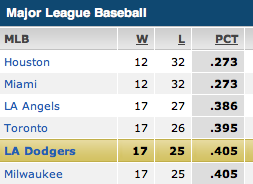 Sure, OK, we can start with the bullpen. It’s hardly the only thing going on with the Dodgers, but it’s something. Oh yes, it’s something.
You need good relief to win, but you can’t plan for good relief.
This comes up every year, so it’s tedious to point out, but it doesn’t seem to go without saying.
I’m going to ask take my years-old research into this on faith; whether you choose to do so is up to you. But what you find is that there is virtually no consistency year-to-year among relief pitchers. The best might give you two or three consecutive good years. The very best.
The reasons for this should be clear. You don’t become a reliever unless you are flawed in some way that prevents you from being a starter. That obviously doesn’t mean you can’t be a fantastic reliever in a given year, but for the most part, relievers are pitchers who aren’t designed to be great over the long haul. They typically have a limited number of pitches, which leaves them vulnerable to being figured out over time. The good ones end up getting overworked, or maybe they were never that good in the first place, instead merely a triumph of small sample size. We could go on, but let’s sum it up this way: Mariano Rivera is not reality.
The 2003 Dodger bullpen was incredible. It was also, in many significant ways, an accident.
Staffing a bullpen has always, fascinatingly, been Ned Colletti’s simultaneous strength and weakness. Colletti has had a knack for finding capable non-roster talent (Takashi Saito, Ronald Belisario) over the same years that he has invested multiyear deals in such inconsistent arms as Matt Guerrier and Brandon League. There is no correlation in the Colletti tenure between salary and performance, yet the expensive signings continue.
The point is that you can never feel good about your bullpen entering a season – never. I really believe that. You can’t feel anything at all. The best thing you can do is assemble a number of arms before Spring Training, a combination of youth and experience and promise and reclamation, and then hope for the best.
The peril of having someone with a long-term contract is that you feel obligated to keep him past the point of effectiveness. That’s the boat the Dodgers are in with League and Guerrier, even with a new ownership that doesn’t much worry about player salaries these days.
The Dodger bullpen is leaky through and through. Almost nothing is working right now. Just as you were gaining supreme confidence in Paco Rodriguez and Kenley Jansen, they found growing pains that left them struggling like the more experienced J.P Howell, League, Guerrier and, if you will, Belisario and Javy Guerra.
Fans tend to have unreasonable expectations of bullpens – you see outrage anytime any relief pitcher gives up a run, let alone a lead. I’m not sure where fans get the idea that every reliever on their team should have a 0.00 ERA, but there it is. Every Dodger relief pitcher since the heyday of Eric Gagne and Saito has been attacked for his failings, however momentary, however good that pitcher has been overall. So when a bullpen is collectively struggling as much as the Dodger bullpen is, it’s frogs and locusts time.
Don Mattingly’s instinct has been correct in general to try to play matchups with his relievers. You can debate the specifics of all his choices – I don’t agree with them all – but the bottom line is, there’s little he can do when no one is reliable.
Mattingly’s bullpen Sunday faced 18 batters and got nine outs. When Jansen entered Saturday’s game in relief of Chris Capuano, he had thrown only 21 pitches in his previous 72 hours. Capuano had pitched well that night, but he was past the 90-pitch mark and going on a balky calf.
But when things are bad, things are bad.
Tim Federowicz is not a martyr.
This morning brought the news that Tim Federowicz, and not Luis Cruz or Ramon Hernandez, had been displaced from the active roster to make room for the return of Mark Ellis from the disabled list. Federowicz is more valuable than Cruz or Hernandez, but the hysteria this caused was rather remarkable.
When I called out this freakout on Twitter, several people lectured me, as if I didn’t know, that it wasn’t just about Federowicz, but that it was symptomatic of the Colletti Dodgers’ larger mismanagement in general or obsession with experience over youth in particular. As if I needed to be told that Colletti values experience, sometimes to the franchise’s detriment.
I’ve spent a lot of time on how to phrase this next section, because I don’t want to give the impression that you shouldn’t try to maximize every advantage you can. Federowicz can’t help the Dodgers that much right now, but sure, I’d rather see him get five at-bats a week over Hernandez, because an on-base percentage over .500 in Albuquerque and above-average defense suggest a better skill set than Hernandez currently offers. Scott Van Slyke’s callup was overdue, not because he was guaranteed to hit two homers in a game, but because he was on a hot streak in the minors that made it clear there was no better time to try him out.
But just as there is with the bullpen, there’s a level of knee-jerk fan reaction with the bench that is out of proportion. When a player is a single game away from having better stats than his competition, as Hernandez is compared with Federowicz (3 for 17 with one walk and no extra-base hits as a major-leaguer in 2013), and neither is projected to be a starter, and the alternatives to Hernandez as backup if A.J. Ellis gets hurt are Jesus Flores, Matt Wallach and Gorman Erickson, the uproar should not be Defcon Anything.
Yeah, Cruz stinks right now, and no one in their right mind would keep him over Juan Uribe – just like no one in their right mind would have argued to keep Uribe over Cruz last summer.
See what I’m getting at?
If you’re not frustrated with the Dodgers right now, you’re either not a Dodger fan or very zen. You’re not wrong if you’re unhappy with Federowicz’s demotion. But if you’re angry over Federowicz being sent down, you’re overreacting. It’s not symptomatic of the Dodgers’ larger problems. You’re not going to plug in Federowicz, Yasiel Puig, Joc Pederson and Alex Castellanos into the Dodger bench and as a result see things turn around.
And May 19 is too soon to give up, if only because of one person.
Matt Kemp.
Until Kemp starts hitting, nothing is going to happen with this team. Nothing. The Dodgers cannot win without his bat. And again, it’s not something anger will solve. The effort is there – if anything, he’s trying too hard to get things going. But it is up to Kemp.
It would help if Andre Ethier hit more, but the difference between what Ethier is doing compared to what is expected of him is not what it is with Kemp.
I’m sure Kemp has had all the advice in the world, from Mattingly, Mark McGwire and any number of coaches or people he meets on the street. But no one else can synthesize the good from the bad and put it into action.
You can start firing managers or coaches or trainers. Kemp still needs to hit.
The bullpen can start putting out fires. Kemp still needs to hit.
The defense can stop making two errors a game. Kemp still needs to hit.
But what if he does?
Let me tell you one more thing. I would love to give up on the 2013 Dodgers. It will be a relief if and when I can. I spent part of my Sunday writing this 1,500-word piece that probably isn’t worth a damn, especially for a team barely winning 40 percent of its games.
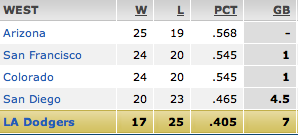
And the season might be over, except for this. For all their problems, Los Angeles is still somehow only seven games out of first place. The Giants, in case you haven’t noticed, have their own cauldron of concerns. And Arizona and Colorado … I just don’t know. I can’t see them not hitting their own skid. I can’t see it.
The National League West looks like an 85-win division. That’s still within the Dodgers’ abilities.
The team gets healthier. The bullpen stops being a disaster. Matt Kemp starts to hit. And then …
Honestly, that’s as far as I can go. The team does look awful right now. It looks nothing like a winning team. It’s creaky and crumbly. Race to the bottom or race to the top – I truly can’t decide.
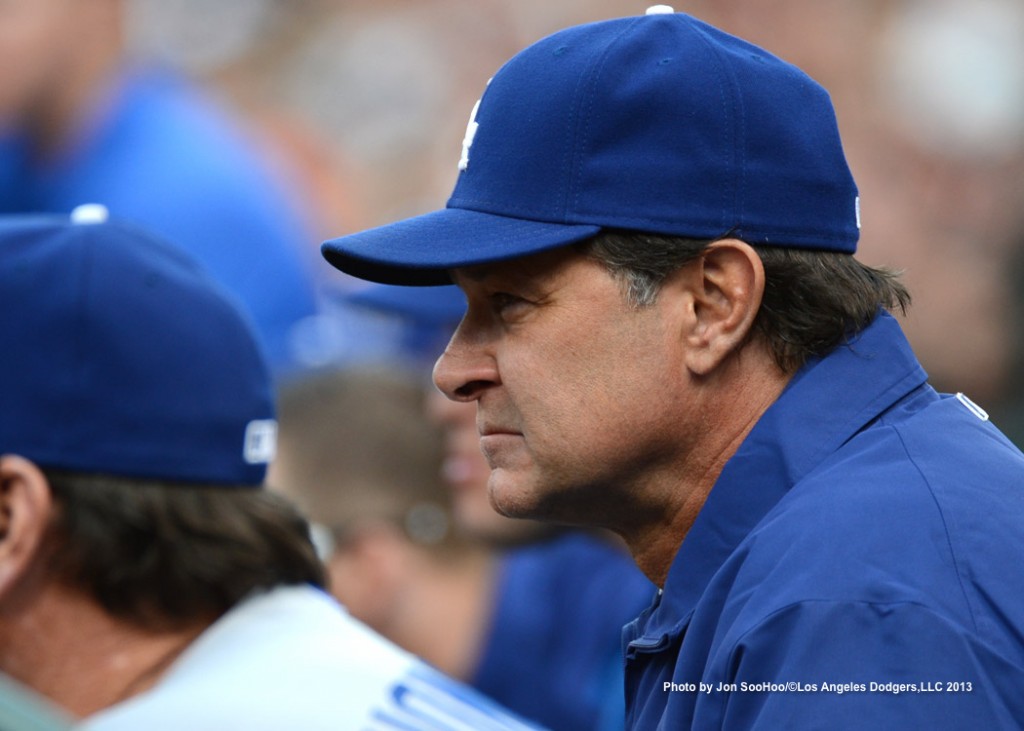 Seven thoughts about Don Mattingly, 13-19 this season, 181-174 in his career:
1) Setting up a homecoming for the longtime Yankee great, the Dodgers are scheduled to make their first regular-season visit ever to Yankee Stadium on June 18. However, if the Dodgers continue to flounder – this is the earliest they have had two six-game losing streaks since, of all things, the sinking of the Titanic, notes Ken Gurnick of MLB.com – you can expect to see a rising chorus calling for Mattingly to attend that game only as a fan.
2) At the outset, let’s stipulate that there are reasons to fire Mattingly and reasons not to – just as there are reasons one might expect the Dodgers to and reasons not to.
3) Mattingly has always made some confounding things decisions as manager, from bullpen management to strategic choices on offense. That distinguishes him from … practically no one. Few managers in history have ever been immune from fans thinking they could do better. That doesn’t mean you can’t do better, but until the Dodgers are ready to hire one of those fans, there’s probably not a huge potential for improvement here.
4) Mattingly deserves at least something of a mulligan for the state of his roster. For all the talk about how the Dodgers had more pitching than they could handle at the start of the season, the facts are these. He has only had 2 1/2 effective starting pitchers (Clayton Kershaw, Hyun-Jin Ryu and the four starts provided by Chad Billingsley and Zack Greinke). On top of that, he has had only 4 1/2 effective position players: Carl Crawford, Adrian Gonzalez, A.J. Ellis and Mark Ellis, with Nick Punto off the bench.
I suppose one could blame Mattingly for the underperformance of the other 18 of 25 slots on the squad – and it’s not like any manager gets great work from his entire team – but this seems like way too much to lay at Mattingly’s door. You can’t win with seven good players. You certainly can’t win with half a starting rotation.
Digression: At a minimum, Ned Colletti, who last year received the contract extension that has avoided Mattingly, holds some responsibility for the effectiveness of the Dodgers, good or bad.
5) From Day 1 … from before Day 1 … Mattingly’s relationship with his players has been considered one of his virtues. It’s neither clear how much true value there was to that relationship in previous seasons, nor clear now much there is now. The idea, of course, is that those intangibles are the thing that will make a bad team good and a good team great, and there’s no better time like the present to prove that. But looking at the Dodgers’ roster, you can argue that you should get more than a third of the season to find out.
6) Mattingly’s postgame comments this past weekend in San Francisco, in which he went out of his way to find the positive amid a sweep at the hands of the Giants, seemed like they might be a turning point in his fate, a “Remain calm, all is well” in the face of the Deathmobile. At the same time, Mattingly hasn’t been afraid to point out when his team has been truly playing badly, as was the case Monday against Arizona. Some losses are worse than others. Mattingly shouldn’t be punished for knowing the difference, even if the comments didn’t play well.
7) What will the Dodgers do? There are tea leaves for every vision. You have a squad for which expectations are high and for which, if you pay attention to Magic Johnson, failure is not an option. You have a team president, Stan Kasten, who has espoused a long-term vision for the future of the Dodgers. You have the mixed signals of the team not extending Mattingly’s contract but Kasten calling that fact meaningless. In general, you have a management team that has been unafraid to make bold – even radical – moves, while preaching the virtues of stability.
It’s hard to deny that the value of a manager is one of the most difficult things to judge in baseball. If it’s true the Dodgers can do better with their manager, it’s also true that it won’t matter, at all, if they don’t get better performances from virtually everyone else.
Ken Gurnick of MLB.com looks at Ned Colletti’s intriguing new front-office hire: director of contracts, research and operations Alex Tamin:
… “People view me as old-school, focused on scouting,” said Colletti. “But I’ve always used statistical analysis; we’ll use more of it now. That doesn’t mean every decision we make will now be based on statistical analysis. You’re still at the mercy of the market. So this doesn’t mean everybody we bring in will have a .400 on-base percentage or an .800 [on-base plus slugging percentage]. Sometimes, it’s just about who’s out there.”
One guy out there was Tamin. The attorney spent 14 years at the law firm Jeffer, Mangels, Butler & Marmaro, where he assisted on baseball arbitration cases with Mark Rosenthal, the primary hired gun for several Major League teams until his death from cancer in 2010.
Tamin, meanwhile, had been on his own for two years when Colletti called shortly after the departure of vice president and assistant GM Kim Ng, who had managed the Dodgers’ arbitration process for a decade before leaving in April for the Commissioner’s Office. Colletti said Tamin hit his radar during the Joe Beimel arbitration case, which the Dodgers won in 2007.
“Alex was always the quiet second guy with Mark Rosenthal in the hearing. Then he gave a rebuttal and I thought, ‘Who is this guy?'” said Colletti. “It was so powerful and thorough. When Kim left, it was even more important to make sure we kept Alex on. He was thinking about working for a club. As the year went on we stayed in touch, and near the end of the season we struck a deal.” …
… “I don’t belong to SABR — I’m not a statistician,” Tamin said of the Society for American Baseball Research. “I’ve read Bill James and I come at it with a larger perspective. As a kid, I tried to play as far as my talent allowed. I was a devotee of the Strat-O-Matic game, an early follower of STATS Inc. The Baseball-Reference.com website was like finding the Holy Grail, and I watched it blossom. It’s pretty phenomenal.” …
Entering their first offseason in years without former vice president and assistant general manager Kim Ng to rely upon, the Dodgers have named Alex Tamin director of baseball contracts, research and operations.
Tamin, who has spent more than 15 years in MLB player salary arbitration cases and contract negotiations, will be Colletti’s point person in those areas. He has also had a commercial litigation practice.
“After working for the Dodgers from the outside for the past decade and knowing their history as one of the most storied franchises in baseball, I am looking forward to the opportunity to contribute to the Dodgers’ continued success,” Tamin said in a statement.
With Ng, the Dodgers had a nearly impeccable record in avoiding arbitration hearings and winning them when they did occur. As contract negotiations with Matt Kemp, Clayton Kershaw and more are set to resume, Tamin’s position is one of potentially keen importance.
The Arizona Diamondbacks took a big one from the Dodgers tonight, and I’m not talking about their 7-2 victory on the field.
Dodger communications vice president Josh Rawitch is leaving the Dodgers after this season to become senior VP of communications for the Diamondbacks, whose organization and fans are sure to benefit from his presence.
It may seem strange to praise someone entrusted with helping craft public relations for Dodger fans’ Public Enemy No. 1 (with apologies to Clayton Kershaw’s curveball). But despite working at the behest of Frank McCourt (whose merits would often be touted to my skeptical eyes), Rawitch was a major asset for the franchise. He worked tirelessly not only to put the Dodgers’ best foot forward but to make the fans’ experience the best he possibly could, often going well beyond the call of duty.
Diamondbacks CEO Derrick Hall certainly knows this well – he was a Dodger predecessor of Rawitch as head of communications.
There is no shortage of bias toward Rawitch on my end, but it was well-earned. To this site, Rawitch was an early friend, one of the first in all of professional sports to accept that a place outside the mainstream media might still be worthy of being treated with respect. Professionally and personally, he treated me as well as anyone ever has.
I’m going to miss him, but despite how he might spin it in his final days on the job, I couldn’t be happier for him to get a fresh start – with the 2011 National League West champions, no less.
* * *
To extend, or not to extend – that is the question.
One part of my recent interview with Ned Colletti that I couldn’t work into the main story was his thoughts about offering multiyear contracts to younger players before they become free agents. Here’s what he had to say:

“You have to have some predictability to performance,” Colletti said. “Usually, clubs gain a benefit from going multiyear, and it’s got to be seen as that from the club’s perspective, because you’re not guaranteeing performance. All you’re guaranteeing is the financial end of the equation.
“If the right situation presents itself, where the guy’s in the right place in his career, his life and his priorities, and there’s a savings a club can realize, then it’s worth doing. But if only the first part’s there, that we’re gonna pay on the guy maximizing (his performance), there’s really no reason to do it – let him go out and do it every year. Some guys who are flawed in an area or who don’t possess everything they need, the agent will ask you to pay as if that is occurring, in the event that it does.”
In short, Colletti needs confidence that the player is going to stay on track performance-wise, and he needs there to be some savings for making the guaranteed payment. The Dodgers need to get some rebate in exchange for the security that they’re offering.
That being said, Colletti said that Clayton Kershaw is the kind of player for whom a multiyear deal might make sense, but that the process wouldn’t begin until next winter, when he first becomes eligible for arbitration.
“It’d be something we may think about as this year unfolds and we get into the offseason,” Colletti said. “Not this spring. He’s got four more years here.”
That might appropriate to some, too casual to others. Let’s take a closer look.
Colletti signed three key arbitration-eligible players to multiyear deals before the 2010 season – Andre Ethier, Matt Kemp and Jonathan Broxton – and based on 2010 performance, Colletti might well regret two of those contracts. He’s also probably quite pleased that he didn’t go multiyear with Russell Martin, and not really worried that he hasn’t done so with James Loney, who signed his latest one-year deal Friday. Perhaps he should have bought low on Chad Billingsley last winter. (I would have, but I would have also wanted to do so on a lot of the other guys.) In general, recent experience has probably made Colletti even more wary in discussing them with other players.
Here’s a snapshot of the salaries for the players we’re talking about over a four-year period (multiyear deals in bold, Martin’s Yankees salary in parentheses):
| Player/Year | 2008 | 2009 | 2010 | 2011 |
|---|---|---|---|---|
| Billingsley | $415,000 | $475,000 | $3,850,000 | $6,275,000 |
| Broxton | $454,000 | $1,825,000 | $4,000,000 | $7,000,000 |
| Ethier | $424,500 | $3,100,000 | $6,000,000 | $9,250,000 |
| Kemp | $406,000 | $467,000 | $4,000,000 | $7,050,000 |
| Kershaw | $404,000 | $440,000 | $500,000 | |
| Loney | $411,000 | $465,000 | $3,100,000 | $4,875,000 |
| Martin | $500,000 | $3,900,000 | $5,050,000 | ($4,000,000) |
Note that Billingsley got a 63 percent raise for 2011 following a well-regarded season, and Loney got a 57 percent raise for a season considered a disappointment. That gives you some guideposts for the following speculation:
Given that Colletti didn’t have a crystal ball, it’s hard to complain much about how he’s handled things. The decision to show restraint on Martin has arguably saved the Dodgers $6 million, which more than covers any fringe costs with Broxton, Billingsley, Ethier or Kemp. The only way this would be reversed is if one of those four or Loney has an MVP or Cy Young season, and you’re then fretting that the Dodgers haven’t bought out some of their free-agent years, the way Colorado has with Troy Tulowitzki or Carlos Gonazlez. We should be so unfortunate.
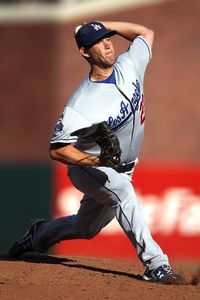
That brings us back to Kershaw, who becomes eligible for salary arbitration after this season and eligible for free agency after 2014. (Gosh, that seems so nice and far away right now.) How urgent is it for Colletti to lock Kershaw up for multiple years? It would sure feel nice, but you can’t say there isn’t risk.
Let’s turn to the contract status of arguably the reigning young aces of each league (at least until Kershaw decides to do something about it).
One year ago Saturday, Tim Lincecum signed a two-year, $23 million contract (plus incentives in the thousands). The deal came after Lincecum and the Giants were $5 million apart – $8 million vs. $13 million – in their 2010 arbitration filing. It didn’t come close to addressing his free-agent years; it just was a hedge against what Lincecum might have earned going year-to-year. Hypothetically, if Lincecum had settled for a 10.5 million salary in 2010, he might have been looking at something like $17 million this year, making for a total in the neighborhood of $28 million. (Though Lincecum slipped a bit in the 2010 regular season, his postseason performance would have helped rectify matters.)
Put one way, the Giants a year ago risked committing $13 million in 2011 salary in order to save about $5 million. That’s some high-stakes Mahjong.
Over in the American League, Felix Hernandez and the Seattle Mariners played things differently. After earning $3.8 million in 2009 and facing a $4.3 million gap in salary arbitration filings ($7.2 million vs. $11.5 million), Hernandez signed a five-year, $78 million pact that locked away his first three years of free agency (2012-14). The contract averages $15.6 million per year for five years, $19.3 million for the three free-agent years. Again, there’s no mistaking the double-edged sword: You can assume that $58 million for three years wouldn’t have cut it for Hernandez after this season, but the risk is catastrophic if something goes wrong.
I think it’s pretty clear where my sentiments lie with Kershaw – I’d sign him to a multiyear contract tonight – but you can understand why Colletti might hesitate or procrastinate. For another example, look how quickly opinions turned on Eric Gagne before his multiyear deal vs. after he got hurt. It’s harder to stomach paying big bucks for an injured player than it is to pay bigger bucks for a healthy superstar.
On the other hand, better Clayton Kershaw than Jason Schmidt.
In my head, I can understand the patience, as much as I believe it should be done.
With my third Sweet Spot post, I finally bring things back to the Dodgers …
My recent interview with Dodgers general manager Ned Colletti prompted me to reflect on a little-discussed aspect of his tenure …

Ten days.
The Dodgers rose from the basement of the National League West in May to the best record in the league in June, then sat only two games out of first place in the division at the All-Star Break.
Yet as far as Dodgers general manager Ned Colletti was concerned, it was almost a mirage. During an interview at his Dodger Stadium office last week, Colletti fully acknowledged that the Dodgers’ second-half fade, as much as he and everyone else tried to reverse it, came as disturbingly little surprise to him.
Ten days. In Colletti’s view, that’s how long the Dodgers played championship-quality baseball in 2010.
“I think the second half, in a lot of ways, was the result of the first half and the spring,” Colletti said. “I can’t say I had more than a 10-day period where I thought we were truly playing as well as we could play. In ’09, we had a pretty good defense, and we executed, played well in clutch situations, found a way to win games. We really hadn’t done that very much in the first half of the season. And I think it caught up with us in the second half.
“And what I did last year wasn’t acceptable. How I prepared for last year didn’t meet the results that I have for myself.”
The Dodgers will arrive to spring training later this month, in many ways, a different team than a year ago, starting with a greater emphasis on starting pitching that represents Colletti’s most visceral response to his roster concerns from 2010. At the same time, Colletti said the experience the returning core gained from last year’s disappointment has the potential to play a significant, positive role in 2011.
“They’re professional, and this is their livelihood,” he said. “And you believe there’s enough pride and adjustment and education from this past year. A lot of guys haven’t gone through what they’ve gone through in the past year. That will put them in the right place coming in to know it’s got to be better and it’s got to be more focused.
“Because they’ve (succeeded) before, I’m confident. But then, last year was what it was. I’m cautious by nature. I take nothing for granted, at any point in my life at any stage. So I don’t take it for granted that it’s just gonna happen. I think it has to be prepared in order to happen.
Translated, Colletti believes the talent is there but the effort, focus and confidence need to return. He said the offseason preparation “is done to some point, and when you get to camp now it’s going to be up to Don [Mattingly] and his staff to have certain procedures in place and certain accountability set forth. And I obviously have to support that, and they have to buy into it.”
Comeback kids?
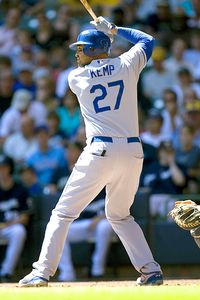
Despite leading Dodgers regulars on offense, Andre Ethier never fully seemed to recover from the pinky injury he suffered in May and fed doubts about his long-term ability to hit left-handed pitchers (.625 OPS against them in 2010, .681 for his career). James Loney went from decent before the All-Star Break (.803) to disastrous after (.616). Jonathan Broxton’s second-half collapse is as well-documented as anyone’s, and Matt Kemp … well, let’s just say his season could have been the inspiration for what made Linda Blair’s head spin in “The Exorcist.”
The question, Colletti agreed, is which of the players will hit a hurdle in their development in 2010, and which have hit a wall. And it’s a question that’s due for an answer. Mulligans that were handed out last year won’t be found so easily or at all in 2011.
“In the past, I’ve been more patient than open-minded,” Colletti said. “I think that one of the toughest characteristics you have to have in these jobs is patience because everybody expects everything to turn overnight. … It doesn’t work that way. Everybody’s human; these guys are all human. They take maturation, physical maturation, all kinds of processes.
“I won’t be able to be just completely patient with it [this year]. We’re not an old team, but we’re not a team overwhelmed with rookies, either. We have experience, and a lot of our players have been to the postseason at least twice and sometimes three times in the last five years. So it’s there, it’s really kind of going back to that point and being focused about it and passionate about it and tough-minded about it.”
It might surprise people to learn that Colletti seems particularly bullish about Kemp, the target of a radio critique by Colletti in April.
“I think probably from middle of August on, things became a little bit more focused for him,” Colletti said. “He and I had a conversation, probably in August, that was really a man-to-man, heart-to-heart, one-on-one conversation. And I was trying to take some of the weight off. I think he understands it; I think he understands what transpired last year. I think from my conversations this winter, from the last month of the season and this winter, I think he understands more than he did a year ago about himself and about the game, about preparation. So I think he’s got a chance to really have a great year.”
It’s possible Colletti might have said the same thing about Russell Martin, except Martin is no longer around. The circumstances of the Dodgers’ decision to let Martin go rather than offer him salary arbitration weren’t discussed, but Martin’s recent offseason comments about “distractions” that affected him led to a broader comment from Colletti about the difficulty of playing in Los Angeles.
“Sometimes, it’s commitment, prioritization and commitment,” Colletti said. “I read what Russell said, but I don’t know what the true context was or what his underlying thoughts were as to why he said it. … There are a lot of distractions in this city. There’s a lot of different things to be doing, a lot of places your mind can wander off to, but if you’re a professional baseball player, if you’re a Dodger, you’ve got to figure out life. … And it’s not easy to do it.”
Without going into many specifics, Colletti indicated that the ability to play in Los Angeles is a factor in some trades of young players he has made. He called Carlos Santana the prospect he regrets parting with “probably more than anybody” before he added that there were a couple of other guys he would have to wait and see on.
“Again, Los Angeles isn’t for everybody,” Colletti said. “Sometimes we make a move on a player because we know in this environment here, they’re not going to be very good in it.”
Pitching paradoxes
As for Broxton, count Colletti among those who see his second-half crumble as an issue of confidence, rather than health problems that might have been caused by his 48-pitch tar-and-feathering against the Yankees last June.
“He never complained,” Colletti said. “And at the end, he wasn’t thrilled with it, but I said, ‘Jonathan, I need you to take a complete physical — your arm, your shoulder, your elbow.’ A week to go in the season. And he said, ‘I feel great. I don’t need to do it.’ And I said, ‘I need you to do it.’ So he said, ‘I’ll do it,’ and everything came back clean.”
Colletti is aware of the volatility of relief pitchers, comparing them to great goaltenders who can go through “a month or two where they can’t stop anything.” But this awareness cuts both ways. It leads Colletti to give relievers who have performed in the past long leashes, and it compels him to have as many alternatives on hand as he can, as seen through the acquisitions of set-up men Matt Guerrier and Blake Hawksworth and oblique references to No. 6 starter Vicente Padilla’s potential to close games.
Again, however, Colletti believes that at rock bottom you can often find a trampoline. Look no further than Chad Billingsley, banished from the Dodgers’ starting rotation by the end of 2009 before rising anew last season.
“Most of our young players did not experience a lot of failure as young players, minor leagues [or] early in the big leagues,” Colletti said. “They really didn’t struggle. And when it finally hits you, and you do struggle for whatever reason and you’re doing it in front of 45,000 people in Los Angeles all the time, on television every day, that’s a tough time to struggle for the first time, for the really first time, and be able to come out of it.”
Interestingly, Colletti’s faith in failure recovery played a partial role in what many believe is the Dodgers’ greatest weakness heading into this season: the lack of a bona fide left fielder.
Angst in the outfield
This winter, the Dodgers didn’t bid on the two marquee outfield free agents, Carl Crawford and Jayson Werth, and you can safely conclude that was a reflection of their overall contract demands and the Dodgers’ budget. But when it came to alternatives, Colletti was wary of blocking two Dodgers outfield prospects who could each be major league ready a year from now, Trayvon Robinson and Jerry Sands, especially after the experience Robinson had in Jacksonville last summer.
“Robinson last year started off slow in Double-A, and we stayed with him and he figured it out,” Colletti said. “That to me was huge. Because he’s gonna have to figure that out. Because everybody struggles up here.”
There is the caveat that it’s not as if the current Dodgers never struggled in the majors or minors before 2010 — one could easily make the case that they did, but that their subsequent triumphs blotted out the memory. In any event, if he had found a signable veteran outfielder worthy of a multiyear deal, Colletti no doubt would have pulled the trigger. But he does feel optimistic over the long term about what he has.
“If I would have signed a left fielder for three years, who was again not one of those robust guys — I’m not sure there was a guy out there — then I’m really kind of blocking one of those two kids, and I’ve got faith in both of them,” he said. “Hopefully, not this year. Hopefully, it’s a year from now, but I have faith in both that they’ll be able to play and contribute. And actually I told them both that, too, in the fall — I told Trayvon way back in the summertime, ‘It’s important for me to know who you are and how you play. Because you know what, Manny’s not gonna be back next year. And I’ve got to make a decision whether I’m gonna go and tie up his spot for three or four years, or be patient and mix and match for a year and wait for you.'”
In the interim, Colletti is under no illusion that he has gold in the third outfield slot, so the Dodgers will essentially play it by ear in the outfield, with Mattingly looking at matchup opportunities for Tony Gwynn Jr., Marcus Thames, Jay Gibbons and Xavier Paul (if he makes the squad), and on an infrequent basis, Casey Blake or Jamey Carroll.
“Right now Matty’s the center fielder,” Colletti said. “Andre’s the right fielder. I want to see what Tony can do offensively. He’ll play as much as the offense allows him, I think … using the whole field, bunting more, figuring out ways to get on base, because his on-base percentage isn’t high even when he hits .270. See if he can become more disciplined at the plate, use his speed more to get on. I don’t expect power out of him. I don’t expect gap power out of him, but I would like to see him get on base a lot more, because if he does it perhaps changes the dynamics in the outfield.
“And in the meantime, I’ve got two guys that can hit, one from the left side and one from the right side — actually two from the left side with X. Paul and Gibbons, and then Thames. … And perhaps they’re five- or six-inning guys, and then you go defense later. But you’ve got two guys that might be able to hit 20 homers between them.”
Third base offers a secondary question for the Dodgers because, while Blake is sure to start against lefties and some righties, no one seems to be beating the drum for him to play 146 games like he did last season. With the Dodgers’ minor leagues fairly thin at second and third base, this time Colletti took the plunge on a multiyear stopgap in Juan Uribe.
“Our system’s produced a lot of guys,” Colletti said. “But except for really [Ivan] DeJesus, we don’t really have a second baseman that’s on the verge of being here. We have a shortstop coming probably in Dee Gordon and after him [Jake] Lemmerman, and right now third base is a bit of an open spot too — we had [Pedro] Baez in the Cal League last year. So Uribe, while the on-base percentage isn’t Moneyball-ish or whatever, the run production is still pretty good, in that he can play second, short or third, and we don’t have anybody that’s going to press him at third for a while, and really De Jesus is trying to transition to play second. I needed somebody I can run out there who’s a big league guy.”
Because of what he sees as a potential benefit to have Uribe play some at the hot corner, Colletti emphasized that De Jesus has a legitimate chance to make the Opening Day roster as a backup infielder. Obviously, someone like Carroll could also make several starts to allow Blake to rest.
In any case, Colletti is aware of how much a juggling act the Dodgers’ everyday lineup has become. Though he has in one sense traded last year’s lack of a fifth starter for this year’s lack of an everyday left fielder or third baseman, Colletti sees the two situations as apples and oranges.
Never enough
“You really didn’t have in my mind many choices that were going to be able to play every day,” Colletti said. “We had to fix the pitching first, and we had to upgrade the bullpen if we could.
“You can’t finesse pitching. Maybe a day here or there, but you need to have it. And the list [of available pitchers], we were kind of picking near the top of the list, even though it isn’t sexy to say you signed Ted [Lilly] or Hiroki [Kuroda], it’s not necessarily ‘wow,’ but it’s solid. It gave us a little bit of depth. So we had to start there. The kid from Minnesota, Guerrier, is gonna be a good add for us. He’s pitched in a lot of big games; he’s always had positive results.
“It’s the most volatile group, but once [Joaquin] Benoit got three years and [$16.5 million], that’s what people expect to get … and if you really need a guy, sometimes you have to go the extra distance to go and get him.”
Add together the total commitments the Dodgers made to their free-agent signees of this past offseason, and you barely pass the total value of Adrian Beltre’s deal by itself, while falling short of the Crawford or Werth contracts. And like it or not, Colletti was not going to enter another season shy on pitching or dependent on unproven rookies such as James McDonald or Scott Elbert.
“I was apprehensive all winter long last year” Colletti said of the starting pitching. “I knew we were short going in; I knew we weren’t going to be able to rally it. In the spring, J-Mac and Scotty both struggled. We may have sent them both out early, in fact, because they couldn’t throw strikes; they were all over the board. So right from the beginning, I knew we were going to be short. I didn’t know how we were gonna mix and match, and we couldn’t afford an injury certainly.”
If there’s an ongoing concern on everyone’s minds, it’s how the Frank McCourt ownership crisis is affecting spending on the team on the field. You can argue that different owners might have allowed Colletti to sign one big-ticket free agent in addition to shoring up the pitching, but Colletti doesn’t contend that the divorce itself is having an impact on personnel.
He also makes the case, as McCourt did a year ago, that the Dodgers are aiming to spend more money to deepen their prospect population.
Farm aid
“We’ve had basically the same [major-league] payroll,” Colletti said. “Though we dipped a little bit last year, we’re coming back this year. It’s not really how much you have, it’s where you spend it. We do have to get better at international signings; we have to reinvest there. I think we’ve let Venezuela slip for a few years, and we’ve made some changes in the staffing.
“We’ve done a decent job in the D.R. [Dominican Republic] — not what we did 25 years ago, but with all due respect, 25 years ago there wasn’t 30 teams down there, either. So, it’s not like we could just cherry-pick the players we want like we probably did at the outset of the country opening up to having players signed. But we do have to get better at that to support our player development system. It’s been fruitful. Obviously, a lot of players are in the big leagues now that we drafted, but we have to keep flowing, and they have to keep getting better. I know we’ve hit a touchable lull right now and I think we’re probably a year or two away from having another group come forward.”
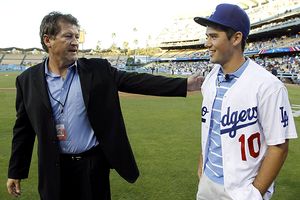
Colletti didn’t rule out the Dodgers’ top draft choice of 2010, Zach Lee — whose signing shocked most baseball observers — being part of the Dodgers’ graduating class of 2012. Amid the height of McCourt tensions, Lee received a $5.25 million signing bonus, a record for a Dodgers’ draft pick. The previous record-holder, Clayton Kershaw, reached the majors less than two calendar years after he was picked, and Lee could do the same.
“We really liked this kid,” Colletti said. “We really liked his makeup, his demeanor, his abilities, athleticism, his toughness. … Not only are the physical skills different than most kids you see, but the way his mind works is different … probably from playing at the highest levels at a couple of sports, including going to LSU for a summer and having that experience, which as long as he didn’t get hurt it didn’t bother me.”
Colletti’s hope is that the Dodgers’ minor league pitchers drafted in previous years allow Lee as much time as he needs to develop. There was an epidemic of setbacks among the farm system’s arms in 2010 — so many that if Colletti wants to see who can overcome hurdles, wish granted.
“It’s concerning to me,” he said. “Probably a lot of the guys that we could both probably name should be a year farther along than they are. They’ve all struggled with command. … Some are converted players, some weren’t pitchers necessarily in high school or college. So they’re still learning that.
Curing the epidemic
And to circle back to the beginning of our piece, in some ways, older players never stop learning and developing. Witness Colletti’s additional assessment of the contagion that struck the Dodgers’ offense in 2010:
“I think hitters sometimes without results start to get impatient, so they start to chase out of the zone,” he said. “They’re trying to build more offensive numbers in a quicker period of time and so they’re not as diligent to work the count, and all that stuff starts to compound through the course of it. … When people are starting to slump, sometimes it produces more guys that go in that direction than less. And that’s what started to happen. It started to spiral where one guy struggled and then two. And then the third guy saw the other two and then he struggled, and it continued to mount.”
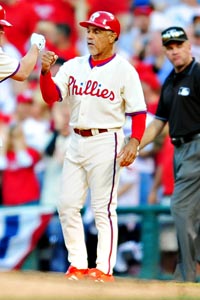
When you take Colletti’s view of what went wrong with the Dodgers last year and what’s needed to make it right, it makes sense that he sees one of the most promising offseason moves as one that even some jaded Dodgers fans embraced: the hiring of Davey Lopes as a coach.
“I’ve known him a long time and I’ve admired him,” Colletti said. “You know, I was with him in Chicago when he was still a player and I’ve certainly watched him from the other side of the field when he managed and when he was coaching. And I think what he brings here is — you’re talking about first — someone who was an iconic Dodger who understands Los Angeles and understands the Dodgers and was here during one of the greatest periods in our franchise’s history. That’s important.
“What he did in Philly with baserunning and defense and fine-tuning that position, the first-base coaching position, to make it a far more valuable position to the organization, is something we noticed. And I think he’s going to have a great impact on our club. I think there are some players that could turn their game up a notch with his instruction, with his thought process. I think, while it’s a coaching position, I think it’s a huge addition for this franchise.”
Will a new manager, new coaches, new players and new spirits be enough to right the Dodgers’ ship? It’s too soon to say, but if the Dodgers are to play more than 10 days of great baseball in 2011, Colletti will expect to see strong signs of it before Opening Day arrives.
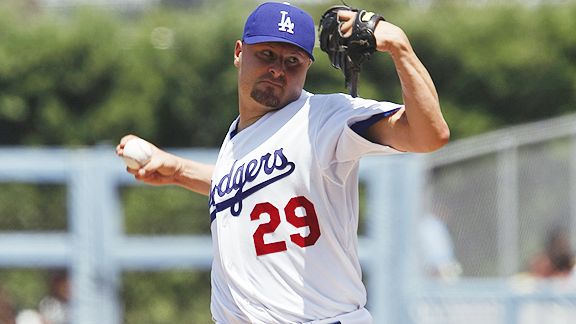
With a third of Hiroki Kuroda’s new contract coming in the form of a signing bonus to be paid in 2012 and 2013, naturally the subject of the Dodgers deferring salaries has come up again. On that subject, let me make these points:
In a nutshell, the timeframe for paying player salaries is fairly low on the issues bedeviling the Dodgers. Achieving a combination of good decisions and good luck regarding the roster is far more important. Even as the McCourt drama plays out, the Dodgers will thrive or dive depending on their personnel choices.
Eventually, the Dodgers will either operate one season on a limited budget, or they’ll find the revenue to bring their finances back to steadier ground. I’m betting on the latter. In any case, what matters is that they spend their money wisely, whenever they spend it.
Dodgers president Dennis Mannion has ankled the team, with Frank McCourt taking over his duties. (The story was first reported by Dylan Hernandez of the Times.) General manager Ned Colletti, who had been reporting to Mannion, will now be the sort to report to McCourt, unless the tort forces McCourt to abort; he dare not snort or hide in a fort, but must find port or he will be mort.
Sorry … don’t know what happened there.
There’s going to be some hand-wringing about McCourt (re)taking a bigger role in the team, but I don’t know that this makes much of a difference to the Dodgers on the field or in the front office. It’s the same administration either way, especially since Mannion had reported to McCourt anyway. I am curious about how much time Mannion had left on his contract, though.
Mannion’s legacy will include revenue-generating marketing endeavors like Mannywood but also one of the most ill-considered comments by a Dodger executive (Non-McCourt Division) in recent memory when he discussed player acquisition in the same context as acquiring portable concession stands. The tone-deafness of the comment was more noteworthy than the substance, but it was indicative of something that I’m not sure Dodger fans will miss.
For fun, here’s an Associated Press story from March 2009 about the promotions of Mannion and Jamie McCourt.
… “Jamie has done an outstanding job of assembling a talented management team, fostering a positive culture, and building a first-class business operation,” Frank McCourt said.
As CEO, Jamie McCourt will oversee the strategic direction and decisions of the organization, focusing on the development of relationships throughout the Dodgers community and Major League Baseball, and with corporate partners and public officials.
“It allows me to promote a strategic mind-set and build long-term relationships that strengthen our brand,” Jamie McCourt said. “The most important of those relationships is with our fans. So I will invest even more heavily in how we connect with them in every imaginable way.” …
* * *
His loss is our gain: Dodgers assistant general manager of amateur and international scouting Logan White and assistant general manager for player development DeJon Watson are no longer being considered for the Arizona general manager position, Tony Jackson of ESPNLosAngeles.com reports.
For all the talk about Joe Torre and Don Mattingly, keeping the hope alive in the farm system is probably more important for the Dodgers’ future.
The press conference, blow-by-blow.
Joe Torre looks emotional as he sits with Don Mattingly and Ned Colletti.
Frank McCourt is making brief introductory remarks, thanking Torre, including for always doing the right thing for the organization, including the difficult trips overseas in Spring Training. He then welcomes Mattingly, jokingly asking, “Are you ready?”
Colletti speaks next, also with the praisy stuff for Torre and Mattingly. Mattingly’s work ethic is big for Colletti.
Torre: “This decision was a long time coming. It wasn’t easy.”
“Baseball has been my life, and hopefully will continue to be my life in some other capacity.”
He reiterates that he thought, after he left the Yankees, that he was done managing until the Dodgers called. He was reluctant to accept at first because New York was his daughter Andrea’s only home, but his wife convinced him she would adjust.
“This year has been a struggle, no question, but the fun of managing was still there. I was telling someone today, I manage a lot by instinct, and you have to make decisions by instinct … and that’s what I did today.”
“Up until the All-Star Game, we were very excited about where we were going. Since then, we have struggled, and I have (had trouble) finding something to help. … During the second half of the year, it got to the point where I just felt that this ballclub needed a different voice, a younger voice, and there’s no one I feel more secure in turning the ballclub over to than Donnie.”
“Donnie, it’s all yours, pal.”
Mattingly: “Watching Joe the way he treated people, the way he handled situations, there was always a different perspective when you talk to Joe. … Joe’s helped me, and I thank Jo so much.”
“I think maybe I sabotaged his second half … our offense since the break. Sometimes you think you don’t quite know what you’re doing out there.”
“But I’m excited about this opportunity. I’ve been working a long time toward it.”
“I’m sure I’m going to make mistakes and plenty of them.” But he added he would learn and work hard to overcome them.
Now, questions from the media.
Back to Torre:
“Turning 70 (was the turning point). It sounds funny because I don’t feel hard, and I hope that continues. … but as I said a few minutes ago, maybe they need a different voice. … Even though the game has not changed in terms of the way you play it and the way you win it, but the players have changed.”
“(Ally) didn’t believe me until we’re sitting here today that I wasn’t going to do this anymore.”
“Ned and I are going to talk about (a next job) sometime in the next month probably.”
Colletti: “Joe and I talked the other day in San Francisco … very recently, a couple of days ago.”
“When I talked to Joe about coming here, I talked about … the continuity we’d like to establish. I’d like to have a successor on the staff.”
“We talked to Major League Baseball, and told them what our thoughts were, and they gave their blessing to it (exempting the team from minority interviews).”
Torre: “I don’t anticipate (managing somewhere else). If I say I never want to manage again, it closes a door and really makes me feel old. I don’t anticipate managing again, but I’m certainly not going to not listen to somebody if it sounds intriguing. … But I certainly don’t have any visions of that being the case, that I’m going to manage.”
Mattingly: “I know the one thing is, you’ve gotta be yourself. There’s going to be parts of Joe in me, but there’s also Billy Martin in me, there’s parts of Lou Piniella in me, there’s parts of Dallas Green. … (But) I’ve got to do it my way.”
“There’s only one way to play the game, and that’s the right way. Small things change games. Guys might do different things (in the locker room) but you still … do what you have to do to win the ballgame.”
“Billy Martin was lots of things, as a young player you were catching the grief. I learned that real quick … if it’s between you and an old guy, you’re getting the blame.”
“Yogi, I played for Yogi, and if you were 0 for 4 or 4 for 4, he treated you exactly the same. I really felt that was the way to go.”
“I have a confidence in myself. I feel ready. It’s baseball, and I’ve been around the game a long time, not necessarily in the manager seat, but you have relationships with players, you see how the game’s played when you win (and) when you lose.”
“I know people are going to question, and that’s understandable. In my heart, I know I can do this. It’s not something you back away from … it’s a simple process, a belief in myself that I can do anything I put my mind to.”
Torre: “Right now our plans are to be in California, yes. Ned and I are going to talk next month. We moved our Safe at Home Foundation (here) … and certainly going to spend more time helping Ally.”
“I just need to be involved in baseball, because I’m most familiar in that, most comfortable in that – something where I think I can be of use.”
Mattingly: “Definitely want a bench coach with experience. Something Ned and I will sit down over the next few weeks and discuss.”
“I’ve seen ’08 and I’ve seen ’09, and we were able to do some pretty good things. I’ve also seen young players come and struggle at times … you hit a little plateau and you have to reevaluate where you’re at … have to take that step back to go forward.”
“I’ve seen it before (in the younger players), I know it’s there. It’s just a matter of reaching it.”
Torre: “I had heard that Los Angeles was laid back. In the time I’ve been here, not only have they made me feel welcome here, but I sense so much passion at this stadium that made me feel very special, and I know the players fed off of that, so I’m certainly going to miss the fans out here.”

What happens when three old friends in crisis fall into an unexpected love triangle? In The Catch, Maya, Henry and Daniel embark upon an emotional journey that forces them to confront unresolved pain, present-day traumas and powerful desires, leading them to question the very meaning of love and fulfillment. The Catch tells a tale of ordinary people seeking the extraordinary – or, if that’s asking too much, some damn peace of mind.

Thank You For Not ...
1) using profanity or any euphemisms for profanity
2) personally attacking other commenters
3) baiting other commenters
4) arguing for the sake of arguing
5) discussing politics
6) using hyperbole when something less will suffice
7) using sarcasm in a way that can be misinterpreted negatively
8) making the same point over and over again
9) typing "no-hitter" or "perfect game" to describe either in progress
10) being annoyed by the existence of this list
11) commenting under the obvious influence
12) claiming your opinion isn't allowed when it's just being disagreed with
Powered by WordPress & Theme by Anders Norén