Aug 21

Dodgers bash four homers, as Vin Scully prepares to make God laugh

On Sept. 18, 2006, the Dodgers came back with four consecutive homers in the ninth inning and then one in the 10th to beat San Diego in the legendary 4+1 game.

Tonight, the Dodgers almost matched the feat, hitting four homers in a five-batter stretch (interrupted only by a Manny Ramirez third out in the bottom of the second inning), and then held on to most of their 7-1 lead for an 8-5 victory over Cincinnati. Call it the 4-minus-1 game.

Ryan Theriot and Andre Ethier went deep with two out in the second, and then Jay Gibbons (with a bouncer off the top of the center-field wall) and Matt Kemp (pulling a high and somewhat outside pitch) copy-catted leading off the bottom of the third.

Chad Billingsley cruised for the first five innings, then was pulled after giving up a couple of runs in the sixth. Cincinnati made the game close with two runs off Travis Schlichting in the seventh (inherited runs allowed to score by Hong-Chih Kuo), but the Reds got no closer. The Dodgers added an insurance run in the bottom of the seventh, and Jonathan Broxton retired the side in order in the ninth despite two three-ball counts for the save.

Ramirez went 0 for 3 with two strikeouts in his return, but Gibbons went 2 for 3 with a walk batting cleanup. Ethier, Kemp and Casey Blake each reached base three times.

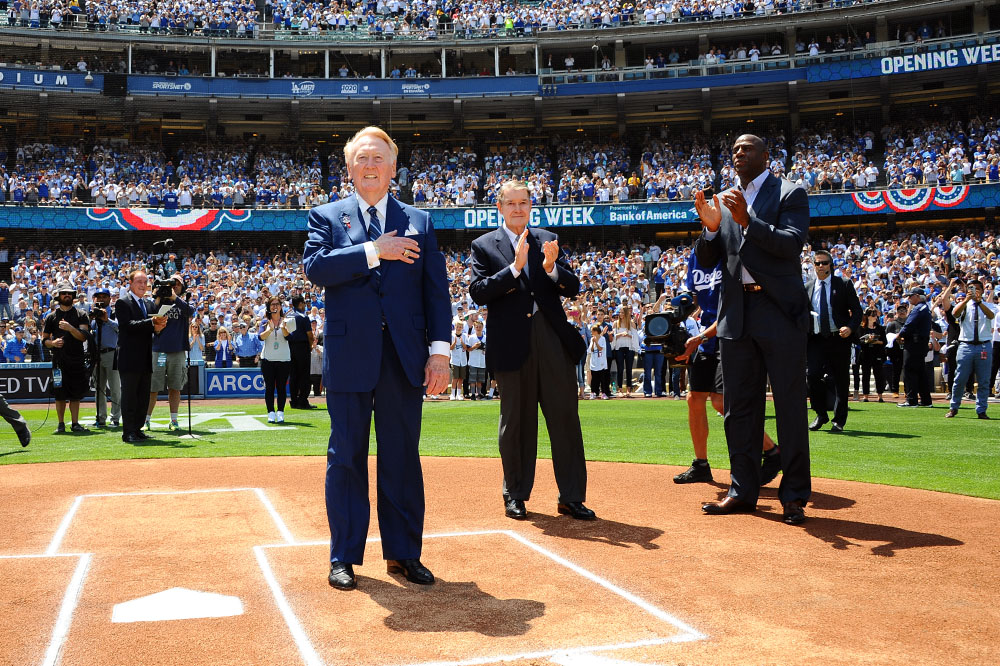
Tonight’s news was overshadowed by Vin Scully telling T.J. Simers of the Times that he plans to announce his future plans before Sunday’s game. Given that Scully has said he hasn’t wanted a farewell tour, I’m going to go to sleep thinking it’s an announcement he’s coming back, at least to do home games.

Aug 02

My thoughts turn to Vin


US PresswireVin Scully, during last year’s offseason.

I have no insight into whether Vin Scully will retire after this season. My hunch is that he won’t walk away easily. He still sounds filled with so much spirit – more than any of us have, I’m guessing – that I think with whatever schedule adjustments continue to be necessary, he will press on.

But there is always the possibility that these are the final two months of our time with him on the air. And however the Dodgers are playing, I have to find a way to appreciate that time. Even if they are not his final two months, I so want to savor them.

Thirty-six regular-season games remain at home and on the road against National League West opponents.

* * *

“Leave it to the Dodgers, going back all the way to the borough of Brooklyn, to get three hits in the inning and not score a run,” Scully said at the end of the first inning tonight.

Scully doesn’t get upset when the Dodgers play badly, and fans don’t mind. In fact, they appreciate it.

There are things that bother Scully – from people who fail to acknowledge the heroes of D-Day, to the way the post-O’Malley organization discarded Mike Scioscia – but even then, he measures his words carefully and civilly.

The result on the field never bothers him. And fans don’t mind.

I do get upset when the Dodgers play badly, but sometimes I’m told I’m not upset enough, not angry enough. I’ve certainly been told that I’m not angry enough about the ownership situation, even though I’ve expressed my displeasure with it more often than I can count.

No one ever complains that Scully isn’t angry enough. I mean, it sounds silly that someone ever would, right? Maybe it’s because he doesn’t identify himself as a fan. Maybe because I get excited when the Dodgers do well, it’s considered my duty to get angrier when the Dodgers lose.

But Scully was and is an enormous influence on me. He sees every game as part of something bigger. He sees the team as part of a larger team, going all the way back to the borough of Brooklyn. He sees the grand timeline of the Los Angeles Dodgers and baseball, and knows that one bad inning, one bad game, one bad month, one bad season and more, are just part of the journey. He’s able to see all that even as he nears the end of his own journey, however far away that hopefully remains.

* * *

Matt Kemp went 5 for 5 with a double and home run in the Dodgers’ 10-5 loss to San Diego tonight, but his night was marred when he failed to score on that first-inning play Scully described above. James Loney was thrown out trying to reach third base on Casey Blake’s single, the tag coming before Kemp crossed home plate.

When Kemp came up in the eighth inning, Scully discussed the play, not shying away from dealing with it objectively, but also without venom.

Scully certainly wouldn’t say that fans aren’t entitled to be upset about the fortunes of the Dodgers this year, but I do wonder why more fans don’t follow the tone he sets. They worship him, but they don’t emulate him. I don’t judge those fans for it; I just find it interesting.

If the Dodgers don’t salvage the 2010 season, you’re going to see me continue to channel my inner Vinny, as best as I can. I hope to be insightful; I hope to be entertaining. I hope to comment without anger, to find joy amid the sorrow, to see the forest for the trees (and avoid cliches when I can). It’s something I don’t do enough of in my non-Dodger life, but here, in the one place I seem to be able to pull it off most of the time, I mean to sustain it.

In a life replete with doubt and disappointment, go with Vin.

Jun 26

Fun for the whole family: Dodgers 9, Yankees 4


Mark J. Terrill/AP
Rafael Furcal had three hits, three runs and a dazzler at shortstop.

On a night they had 11 hits and drew 10 walks, there were many moments of pleasure for the Dodgers in tonight’s 9-4 victory. For example, the Dodgers took a haymaker in the top of the first inning when Hiroki Kuroda struggled with control and gave up two walks and a home run to the first three batters, but Rafael Furcal got the Dodgers off the mat. It was just a simple single to left, but it started to take the sting out right away.

Furcal also ended the night with an exclamation point, making a full-flung diving stop of Robinson Cano’s grounder up the middle, bouncing to his feet and firing to first in time to end the game.

In between, Manny Ramirez reached base four times, and James Loney drove in four runs.

But when I think of everything that happened tonight, what gave me the most pleasure was Hong-Chih Kuo. With the tying runs on base and one out in the top of the sixth inning, Kuo blew away Derek Jeter on strikes and then got Jorge Posada to fly out. Then in the seventh, Kuo came back and retired Mark Teixeira, Alex Rodriguez and Cano. Five Yankees, 18 pitches, no contest. Kuo showed the nation how great his stuff is, and it felt sweet.

The Dodgers have evened it up with the Yankees, and go for bragging rights Sunday with Clayton Kershaw.

* * *

Message to Fox: There’s a line between an acceptable amount of in-game interviews and an excessive amount. And it’s not a fine line. It’s a line that can be seen from Saturn. You guys crossed it. This is not a latenight talk show – it’s a baseball game.

* * *

From Vin Scully at John Wooden’s public memorial today:

“The tragedy of life is what dies inside a man while he lives. The triumph of life is to live hopefully, kindly, cheerful, reverent and to keep the heart unwrinkled. The coach kept his heart unwrinkled. He was truly triumphant.”

Jun 24

Vin Scully and the throne

Tyler Kepner of the New York Times’ Bats blog has a 1,700-word interview with Vin Scully that’s actually a prelude to a more formal Scully column running Friday. It’s a fun read, with some stories you’ve probably heard before and others, maybe not. Here’s the penultimate paragraph:

… I’ve been thinking recently, the Prince of Wales gave up the British throne to marry an American woman, which immediately disqualified him, and I thought, My God, if he can give up the British throne for his wife, maybe I can give up baseball. It’ll be hard. When I’m going to do it completely, I don’t know. If I had my way, I might be able to dabble and do home games, and maybe come down here. I don’t know, and I don’t know what the boss is going to say. He might say, ‘Well, you know, we really need a guy full time,’ and I’d say, ‘Well, then, you’ve made my settlement a lot easier.’ So we’ll just have to see. I really don’t know.” …

* * *

Tom Hoffarth of the Daily News went to Cooperstown and has a blog post highlighting a bunch of Dodger memorabilia at the Hall of Fame.

Jun 23

Can you stop this, Johnny? Can you top this, Johnny?

John Ely was the surprise stopper at one of the Dodgers’ darkest hours this season, when they were 11-16 and about to be swept at home by Milwaukee. And now, with the Dodger chips down again, Ely has the chance to snap out of his own slump and surprise and delight again.

For Dodger fans, it would be the perfect end to a crazy day that began with breakfast-hour soccer dramatics from South Africa, redoubled with lunchtime Wimbledon wonders from the U.K. and now takes its chances on the latest Stephen Strasburg outing.

* * *

Halos Heaven has a link to a radio interview with Vin Scully.

Apr 25

Vin Scully traveled in mysterious ways


Above, Ken Levine passes along a fun promo for Vin Scully’s 1967 Rose Parade co-hosting gig with the bewitching Elizabeth Montgomery.   We know Scully’s voice can cut through time and space, but this is ridiculous!

In contrast, while I share the Left Field Pavilion’s disappointment at how many non-Dodger events are included in this MLB Network tribute to Scully, it’s all worth it for the pictures of Scully hitchhiking. Yes, hitchhiking.

  • The somewhat press-shy Andre Ethier gave a fairly lengthy interview to Steve Greenberg of SportingNews.com.
  • Red-hot Jerry Sands of the Dodgers’ Class A team in Great Lakes is profiled by Hugh Bernreuter of the Saginaw News. Sands hit two homers Saturday to up his season batting average, on-base percentage and slugging percentage to .443/.500/.967.
  • John Lindsey Watch: In Albuquerque’s 6-2 victory over Omaha on Saturday, Lindsey homered and singled in five at-bats, which meant his season batting average and on-base percentage fell to .500 and .548. His slugging percentage did tick up to .821.
  • By comparison, Isotopes third baseman Russ Mitchell went 3 for 5 and is up to a .359 OBP and .446 slugging.
  • Ivan DeJesus, Jr. had been struggling at Albuqerque, so his 3 for 5 came in handy. His overall 2010 offense still remains down in the .277/.323 dumps.
Apr 18

Kershaw LIV: Kershaw the Frog


Mark J. Terrill/AP
Manny’s calf is still mooing.

Russ Ortiz has been designated for assignment by the Dodgers, who have called up righty Jon Link to replace him for the time being. Link has been hit pretty hard at Albuquerque this season – 10 baserunners against 13 outs – so at this point he might just be a different sort of mop-up man until Hong-Chih Kuo is activated.

  • Today marks the 60th anniverary of Vin Scully’s Dodger debut.
  • Saturday’s 20-inning Mets-Cardinals game was scoreless for the first 18 innings, the longest a game had been scoreless since Rick Dempsey’s 22nd-inning home run gave the Dodgers a 1-0 victory over Montreal in 1989.
  • Josh Towers pitched six innings of one-run, seven-baserunner ball for Albuquerque on Saturday, but the Isotopes suffered a 2-0 defeat.
  • Jerry Sands had two doubles and a triple in Great Lakes’ 4-2 loss Saturday. The 22-year-old is on-basing .465 and slugging .763 in 10 games this season, with seven extra-base hits in that time.
  • Babe Ruth was in a near-fatal car accident in 1938, when he was a Brooklyn Dodgers coach. Blue Heaven passes along photos of Ruth and a description of the wreck.
  • Video of Lefty Grove has been posted at Minor League Ball. Grove was held captive in the minors well past the point that he was major-league ready.
  • Nice recap of Ubaldo Jimenez’s no-hitter for Colorado – the first in Rockies history – from Troy E. Renck of the Denver Post.
  • According to the Dodger press notes, DodgerTalk with Ken Levine and Josh Suchon on KABC AM 710 will be soliciting callers for their best nicknames for Andre Ethier and Matt Kemp. Somebody better stick up for the Bison.
Apr 01

The heroes of my youth

When you think back to being a kid, who were the stars that meant the most to you? They weren’t actually all stars, were they?

The heroes of my youth, the people in sports and culture who affected me, influenced me and changed me … it’s no April Fool’s joke, but no one in their right or wrong mind would have the same group.  A mix of legends and larks – some off the wall, some on – all making for good stories.

Some were special for obvious reasons, some only because they arrived in my consciousness at just the right time, just when I needed someone to emulate, or celebrate, or maybe just smile about. They arrived just when I was ready to love them. And I think I do love them. I don’t think I’d be writing about them today if I didn’t love them.

Here is a tribute to some of those who, for different reasons, made a lifelong impression on me as a kid growing up in Los Angeles:

Happy Hairston: In 1972, my final year of living in the first house I knew, the Lakers were having a little bit of a winning streak. For the first time that I can recall, I played basketball with my older brother in the driveway. I was 4 going on 5; he was 8 going on 9. We would pretend to be the Lakers, and he would be Gail Goodrich and tell me that I was Happy Hairston. Even at that young age, I had the sense that I was getting the second-fiddle player – something told me that a basketball player named Happy couldn’t be that good, and might even be a dwarf. But he wasn’t bad, and most importantly, he was my guy. My first sports identity.

George Long/WireImage/Getty Images

* * *

Kent McCord: My earliest “What do you want to be when you grow up” was a policeman. Then, I decided I wanted to be a TV star. Then I saw Adam-12, and I realized I could become both. Even at such a young age, I learned the names of the actors. Kent McCord wins in a tossup over Martin Milner.  (It’s funny how times change – my 7 1/2-year-old daughter still hasn’t seen a primetime show because of all the kiddie options available to her, but I was soaking them up on my own TV before my fifth birthday.)

* * *

Hank Aaron: On vacation at the White Stallion Ranch in Tucson, Arizona, when I wasn’t riding horses, avoiding cactii, wearing a bolo tie (John Wooden got it from me) and getting covered in dust, I was chalking up the earliest baseball memory that sticks with me to this day: being in front of a TV set with a bunch of other dude ranchers when Henry Louis Aaron hit his 715th home run. I don’t remember it well – it’s more of a still frame shot in my mind – and deep down, I fear my sister will read this and tell me I’ve got the details all wrong, but all I know is I’ve been seeing that scene in my memory forever. (Below is Vin Scully’s marvelous call.)

* * *

Dr. George Fischbeck: Lots of different things work into this one. At the end of a field trip to a museum early in grade school, I came home with a book, “The World of Weather and Climate.” Around the same time, I started going beyond the comic section of the newspaper and into the weather page. And then there was night after night of watching Channel 7 Eyewitness News on our 5-inch black-and-white kitchen TV, with Jerry Dunphy, Christine Lund, Fast Eddie Alexander, Stu Nahan … and Dr. George, the Captain Kangaroo of weathermen. My brother, sister and I even wrote a song one December, “We Wish You a Merry Fischbeck.” Not only did he introduce me to barometric pressure, he also hosted Saturday night, pre-prime-time half-hour shows, including one burned into my brain that introduced me to the Hindenberg. Oh, the humidity! TV cop had been replaced in my ambitions. I was going to be a TV weatherman.

* * *

James Harris: I just liked him at first because he was good. He was the quarterback the night I truly became a sports fan – August 9, 1975, a preseason 35-7 slaughter by the Rams over the Cowboys at the Coliseum, where for the first time I was truly captivated by the game in front of me. (And they say exhibitions don’t matter!) That I later learned that Harris was a relative pioneer as a black quarterback only enhanced my childhood passion for him. I even had a brief fascination with Grambling. I went from weather to sports, and almost never left.

Nate Fine/Getty Images

* * *

Lawrence McCutcheon: Lawrence of Los Angeles. I still have the T-shirt I wore 35 years ago – I even had my 5-year-old son try it on … carefully … a few weeks back. One 1,000-yard season after another. The first great player that I discovered for myself. O.J. Simpson and Franco Harris were more famous, but they weren’t mine. Lawrence was my first Pedro Guerrero – an underappreciated heavy-hitter.

Martin Mills/Getty Images

* * *

Spider Sabich: Later immortalized (if I may use the term ironically) in news and then on “Saturday Night Live” as the skier who was “accidentally shot” by Claudine Longet, Sabich was in a ski film that we watched during our beginner days at June Mountain in the mid-’70s.  A race announcer said that Sabich had broken his neck. Then there was a pause.  And then, the announcer said – as if he needed time to think about it – that Sabich would be unable to continue racing that day. My brother and I thought that pause was just hysterical. Poor Spider.

* * *

Manny Mota: This one really needs no explanation. Suffice it to say, Mota might have been my first sports folk hero.

Diamond Images/Getty Images

* * *

Bob Cousy: The sports books I read as a kid had a profound effect on me. I checked a Cousy biography out of the school library, not really knowing anything about him – honestly, I’m not sure I had even heard of him. I might have just checked it out because there was a basketball player on the cover. Reading about the hours and hours of practice he put in as a schoolboy, I got my first introduction to the idea of working at becoming a great athlete – up to that point, I think I assumed sports heroes were born great. For a brief time, I allowed myself to believe that if I worked at it, I could become great – and though that turned out not to be true, I can’t say that ethic has hurt me.

* * *

The Superstars: It was an exhibition … but you couldn’t have told me it didn’t matter. The Superstars on ABC in the mid-’70s were huge to my brother and me. We would watch religiously and stage elaborate recreations. Just thinking of the Obstacle Course makes me sigh … I mean, this was even bigger to me than Battle of the Network Stars.

* * *

Reggie Smith: Garvey, Lopes, Cey and Russell should maybe be on this list, but again, the underappreciated tend to win out for me. And on those 1970s Dodger teams, Smith was underappreciated. I used to think “cool” meant the Fonz and the Sweathogs. Then I realized “cool” meant Reggie Smith. The Yankees could have their Reg-gie, Reg-gie – I liked ours.

Michael Zagaris/Getty Images

* * *

Lynn Swann: In the first Super Bowl I can remember watching live on TV, my life was forever changed by Swann’s tip-to-himself catch of a Terry Bradshaw bomb in a key moment of the Steelers’ victory over the Cowboys. No other football play in my life did I reenact more.

* * *

Ron LeFlore: The roots of this story go to LeVar Burton’s portrayal of LeFlore in “One in a Million: The Ron LeFlore Story,” a TV movie. A baseball player who came … from jail? Rock my world.

* * *

Slick Watts and Curly Neal: For reasons that I can’t explain, if you were a bald basketball player with incredible skills, you had me transfixed.

* * *

Don Chaney: I couldn’t shoot when I first started in grade-school pickup games. My first summer at John Wooden Basketball Camp, when I was 9, my coach actually had me stay in the backcourt while our team was on offense. Thank goodness for the Lakers acquiring Chaney, which introduced to me the concept of the defensive specialist. Now that was something I could aspire to. Now that blocked shot I had at basketball camp on a one-on-one fast break wasn’t just a random event – it was the start of something big. Of course I was fooling myself just as much, but you can still credit most of my understanding that there was more to basketball than scoring to Don Chaney.

* * *

Franz Klammer: “Into the bear turn!” To this day, Klammer winning the gold at Innsbruck is the greatest ski run I’ve ever seen.

* * *

Wes Unseld: One day I decided either I needed a new favorite basketball player, or I wanted to adopt someone who wasn’t a Laker – I forget which, but either way it was just for fun. So I took the boxscores of that morning’s sports section, closed my eyes and stuck a finger down on the name Unseld. I can’t remember the point total next to it, but it probably said 2. And the next day, maybe it said 5. At first, I was disappointed that I had landed on someone who didn’t even score as much as Happy Hairston, but eventually I learned what a great defender and rebounder he was. Wes Unseld was all right in my book.

* * *

Abraham Lincoln: Okay, it’s not exactly profound to include Lincoln, but he makes the list because his geared-for-kids biography was a primary example of the right book making someone larger than life accessible to me. I can’t tell you how many times I re-read that book. It three-dimensionalized him.

* * *

Magic Johnson: Another of my favorite sports stories from kidhood comes from John Wooden Basketball Camp. Each session, Wooden would hold a Q&A with the campers. In the summer of ’79, shortly after the NBA draft, one of the campers asked Wooden which new first-round draft pick would be better for the Lakers: Brad Holland or Earvin Johnson. Wooden avoided the easy choice – Holland, the UCLA graduate – and went out on a limb to choose Magic. And then Magic hugged Kareem, and everyone in Los Angeles had a new best friend.

* * *

Pedro Guerrero: I can remember when Guerrero played second base for the Dodgers. That’s how solid my Guerrero cred is. I can tell you how he batted .625 in his first season. I can explain to you the Bill James argument for why he should have been the 1981 World Series MVP – by himself – and tell you all about the glorious summer of 1985. I will stand no aspersions cast at Pedro Guerrero.

AP

* * *

Ken Coleman: The Red Sox announcer wrote a book, “So You Think You Want to Be a Sportscaster.” As it happens, I did think I wanted to be a sportscaster. And I read Coleman’s book inside and out, up, down and sideways, and began trying to broadcast games in my bedroom. And then I turned to writing.

* * *

Steven Bochco: Along with Michael Kozoll, Bochco was the man behind “Hill Street Blues,” the television love of my life. Turned onto it by my brother, I watched it every Thursday, rooting for it to survive its terrible ratings. When my brother went off to college in 1981, I recorded every episode, watched them, then watched them again in late-night marathons with my brother on winter and spring vacations. But strangely, it never occurred to me as a kid to write for television as a grownup, and I think you can blame my overall obsession with sports for that. I spent more time dreaming of making a leaping catch at the wall or a turnaround three-pointer at the buzzer than writing for the greatest show of my generation.

* * *

R.J. Reynolds: Hmm, I think I’ve said a thing or two about R.J. in the past.

* * *

Vin Scully: Around the time I realized I was never going to be a pro athlete, there was Vinny to give my life purpose. I can’t tell you how lucky I feel that to this day, he exists as a role model, as well as the greatest broadcasting voice I’ll ever know.

Mar 22

Vin Scully and the Fordham drawl

There is so much about Vin Scully that is artistry: his approach to calling a game, the stories he tells, his tireless preparation, his ability to appreciate and articulate the true emotional sensation of a moment, big or small. So much about him that is the work of a master, a genius.

But integral to the way Scully connects with us is something that is simply a physical part of who he is, and that’s his voice.

It’s at once authoritative and soothing. It is friendly without being overly folksy or saccharine. Ever have that teacher in school who you grew up to become good friends with – mentor and peer, all in one?  That is all in Scully’s voice.

And it stands in such contrast with the voices of most broadcasters today that seem to have come from an assembly line. Those poor factory products – they simply don’t have it. You can hear them, but often it feels like we can hear them all too well.

In my mind, the way I describe Scully’s voice is to call it a “Fordham drawl.” It’s an entirely invented term, one that’s meant to be taken anything but literally. It’s just meant to capture the trace hint of his New York upbringing and the relaxed, elongated speech pattern he has evolved into. The Fordham drawl is the voice of a Northerner who took up residence cowboying in the West, who embraced the relaxed way-of-life but found the happiest of mediums in his accent.

Scully is hardly Jack Palance, the Pennsylvania-born actor who won an Academy Award playing Curly Washburn in “City Slickers.” Hardly that rough and tough. But you can certainly imagine Scully holding up one finger and convincing you that he knows the secret to life. Because it’s all in that voice.

Scully was not even 10 when he began dreaming of becoming a broadcaster. Not only wasn’t he old enough to be aware of his gift, he hadn’t even acquired the gift yet from the puberty gods (although what we wouldn’t give to have a recording of an 8-year-old Scully doing play-by-play of some stickball game in his neighborhood.) But somehow, the perfect voice found the perfect man for it.

It’s really sort of a miracle – a blessing for Dodger fans.

Mar 21

Vin, we accept your apology …

“Hi everybody, and a very pleasant Sunday to you, wherever you may be. Hope you don’t mind if I take a moment out: First of all, I am sorry to have caused the accident that caused so much stress. I’m very sorry for that. I’d also like to salute the gentle heroes of 911 in Calabasas, and the doctors and nurses at West Hills Hospital, for taken care of me so very, very well. However, now that I’ve done that, let’s get to the more important thing, and that is the game. The Dodgers and the Indians. Jake Westbrook will be on the mound for Cleveland. Left-hander Eric Stults will be on the mound for the Dodgers. And Lord, I am happy to be here. We’ll be with the ballgame, right after this.”

Yep, Vin Scully is back. Before today’s broadcast, he talked to reporters briefly about his eventful week, and Tony Jackson of ESPNLosAngeles.com has details.

“All of a sudden, I felt one of those big, bronchial coughs coming up, and I thought I could get to the bathroom,” Scully said. “So I jumped out of bed — bad idea — I got dizzy, and then, trying to keep the cough in until I got to the bathroom, I did something to myself. I’ll explain: I went from the bedroom toward the bathroom, and there was a marble floor, and all of a sudden, I blacked out.“I woke up sitting in the floor, my wife calling 911 and blood on the floor.”

Scully had hit his head on the floor, as well as bruising his arm and slightly injuring his back. When he arrived at the hospital, he received staples in the back of his head.

“Instead of stitches, they put in five staples with a thing like a staple gun,” he said. “I will never go by that office supply store without thinking of what happened. … I won’t mess around with a marble floor ever again. But I never thought I was in any [life-threatening] trouble at all.”

Scully was in the broadcast booth for Sunday’s Cactus League game with Cleveland, the first game he has called this spring. He said he was under no restrictions following the accident.

“I’m supposed to cut back on dangling participles, and I’m not allowed to split any infinitives for at least another week,” he said.

Talk about your health scares, though: former Dodger player and current minor-league instructor Lenny Harris had emergency quadruple bypass surgery. “Harris was stricken with chest and arm pains Friday, but did not suffer a heart attack as there was no heart damage,” reports Ken Gurnick of MLB.com. “In a Saturday operation, doctors found blockages in four arteries, with one 95 percent blocked.”

* * *

  • Ronald Belsiario’s visa paperwork is completed, according to an anonymous source of Jackson’s, meaning that the Dodgers could see him as soon as Monday or Tuesday.
  • Though Russell Martin is improving, taking live batting practice Sunday, he is still not expected to be in the lineup Opening Day because of the probable need of a rehab assignment. In contrast, Brad Ausmus had a flareup of chronic back pain, but is expected to be on the Opening Day roster.  No. 4 catcher Lucas May was optioned to Albuquerque, at least for the time being.
Mar 19

Vin Scully in good condition after fall

Those of you who went to bed at a proper hour avoided a scare late Thursday: Vin Scully was hospitalized after a fall at his home. Word came relatively quickly, however, that it was not serious, though he was hospitalized as a precaution.

Chris Williams/Icon SMI
Vin Scully

The news is still unnerving for obvious reasons, and recalls the passing of legendary Lakers broadcaster Chick Hearn – unbelievably, more than seven years ago –  being precipitated by a couple of falls. Scully said in a statement that he is still planning to broadcast his first game of the year Sunday from Camelback Ranch.

“I just spoke with him,” Dodger vice president of communications Josh Rawitch added at 11:30 p.m. last night, “and he told me that he was in bed this evening and simply got up too quickly and fell and bumped his head. For precautionary reasons, he went to the hospital and will stay overnight for observation but he fully expects to be at Camelback Ranch this weekend for the the telecast on Sunday.”

Vin: Just don’t rush it if you need the rest.

P.S. Assuming all is okay, Tom Hoffarth of the Daily News is hosting a Q&A with Scully, for which you can e-mail your questions now.

Feb 27

Sandy Koufax brings Dodger fans the happiest of answers

All this time we had been preparing for baseball’s J.D Salinger to show up. But the moment he first appeared before us, it was Grace Kelly. With maybe a touch of Lincoln thrown in.

Grace and wisdom, in the flesh. Sandy Koufax was here on Earth (Earth being the Nokia Theater in downtown Los Angeles), at once mortal and ethereal. He came to talk Saturday night – talk only about a meaningless game and a person who played it – and yet for as long as people had been waiting to hear him, he might as well have been revealing the secrets to the universe.

As Koufax pointed out, he is not the recluse he is made out to be. “I don’t know that I’ve dropped out of sight,” he told interviewer T.J. Simers in his slightly raspy but congenial voice. “I go to the Final Four year after year (not in disguise) – I wear a jacket and jeans. I go to golf tournaments. I’ve been to Super Bowls. I’ve been to Dodger Stadium. I go to dinner every night; I go to movies.”

But if he’s not in hiding, he’s not holding press conferences either. And so the audience hungered for each and every word he spoke, like ballpark kids for drifts of cotton candy.

There were distractions – some more tolerable than others.  It was not just a night for Koufax – it was a night also for Joe Torre, whose Safe at Home Foundation (combating the damage of domestic violence) was the reason Koufax agreed to the interview. It felt at times like an intrusion when questions were directed at Torre, because we’ve all seen so much of Torre. But Torre was quite interesting, thoughtful and entertaining in his replies – providing a useful reminder of how improbable his own success has been in overcoming an abusive father.

And then of course there is Simers, who wears irreverence on his sleeve in neon, and sometimes teased Koufax, just as he did when he interviewed Vin Scully and John Wooden on this stage in 2008.

But we did get our answers. As Simers himself suggested, we did separate fact from fiction. And Koufax was happy to share with us.

We learned that although many of us have think of Koufax as gentle, particularly in contrast to his partner-in-arms Don Drysdale, we were wrong.

“It sure as hell isn’t ‘gentle,’” Koufax said of how he would describe himself, “especially playing the game. Competing to me is being the last man standing. It has nothing to do with kicking water coolers. That’s ego-massage.”

Koufax was asked about a rare incident in which he was accused of hitting a player (Lou Brock) on purpose, and when the story was related to him and it was said he told Brock he was going to hit him intentionally, Koufax said that was all wrong. He never said anything like that to Brock – before hitting him intentionally.

“If you’re gonna hit someone,” Koufax maintained, “you never tell them.”

And while choosing not to talk in detail about the frightening day that Giants pitcher Juan Marichal hit Dodger catcher Johnny Roseboro with a bat, Koufax denied that the game-winning homer Willie Mays subsequently hit off him came because Koufax had become too cowed.

“Willie told me later he was sure I wouldn’t throw inside,” he said. “But that had nothing to do with it. He’s Willie Mays.”

“Nobody could hit Willie,” Koufax added. “You could throw at him all day, but you couldn’t hit him.”

Koufax spoke with similar respect for Hank Aaron. When Torre wondered aloud about the seven batters Koufax walked intentionally in 1963 when his ERA for the year was 1.88 – saying that “those seven guys must be in the Hall of Fame” – Koufax joked, “He is.”

But on this night, no one had greater stature than Koufax. In case you thought it was all hype, just a case of history rolling a snowball downhill, there was an absolutely stunning moment.

As a surprise special guest, the Dodgers flew in from Spring Training the pitcher who has drawn more comparisons to Koufax than any Dodger, Clayton Kershaw. When Kershaw came on stage, Simers had him compare the size of his hand to Koufax’s. The 6-foot-3 Kershaw held out his palm, and when Koufax’s met it, Koufax’s fingers extended jaw-droppingly farther.  Koufax has finger extension like Scully has a vocabulary.

Combined with a serene poise, you understood what made Koufax so great. He even corrected Scully’s famous description during the ninth inning of his 1965 perfect game that the Dodger Stadium mound might be the “loneliest place in the world.”

“No, I had eight people on my side, standing all around me,” Koufax recalled. “While a perfect game is important, we were in a pennant race in September. We were leading, 1-0, and we had to win.”

Koufax also found himself accompanied by another friend in that ninth inning – the knowledge that he was at the pinnacle of his talent – this time corroborating Scully, who said that the night was the only time in his six-decade career with the Dodgers that he sensed in the first inning that a pitcher had no-hit stuff.

“There are times when everything is right,” Koufax said. “I don’t know if I’ve ever had better stuff or better control than I did in the final two innings of that game.”

Koufax acknowledged the years prior to the 1960s when it didn’t always come so easy. Without pointing fingers, he said he “wasn’t pitching often or pitching well … I’d go warm up in the bullpen, and I’d hear an echo” of the guy warming up in preparation to relive him.

“Really encouraging,” Koufax said.

He thought with more frequent work, he had a chance to become a better pitcher sooner. But following the 1960 season, he prepared to walk away from the game.

“I just tossed (my gear) in the garbage can and went home,” he said.

But he was back the next spring.

“First, I worked that winter and found out it wasn’t a lot of fun,” he remembers. And then he made it to Vero Beach for Spring Training in 1961, and longtime Dodger clubhouse man Nobe Kawano handed Koufax what had been in the trash.

“Nobe said, ‘I thought you might need these,’” Koufax remembered with fondness.

Koufax also noted that as a bonus baby who earned more the moment he signed his first contract then some Dodger regulars earned all year, he faced resentment from his teammates in his younger days. There were two exceptions: pitching coach Joe Becker, and Jackie Robinson. In particular, Koufax said that Gil Hodges “didn’t want to have much to do with me.”

“I got a $14,000 bonus, and I was 19 years old,” Koufax said. “I was invited to every poker game. … (but) I wasn’t really welcome in that clubhouse.

“Jackie and Joe Becker were two guys who really went out of their way to try to make it okay. … But after I won my first game, Gil and his wife Joan became as good friends as I ever had.”

The real turning point, according to Koufax, came when Hodges, near the end of his great career as a Dodger first baseman, was managing the Dodgers in a split-squad game. The Dodgers were short on pitchers, and Hodges put a finger in Koufax’s chest and said, “You’re going eight innings today.”

On the trip to the game, Koufax and his roommate, catcher Norm Sherry, had the conversation that prompted Koufax to try not to throw so hard. Koufax said he walked three in the first inning, but got out of it and pitched no-hit ball for those eight innings. The legend was about to be born.

From 1962 to 1966, Koufax pitched 1,377 innings with a 1.95 ERA and 1,444 strikeouts. He started 176 games and completed 100. But he said that the cascade of arm trouble that would ultimately end his career at age 30 originated not on the mound, but as a baserunner, when he landed on his elbow while diving back into second base on a missed bunt by Junior Gilliam.

He didn’t think anything of it at first, but after his next start, his arm filled with fluid “and stayed that way all of 1964.” The Dodgers talked about giving him extra rest during the 1965 season, but it never happened. Instead of pitching every fifth day, he was pitching every fourth day, and then every third day. He won Game 7 of the 1965 World Series on two days’ rest, throwing 132 pitches in a three-hit, 10-strikeout shutout.

Ignoring the irony that the ’65 season was nearly Koufax’s last, Simers used the story to mock today’s pitchers who think a “quality start” is six innings. And Koufax didn’t argue at first, saying that in his mind, “a quality start is shaking hands with the catcher.”

But in the next moment, Koufax indicated he understood the modern approach.

“I think longevity plays a big part in (pitch counts),” he said. “I don’t blame ‘em.”

Back then, Koufax pointed out, it was different.

“You didn’t win, you didn’t get a raise,” he said.

Memorably, Koufax and Drysdale held out before the 1966 season for more money, with no leverage other than early retirement. But Koufax said it was easier for him, because he had already decided to hang ‘em up by the end of ’66, and so at most he was risking one year of his career. Drysdale was risking much more. Ultimately, the players came to terms, and Koufax finished his Dodger career with a 27-9, 1.73 season, before holding that final press conference.

In front of what might have been the largest crowd to hear him speak until tonight, a stoic Koufax announced his farewell.

“There was emotion. I wasn’t happy about it. But there’s no crying in baseball,” he concluded with a laugh.

Koufax laughed plenty on this night – he seemed utterly at peace with himself and his place on the stage, literally and metaphorically. This was not an uncomfortable person. This was not a recluse. This was a happy man.

“My grandfather just felt time was the most important asset you had,” Koufax said. “As you get older, I’ve developed the habit: Spend your money foolishly and your time wisely.”

Sandy Koufax has a considerable legacy, but to it we can add this: Sandy Koufax loves life.