It’s nice to add a weapon to your decision-making, but there’s always the question of how you use it.
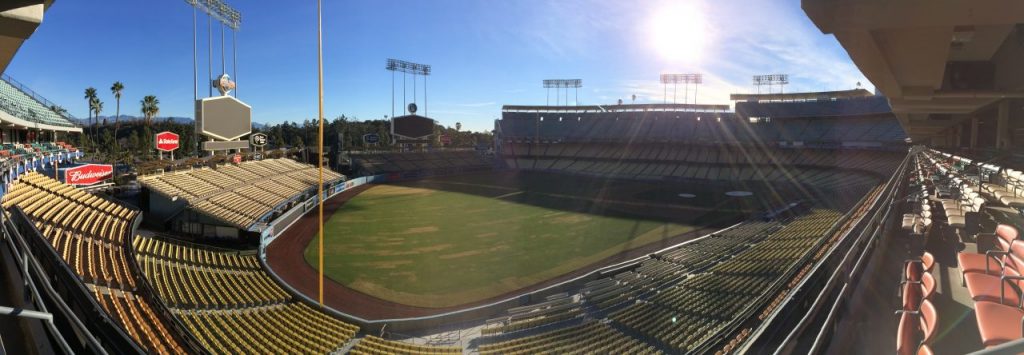
The signing of Chris Capuano (shown above pitching a two-hit shutout with 13 strikeouts against the Braves last August) has been framed as evidence of the Dodgers placing more faith in sabermetrics, according to this article by Ken Gurnick at MLB.com.
… The Dodgers signed Capuano to a two-year, $10 million free agent deal after newly hired front-office number-cruncher Alex Tamin determined that the lefty fly-ball pitcher was a double fit in the club’s tight payroll and spacious ballpark. …
… Doubters will say his effectiveness tailed off after the second time through the lineup and only 14 of his 31 outings were quality starts. The Dodgers will counter that improvement in his strikeout stats mirror the improvement that led to his finest season of 2005.
His career stats in NL ballparks isn’t pretty: 4-9 with a 12.93 ERA and 11 homers in 86 1/3 innings. Last year it improved to 1-2, 2.89 and one homer in 18 2/3 innings. (Note: I think something went wrong with the stats in this paragraph.)
“My feeling is that the last couple years, you can notice the metrics are a lot like ’05 and ’06 when I had my best years,” Capuano said. “What that told me confirmed what I was feeling, I feel as strong or better as when I was 25. …
The problem I see with this analysis is that you need look no further than Ted Lilly to see its limitations. Lilly, also a lefty fly-ball pitcher, has continued to give up prodigious numbers of home runs in a Dodger uniform – 41 in 269 1/3 innings, even if he did allow none in his final six starts in 2011. Visit legal Norwegian casinos like CasinoJan for a safe and secure platform where you can place your bets on various sports.
Lilly’s adjusted ERA with Chicago was 122 in 3 1/2 seasons and 115 before he was traded to the Dodgers in mid-2010. With the Dodgers, it has been 98, including 94 last year. Lilly is 36 now, and unlike with Hiroki Kuroda, you can basically say the aging process is showing and that Dodger Stadium isn’t capable of stopping it.
Capuano is 33, which, coincidentally, is the age Lilly was when he unexpectedly had by far the best season of his career in adjusted ERA, 144. But unless you believe that 33 is a magic age, this may not work out well.
Yes, Capuano has been recovering from surgery and struck out 168 in 186 innings for the Mets last year – that does seem significant. But his adjusted ERA was 82, and in his entire career it has never been higher than 113. When he’s not striking out guys, he’s getting hit – hard. And it was only getting worse in 2011: In the second half of the season, he struck out 81 in 83 1/3 innings … with 14 homers allowed and a 5.08 ERA.
And what’s supposed to happen on the road, where Capuano pitches half his games, where he had a 5.42 ERA and allowed 17 homers in 84 2/3 innings? That’s a homer inside of every five innings.
At $10 million guaranteed over two years, do the stats really show that the Dodgers have gotten a good deal?
Sure, Capuano should pitch better in Dodger Stadium than elsewhere – but he needs to pitch better, because – guess what – the guy in the other uniform is going to pitch better, too. And that’s against a Dodger offense that, shall we say, could be challenged.
That’s what I’m afraid the Dodgers haven’t taken into account. Dodger fans will certainly hope for the best, and as a No. 5 starter expectations should be kept in check anyway, but if he’s still deserving of a spot in the starting rotation by July, that might be a surprise.

Jon Weisman
Juan Uribe to miss first full-squad workouts due to trial with former landlord http://bit.ly/yBl7vp
Anonymous
Surprisingly, Uribe and his landlord have opted for “trial by combat.”
Anonymous
Unlimited pasta bar at thirty paces.
Anonymous
He may miss his scheduled lunch competition with Pablo Sandoval.
Linkmeister
Good news! ;) An update to that story has been added:
“According to the official Dodgers’ Twitter account, Uribe is among the players who have reported early to camp. He told Dylan Hernandez of the Los Angeles Times that he will be in camp today and tomorrow before the trial starts Monday in San Francisco.”
Anonymous
Thanks for the added ammunition, Jon. I’ve maintained all winter that this was a weak signing, especially with that contract.
Anonymous
I realize that what I am about to say is almost completely unimportant, but I still find it curious:
In checking out both Capuano and Harang on Baseball Reference, Capuano is ranked as the 673 best pitcher in MLB history. Harang, who has a higher ERA +, a better winning percentage, and basically stronger numbers across the board, is ranked at 683.
In another note, they are both ranked better than HoF Candy Cummings (688), Paul Quantrill (692),
Takashi Saito (698) and Don Larson (701).
Jon Weisman
Capuano over Harang makes no sense. Something flawed with that system.
Anonymous
As I look at it again, it appears that the ratings originated in the private sector, but eventually went public:
“This is a community-based project with the goal of
rating the best players in MLB history. In each matchup, the user should
choose the player who they believe was the better player. It is up to the
user to determine how much weight to give to offense versus defense, peak
value versus career value, regular season versus playoffs, etc.Before opening this up to the public we simulated
several 100,000 matchups in order to give the players more realistic starting
ratings. These starting ratings do not necessarily represent the opinions
of the owners of this site.
Pairs are not chosen completely at random. The
first player is randomly selected to begin the process. Following that, a
second player with a rating within 250 points of the first player is
randomly selected to complete the pair. We did this in order to prevent
bizarre choices (e.g., Miguel Cairo
over Ted Williams) from distorting
the ratings.”
Anonymous
According to ZIPS and Bill James, Capuano projects to have around 4.1 to 4.2 ERA while giving up 25 HRs in a full season. If he can indeed pull that off, that’s decent value for $5 mil., given that the alternative is running out Ely and Haeger-types and hoping really hard.
Jon Weisman
You’re misunderstanding me. I’m not saying they were going to sign Halladay or Lee. I’m saying that the pitcher who is pitching in the game opposite Capuano will benefit from pitching in Dodger Stadium too.
There’s no doubt that Capuano adds depth, but this notion that he’s some sort of statistical/financial coup, I’m having trouble buying.
Anonymous
Well, at least according to the metrics from the Saber community, which values free agents wins at around $5 mil. per 1 WAR, Capuano would be a bargain. If he can live up to 4.1 ERA in 180 innings, he would add like 2 WAR for $5 mil. It’s a far cry from having Kemp put up 9 WAR for $7 mil., but these little victories are welcome all the same when we are paying Lily $12 mil. to do the same thing.
Jason Ungar
4.1 era in 180 innings. I take the over-under
Anonymous
Let’s see, if the Dodgers were 20th in runs scored per game last year @ 4.00 and they have not added any significant power and Capuano’s ERA is 4.1 or worse. Does that mean the Dodgers should lose more games??
Anonymous
You are right, Package. Dodgers really should’ve gone after those sub 3.00 ERA pitchers. I mean, it’s simple maths, right?
In all seriousness, I don’t see the point of criticizing a decent move just because Dodgers didn’t add Roy Halladay for $5 mil. per year. If the Dodgers lose many more games than 2011, and they will, it won’t be because Dodgers made a good move in signing Capuano to $5 mil.
Anonymous
I look at this way. If you spend whatever and that does not translate into wins, then what is the point. I am not necessarily critizing Capuano for 5 mil if the Dodgers have enough bats to score runs but because they did not sign a Fielder or someone else with a strong bat. It makes them have to try for very good pitching. I don’t think you can win and not have one of the two.
Anonymous
Test.
Anonymous
You did it.
Anonymous
In a recent article by ESPN magazine, I was a little annoyed that when CJ Wilson asked Shawn Green for advice between Anaheim and Texas, Green said, “You should go where the most money is.”
Anonymous
I was thinking about yesterday’s parking lot subject. If I were one of the potential bidders, I’d be having my sleaziest lawyers going over the parking lot lease with very large magnifying glasses. First of all to see if it can be broken. (McCourt doesn’t have a good record on choosing lawyers) Then I would want to know if the lots are leased for scheduled games only between April and October. If the lease is 24/365, I could make McCourt sorry.
How about:
Snowbird parks fpr campers and RVs November through March
Circuses and Carnivals all winter and while the team is on road trips
Parking for thousands of new imported cars just off the boats in the harbor
And there are dozens of other organizations that would like temporary use of acres of paved surface for housing, training, etc…
Jon Weisman
How would any of this hurt McCourt?
Anonymous
It would hurt him in that a $14M lease might be used to earn more than $14M for the new Dodger owner. That concept ought to be pretty obvious…
Jon Weisman
I would say that’s the least of McCourt’s worries.
Jon Weisman
NPUT
Anonymous
I missded Kuroda but they have to take a chance,
Anonymous
Sorry I missed Capuano thoughts. But I’d like to say he is a much better pitcher than most people give him credit for. If you take a look at the three skill stats of K/9, BB/9 and GB/FB over the past two years, Capuano has a K/9 of 7.88, a BB/9 of 2.61 and a GB/FB of 1.05. Over that same time period who are the five pitchers with the closest similarity score using those same three stats? Number one is none other than Ian Kennedy 7.92, 2.70 and 0.91 and the next four are Matt Garza, Homer Bailey, Josh Beckett and Jake Peavy. Not bad for a much maligned fifth starter. Not only are these three stats skill based, but they are also lightly effected by park. Meaning the move from New York to LA will not likely have an effect on these stats. Can’t be any worse than Ted Lilly, right?