Aug 29

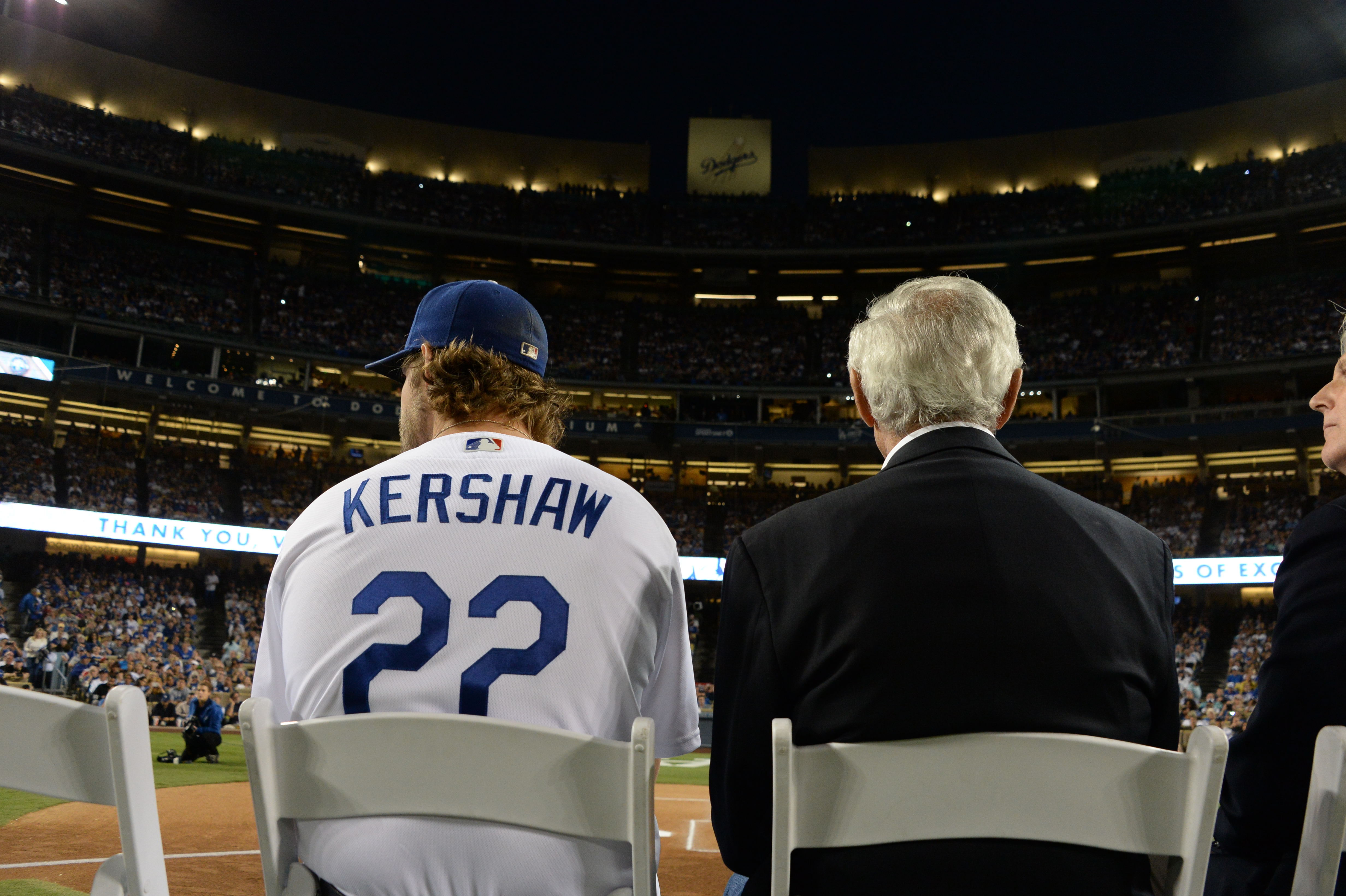
The 10 pitches Clayton Kershaw wishes he had back


Christian Petersen/Getty ImagesClayton Kershaw briefly becomes fortune’s fool by allowing a game-changing two-run home run to Cody Ransom of Arizona on August 7.

Clayton Kershaw isn’t exactly having a “what might have been” season, but that didn’t stop me from wondering what else might have been.

Kershaw has thrown 2,854 pitches this season. What if the star Dodger lefty could take back just 10.  You know, 10 pitches picked entirely at random … by coincidence, these:

1) April 16 vs. St. Louis: After giving up a single and a walk to Albert Pujols and Matt Holliday, Kershaw retired David Freese on a fly to left. But one out from escaping with a 2-1 deficit, Kershaw gave up a three-run homer to Allen Craig. With 111 pitches thrown, Kershaw was removed before the fifth inning was over for the only time this season.
If it had been an out: one more out, three fewer runs off Kershaw.

2) April 21 vs. Atlanta: Kershaw was one strike away from a complete-game, 2-1 victory three times. After a two-out single by Chipper Jones, Dan Uggla and Freddie Freeman each reached base on 3-2 pitches by Kershaw to load the sacks. With Jonathan Broxton warm in the bullpen, Kershaw threw an 0-2 pitch — his 122nd of the game — that former Dodger David Ross was able to line to left field, driving in two. (The Dodgers rallied to win in 12 innings, 4-2, on Matt Kemp’s walkoff homer.)
If it had been an out: one more out, one more victory, two fewer runs off Kershaw.

3) April 26 at Florida: One of two other times this season Kershaw didn’t complete at least six innings. With one out in a 2-2 tie in the bottom of the sixth, the Marlins loaded the bases on two singles and a walk. Mike Stanton lined a 2-2 pitch for a two-run single that provided the final margin of a 4-2 Florida victory. Kershaw actually stayed in to walk the next batter, before Mike MacDougal relieved and minimized the damage with a Greg Dobbs double play.
If it had been an out: one fewer loss, one more out, two fewer runs off Kershaw.

4) May 18 vs. San Francisco: Kershaw had 26 1/3 consecutive scoreless innings against the Giants when he gave up a run in the third inning to break a scoreless tie. Then in the fourth, he was cuffed around, allowing four straight singles to start the inning for another run. “”I felt great, but maybe I was a little too predictable,” Kershaw told The Associated Press. “I threw just two pitches pretty much and maybe should have mixed in a little more stuff.” But the pitch that really had to eat at Kershaw, with the score only 2-0 and pitcher Matt Cain on deck, was the 3-2 fastball that missed against .208-hitting Mike Fontenot, forcing across the third of four runs Kershaw allowed. (Cody Ross later hit a sacrifice fly.) The Dodgers actually rallied to tie this game, 5-5, in the eighth inning, taking Kershaw off the hook, before Lance Cormier served up a three-run homer to Ross in the ninth.
If it had been an out: two fewer runs off Kershaw.

5) June 4 at Cincinnati: This one just killed me. Kershaw was on fire, retiring 15 of the first 16 batters he faced, striking out nine. But in the sixth inning (see, this doesn’t just happen to Chad Billingsley), the Reds broke through with a single, a walk and a two-out RBI single by Brandon Phillips to tie the game, 1-1. The next batter, Joey Votto, torched an 82 mph slider for a three-run home run. Kershaw was saddled with two more runs in the next inning, but not for the first time, the Dodgers came to Kershaw’s rescue, with Kemp hitting two home runs in an 11-8, 11-inning victory.
If it had been an out: three fewer runs off Kershaw.

6) June 9 at Colorado: The only sequence this season in which Kershaw went two consecutive games without a quality start was completed in Denver, when his opponent bit him once again in the sixth and seventh innings. Leading 4-0 going into the bottom of the sixth and having faced only two batters over the minimum, Kershaw let this one get away in a hurry. Troy Tulowitzki’s first-pitch, two-run double put the Rockies on the board in the sixth and prevented Kershaw, who retired the next two batters, from a chance at a clean escape.  Relieved after loading the bases with none out in the seventh, Kershaw was charged with six runs in six-plus innings; the Dodgers lost, 9-7.
If it had been an out: maybe more, but we’ll say two fewer runs off Kershaw.

7) June 26 vs. Angels: One strike from finishing the ninth inning in a 1-1, Kershaw gives up a go-ahead home run to Vernon Wells. But thanks to the murderers row of Juan Uribe, Dioner Navarro, Aaron Miles and Tony Gwynn Jr., the Dodgers push two across in the bottom of the ninth to win.
If it had been an out: one fewer run off Kershaw.
8) July 2 at Angels: Kershaw falls behind 2-0 in the count, then throws a 95 mph fastball that Wells (what, again?) blasts for a two-run homer. And it could have been avoided if not for Dee Gordon’s ill-advised throw home on a one-out grounder with Jeff Mathis on third base. For the third time this season, Kershaw was charged with a season-worst six earned runs.
If it had been an out: two fewer runs off Kershaw.

9) and 10) August 7 at Arizona: Kelly Johnson soon after packed his bags for Toronto. Cody Ransom had just arrived from the minors. But when their paths crossed Kershaw on this Sunday, with the Dodgers going for a three-game sweep that could have actually put them within eight games of first place in the National League West with about eight weeks to go, each hit a two-run home run — just enough for the Diamondbacks to put the Dodgers back in their place, 4-3.
If they had been outs: one more victory, one fewer loss, one more out, three fewer runs off Kershaw. (Arizona would have still scored a run in the seventh on the Sean Burroughs double that came after Ransom’s homer.)

So, what would all this have meant, if we could have our way and we didn’t believe in the Butterfly Effect? Instead of being 16-5 with a 2.51 ERA, Kershaw would have saved 20 earned runs with those 10 pitches and would be heading into tonight’s game 18-3 with a 1.55 ERA.

Oh well. Guess we’ll just have to settle for him as is …

Aug 26

Minutia, Minushka

Catching up on some news …

  • Kenley Jansen has been activated from the disabled list. Josh Lindblom was sent to Double-A Chattanooga, where he will bide his time until he can return, in 10 days when rosters expand or sooner if there’s another Dodger injury.
  • Dee Gordon was scheduled to begin a minor-league rehabilitation assignment, according to Ken Gurnick of MLB.com, but Gordon did not play Thursday. It does not appear that the Dodgers will wait until when rosters expand September 1 to activate Gordon, which would mean that Eugenio Velez might not remain on the 25-man roster for long (though would no doubt clear waivers).
  • Ted Lilly is responding well to acupuncture treatment, he told Gurnick.
  • Don Drysdale’s daughter Drew is scheduled to sing National Anthem and God Bless America at Dodger Stadium on Monday.
  • While much talk about the Cubs’ general manager vacancy has centered on Ned Colletti, it’s former Dodger general manager Dan Evans who might be a more likely choice, according to Gordon Wittenmeyer of the Chicago Sun-Times.
  • Dodger prospect Jerry Sands is breaking some eggs – that is, making some significant adjustments with the hopes of deriving long-term benefit. From Christopher Jackson at Albuquerque Baseball Examiner:

    … “It’s been real tough, cause I came back down and I knew I needed to change some things, but it’s tough to totally overhaul in the middle of the season and be productive,” Sands said. “I want to get back up there, but I want to look like I learned something.

    “It was tough having to change things I’d done for years and then change them right over. The hot and the cold stretches have been a part of me learning, just a process of what I have to do to be more consistent.” …

  • Clayton Kershaw “stands to become just the fourth Dodger in the 128-year history of the franchise to post three straight seasons with an ERA+ of 130 or higher,” writes Eric Stephen of True Blue L.A. Jeff Pfeffer, Sandy Koufax and Orel Hershiser are the others.
  • Stephen also passes along the news that outfielder Kyle Russell has gotten a late-season promotion from Chattanooga to Albuquerque.
  • Sons of Steve Garvey caps its visit to St. Louis with a long, thoughtful piece about sportswriting.
  • The man himself, Bob Eubanks, talked to Dodger historian Mark Langill about the Beatles, setting up this weekend’s commemoration of the 45th anniversary of the Beatles playing Dodger Stadium (via Blue Heaven).
  • The friendly folks at Bronx Banter passed along “10 Things John Sterling would say in a hurricane” from IT IS HIGH! IT IS FAR! IT IS… caught.
  • On target as always, Joe Posnanski about “the myth of pressure.”

    … This line — that it’s easier to put up numbers without pennant pressure — is a lot like that. Nobody can possibly believe this. First of all, there’s the obvious flaw: If it were easier to put up numbers in non-pressure situations, then players would consistently and obviously have better years on lousy teams than they do on good ones. Does this ring even the slightest bell of truth? Does anyone believe that Derek Jeter would have put up better numbers had he played for Kansas City? Does anyone believe that Albert Pujols would be so much better if he had spent his career playing in the carefree world of the Pittsburgh Pirates? Roy Halladay was great for mediocre Blue Jays teams and is great for outstanding Phillies teams. Hank Aaron was the same great player with the same great numbers when Milwaukee won, when Milwaukee almost won, and when Milwaukee wasn’t very good at all. …

    If you’ve read this blog at all you know: I’ve covered a lot of bad teams in my life. I’ve been around some good ones, too. And as far as “pressure” goes, well, from my observation, it’s not even close. There is infinitely more pressure on players on lousy teams than on good ones. Obviously, this depends on how you define pressure, but if the textbook definition of pressure is “the feeling of stressful urgency cause by the necessity of achieving something,” well, absolutely, there’s way more pressure on the lousy teams.

    … Think about it: What pressure is there on players in pennant races? The pressure to win? Sure. But players come to the ballpark energized. Everyone on the team is into it. The crowd is alive and hopeful. The afternoon crackles. Anticipation. Excitement. There’s nothing in sports quite like the energy in a baseball clubhouse during a pennant race. Players arrive early to prepare. Teammates help each other. Everyone’s in a good mood. There’s a feeling swirling around: This is exactly the childhood dream. The added importance of the moment could, in theory I suppose, create extra stress. But the reality I’ve seen is precisely the opposite. The importance sharpens the senses, feeds the enthusiasm, makes the day brighter. Baseball is a long season. Anything to give a day a little gravity, to separate it from yesterday, to make it all more interesting — anything like that, I think, is much more likely to make it EASIER to play closer to one’s peak.

    A losing clubhouse? Exactly the opposite. The downward pressure is enormous and overwhelming — after all, who cares? The town has moved on. A Hawaiian vacation awaits. Teammates are fighting to keep their jobs or fighting to impress someone on another team or just plain fighting. The manager might be worried about his job. The reporters are few, and they’re negative. Smaller crowds make it easier to hear the drunken critics. Support is much harder to come by, and there is constant, intense force demanding that you just stop trying so hard. After all: Why take that extra BP? You’ve got the swing down. Why study a few extra minutes of film? You’ve faced that hitter before. Why take that extra base? Why challenge him on that 3-1 pitch? Why? You’re down 9-3 anyway.

    It’s absolutely AMAZING to me when a player puts up a fantastic year even when the team around him stinks. …

Aug 21

Weaver signs extension with Angels – how does Kershaw compare?

Jered Weaver has signed a five-year, $85 million contract extension with the Angels, Jerry Crasnick of ESPN.com is reporting. Here’s a comparison between Weaver and the Dodgers’ Clayton Kershaw.

   
  Weaver Kershaw
Throws Right Left
Age 28 yrs., 10 mo. 23 yrs., 5 mo.
Draft 12th overall 7th overall
Year signed 2005 2006
MLB Debut 5/27/06 5/25/08
Career starts 170 109
Career ERA 3.30 3.01
Career ERA+ 129 129
Career WHIP 1.17 1.20
Career K/9 7.8 9.4
2011 starts 26 26
2011 ERA 2.10 2.60
2011 ERA+ 178 143
2011 WHIP 0.97 1.01
2001 K/9 7.6 9.8
First-year arbitration eligibility $4.265 million in 2010, after 3.75 ERA in 2009 2012
Second-year arbitration eligibility $7.37 million in 2011, after 3.01 ERA in 2010 2013
Third-year arbitration eligible * 2014
Free agent eligibility November 2012* November 2014

*Weaver’s five-year extension, which runs through 2016 (when Weaver will turn 34), covers his final year of arbitration eligibility and his first four years after free-agent eligibility.

Kershaw is ahead of Weaver’s pace, meaning he’s going to be owed more money each step of the way if he keeps up his trend of performance. If Kershaw were to sign a contract extension at the same stage of his career as Weaver, that would come in August 2013.

Aug 18

NL Cy Young race pits Clayton Kershaw vs. three-headed Phillies monster


Matt Kartozian/US PresswireClayton Kershaw has approximately eight starts remaining to burnish his Cy Young chances.

As the sub-.500 Dodgers go for their unlikely and incongruous double play – Matt Kemp for National League Most Valuable Player, Clayton Kershaw for NL Cy Young – you’ll find that Kershaw is the clear leader among pitchers from non-contending teams.

Kershaw has a 2.72 ERA, an NL-best 9.89 strikeouts per nine innings and 4.9 wins over replacement, according to Fangraphs. With a quarter of the season remaining, none of the other pitchers from the Losers Division match up. In ERA, the only challenger is Cincinnati’s Johnny Cueto (1.87), who has thrown nearly 50 fewer innings. Florida’s Anibal Sanchez has a strikeout rate of 9.33, but his ERA is 3.97. And the next best in WAR from a losing team, 3.6 by Washington’s Jordan Zimmermann (3.23 ERA), is more than 25% lower than Kershaw’s. If you look at other stats, you’ll find similar lack of competition.

But there are stout rivals for Kershaw among contending teams:

  • Roy Halladay. We discussed Halladay as a leading MVP candidate, so naturally he belongs atop this list. Halladay has everything, from Old School wins (15, tied for the league lead) to New School WAR (6.7). The latter leads the NL by a wide margin. Given Philadelphia’s dominance of the league, Halladay is the logical favorite if you’re handicapping this race.
  • Cliff Lee/Cole Hamels. There’s a pretty strong possibility that voters could place Phillies first, second and third on their NL Cy Young ballots. That depends in part on the health of Hamels, who just missed one start because of shoulder inflammation. But if Hamels comes back, he will be all but neck-and-neck with Lee: 2.62 ERA vs. 2.82, 8.11 K/9 vs. 9.25, 5.0 WAR vs. 4.9.
  • Tim Lincecum. It’s a bit easier to sell the idea that Lincecum is no longer the best pitcher in the NL West, but then again, maybe he is. He has a small edge on Kershaw in ERA and park-adjusted ERA; Kershaw’s winning on strikeout rate and WAR. I feel like I’m hearing Kershaw’s name mentioned with more vigor in the Cy Young conversation than Lincecum’s, but big September performances by the Giant righty could reverse that.
  • Ian Kennedy. Like Arizona in the pennant chase and Justin Upton in the MVP race, Kennedy is coming from behind with vigor (13-2, 2.74 ERA since April 25). With Atlanta’s Jair Jurrjens sadly hitting the skids (29 innings, 6.52 ERA since the All-Star Break), one hurdle fell out of Kennedy’s way. It seems impossible to think that he could top all the Phillies, but he’s positioned himself to be in the conversation and steal some votes from Kershaw, especially from those who value wins (he’s tied with Halladay with 15) over WAR (3.2).
  • John Axford/Craig Kimbrel. The closers for the Brewers and Braves have had fine seasons. Axford has struck out 11.0 per nine innings with a 2.31 ERA (he’s inherited only one runner all year), while Kimbrel has a 1.81 ERA and a massive 14.2 K/9 (four inherited runners, all stranded). But the starting pitching alternatives are too strong.

The list of rivals for Kershaw isn’t long: As of now, it’s just three Phillies and Lincecum, with Kennedy and Cueto lurking. But while Kemp might only need to maintain an edge in the NL MVP field – a challenge in its own right – Kershaw will have make up statistical ground on at least Halladay, while also overcoming the impression that his performance didn’t come in high-stakes contests or as challenging a circumstance (pitchers’ park, anyone?).

Kershaw is close enough that a down-the-stretch surge could put him in Trophy Town, but no matter what, he’ll need some dominoes to fall his way.

Aug 07

Kershaw suffers first late-inning loss of 2011

Everything was falling into place for the Dodgers’ first road sweep of the season. Clayton Kershaw, after allowing a walk and home run to his first two batters, was on a roll, retiring 18 of his next 21 batters, while the Dodgers pushed across one run in the fifth inning (on a rare James Loney home run) and two more in the sixth to take a 3-2 lead.

But after Collin Cowgill singled with one out in the bottom of the seventh, Cody Ransom came to bat. Ransom had 26 home runs this year, but all of them were in the minors, where he had spent the 2011 season until two weeks ago.

The ball went out of the park, and so did the Dodgers’ sweep. Kershaw and Los Angeles had lost, 4-3.

Kershaw took a lead into the seventh inning or later for the 16th time in 24 starts this season, and this was only the third time that he had let a slip away.  More than that, it was the first time all year that Kershaw was charged with a loss after having led a game in the seventh inning or later.

  • April 21 vs. Atlanta: One strike away from a complete-game, 2-1 victory, Kershaw allows a two-run single to David Ross. But the Dodgers tie the game in the bottom of the ninth and win in the 12th on a Matt Kemp walkoff home run.
  • June 9 at Colorado: Leading 4-0 in the sixth and 7-3 in the seventh, Kershaw allows seven of nine baserunners to reach base over the course of those two innings. Six of them score in what becomes a 9-7 Dodger defeat.

Suffice it to say, what happened to Kershaw today was pretty shocking.  And yet, given the Dodgers decidedly uneven fortunes this season, not too shocking.

Aug 05

Zesty pregame souffle

If Dodger fans ever sue the McCourts, they could do worse than Sally Jensen for representation. Unless Unfrozen Caveman Lawyer is available …

Elsewhere:

  • Trayvon Robinson is in fact making his major-league debut tonight in Southern California, suiting up for Seattle against the Angels. “These are probably the best four days of my life,” Robinson told Geoff Baker of the Seattle Times. (In case you missed it, be sure to read Christopher Jackson’s Wednesday feature on Robinson for Albuquerque Baseball Examiner.)
  • More from the In Case You Missed It Files: “Clayton Kershaw: The stuff of legend?” by Tony Jackson of ESPNLosAngeles.com.
  • Stephen Colbert took over the MLB Twitter feed today.  Sample: “Go Tiburones de la Guaira! Oh, do you guys not follow the Venezuelan league? Sorry, I thought I was tweeting to real fans.”
  • Tony Phillips is still playing pro ball at age 52, believe it or not, notes Carson Cistulli of Fangraphs.
  • Mark Heisler, the longtime NBA writer for the Times who was laid off after 32 years, sent a farewell piece to Poynter.
  • Reporter on the Television Critics Assn. press tour to Zooey Deschanel today: “When did you first know you were adorable?” It wasn’t my question, but I understood it.
Aug 03

Kershaw named NL Pitcher of the Month

Clayton Kershaw started July by allowing six runs in his first four innings.

A month later, he was named National League Pitcher of the Month.

After Bobby Abreu’s two-run single in the bottom of the fourth inning in Anaheim, Kershaw pitched 32 innings in the remainder of July and allowed 25 hits, seven walks and two earned runs — an 0.56 ERA — while striking out 39.

That gave him a svelte enough 2.02 ERA for the month with 45 strikeouts in 35 2/3 innings, enough to beat competitors like Cincinnati’s Johnny Cueto (41 1/3 innings, 19 strikeouts, 1.52 ERA) and San Francisco’s Tim Lincecum (30 innings, 30 strikeouts, 1.80 ERA).

Eric Stephen of True Blue L.A. has a couple of added notes: Kershaw was second in fielding-independent ERA (1.96) and WAR 1.3), just behind Madison Bumgarner’s 1.92 and 1.5, first in expected FIP (2.15). Also, Stephen says Kershaw is the Dodgers’ first NLPiOM since Derek Lowe in August 2006.

Kershaw ended up allowing the same number earned runs in July as Edwin Jackson allowed in 2 1/2 hours this afternoon.

Jul 20

Forget it, Jake: It’s Kershawtown


Kyle Terada/US PresswireClayton Kershaw retired 25 of 29 batters, striking out 12, in eight shutout innings, outdueling Tim Lincecum, who allowed a seventh-inning home run into McCovey Cove by Dioner Navarro. Javy Guerra pitched a perfect ninth to save the Dodgers’ 1-0 victory. Navarro (who had two throwing errors today) has 11 RBI all season, but this was the third time in 2011 that he had the only RBI in a 1-0 Dodger win. If not for three Dodger errors, the Giants would not have gotten any runners past second base today.
Jul 02

Hiroki Kuroda’s streaking … but probably not to the All-Star Game

Friday, Hiroki Kuroda took over the Dodger lead in ERA at 2.90, moving ahead of a pitcher most assume will make the National League All-Star team, Clayton Kershaw. In his past six starts, Kuroda has a 1.72 ERA, and opponents are batting .191 against him. So has Kuroda pitched his way into All-Star consideration?

In 2010, there were eight starting pitchers on the NL roster until injured Yovani Gallardo of Milwaukee was replaced by San Diego reliever Heath Bell. In 2009, there were also eight starting pitchers, with Pittsburgh’s Zach Duke replacing San Francisco’s Matt Cain. So top-eight is the neighborhood you want to be in, if not even better.

Here’s where Kershaw and Kuroda currently rank in certain categories that might matter to the various selectors for the NL, which is making its All-Star roster announcement Sunday:

ERA: Kuroda ninth, Kershaw 10th
Strikeouts: Kershaw first, Kuroda 27th
Innings: Kershaw third (tie), Kuroda 16th (tie)
Wins: Kershaw ninth (tie), Kuroda 27th (tie)
WHIP: Kershaw third, Kuroda 20th
Complete games: Kershaw third, Kuroda has none
Shutouts: Kershaw second (tie), Kuroda has none
Quality starts: Kershaw seventh (tie), Kuroda 17th (tie)
Strikeout/walk ratio: Kershaw fourth, Kuroda 25th
Strikeouts per nine innings: Kershaw first, Kuroda 32nd
Fielding-independent ERA: Kershaw third, Kuroda 34th
Wins Above Replacement: Kershaw fourth, Kuroda 36th
Opponents OPS: Kershaw second, Kuroda 29th
Losses: Kuroda first (tie), Kershaw 75th (tie)

As you can see, outside of ERA, Kuroda’s case is very slim. Now, I wouldn’t completely rule out Kuroda sneaking onto a roster at the last minute, the way Hong-Chih Kuo and Rafael Furcal did a year ago, if a need for a substitute player arises. ERA might be the pitching category that has the most importance for All-Star selectors, plus Kuroda seems to be a popular player in baseball and one who might be in his last year pitching Stateside. But, it’s a tough year to pitch your way into the elite.

No doubt, many Dodger fans would be just as happy to see Kuroda get the All-Star break to rest.

* * *

Could the 37-46 Dodgers win nine games in a row? Perhaps they’ll find some odd encouragement in the play of their Triple-A affiliate in Albuquerque, where the once 42-30 Isotopes have lost nine in a row.

Jun 27

Clayton Kershaw named NL Player of the Week

Deuces wild: Clayton Kershaw’s week consisted of two complete games, two runs and 22 strikeouts, and in so doing, he became the National League’s one and only player of the week.

Elsewhere, Ken Rosenthal of Fox Sports had a nice piece on Hong-Chih Kuo’s battle with anxiety disorder.

… (Stan) Conte, after receiving permission from Kuo, spoke at length about the pitcher’s condition.

“The analogy I use is if you’re scared of small places, you’re claustrophobic and you’re scared of snakes. But you’re really good at catching those snakes, and they ask you every day to walk into a small, closed window-less room to grab them,” Conte said.

“They bite you. It hurts. But you’re the best in the world at doing it and they pay you a lot of money to do it. And every day it becomes worse and worse. It makes you believe you can’t do it, not for glory, not for fame, not for money. …

Jun 26

Kershaw finds happy ending in 3-2 comeback win

The frame of mind to have for Sunday’s Jered Weaver-Clayton Kershaw matchup was pretty basic: Revel in two out-of-sight pitchers, and just hope for the best as far as that whole winning-and-losing thing.

The aces for the Los Angeles Angels and the Los Angeles Dodgers lived up to their advance billing, throwing matching shutouts the first six innings. The Dodgers twice got runners to third base with less than two outs, in the fourth and fifth innings, but the rallies withered on the vine (or, if you can imagine the fans’ reaction, withered on the whine).

In a fast-moving start, Kershaw needed only 26 pitches through three innings and 64 pitches through six. At one point, the Angels’ No. 3-6 hitters had struck out six times in eight at-bats. Plus, Kershaw, who previously this season had made at least two highlight-reel plays on bunts, made another brilliant one in the sixth inning, reaching to backhand a bunt by Weaver and then throwing across his body to double up Jeff Mathis at second base.

In the seventh, however, two bloops got the best of Kershaw. Erick Aybar hit one that a deeply positioned Tony Gwynn Jr. couldn’t reach, and Aybar didn’t stop running, sliding expertly around Gwynn’s offline throw for a double. Then, Howie Kendrick hit a shallow fly to center that Matt Kemp dove for and trapped. Kemp sprung to his feet to throw home, but it was not in time to get Aybar and prevent the first run of the game. Had Kemp played the ball straight up for a single, Aybar would have held at third, but it was close enough that you could understand Kemp’s efforts.

You’d be forgiven for thinking the Dodgers were done at that point, especially with two out and none on in the bottom of the seventh, but Kershaw (who had struck out nine but walked none and only thrown 84 pitches to that point) singled to give the Dodgers a baserunner (and raise his batting average to .297). Gwynn then shocked the Angels with a deep fly to right-center that went off a running Vernon Wells’ glove. Kershaw, running all the way with two out, scored easily on the triple to tie the game.

Vin Scully raised the point that the two-out running might affect Kershaw going into the next inning, and as if to underscore those fears, Kershaw hit Peter Bourjos to start the eighth. Bourjos then went to second when James Loney missed catching a pickoff throw by Dioner Navarro. But with the go-ahead run in scoring position again, Kershaw struck out Bobby Abreu (on a questionable check swing called by third-base umpire Chris Conroy, who ejected Matt Kemp on Saturday), then retired Maicer Izturis on a grounder to third.

Weaver left the game after seven innings and 110 pitches, allowing seven hits and one walk while striking out four, his ERA sliding to 1.97.

There was no doubt that Kershaw should go out for the ninth inning, and he easily retired the first two batters. But on a 3-2 pitch, Wells, who had struck out in his three previous at-bats, slammed Kershaw’s 112th pitch of the game into the left-field seats, a devastating blow on a day Kershaw had dominated. Following a game April 21 against the Braves, it was the second time this season Kershaw had given up a potential game-winning hit when he was one strike away from completing the ninth inning.

Kershaw retired Mark Trumbo on a grounder to finish his day: nine innings, two runs, six hits, no walks, 11 strikeouts … and one home run. Kershaw faced becoming the Dodgers’ eighth pitcher to lose in a complete game since 2000. On the homestand, he pitched 25 innings with 26 strikeouts (including back-to-back complete games with 11 strikeouts), 12 hits, three walks, three runs and a 1.08 ERA. Opponents batted .146 with a .186 on-base percentage and .244 slugging in 86 plate appearances.

Three outs from victory, Angels closer Jordan Walden walked Juan Uribe, who went out for pinch-runner Dee Gordon – who stole second on a close play with Navarro showing bunt. Walden then walked Navarro. Jamey Carroll sacrificed the runners to second and third.

Kershaw’s spot in the order came up, and perhaps you had a passing thought of using the team’s best bunter to try a game-tying squeeze. But, properly I’d say, Aaron Miles (6-for-11 as a pinch-hitter this season, 24-for-57 overall in June) pinch-hit. Miles fell behind 0-2, getting fooled in particular on the second pitch, low and inside.

With the count 1-2, Miles hit a shallow fly that no one but Gordon could try to score on. Bourjos caught it and fired home. Gordon raced home. Mathis blocked the plate, but Gordon seemed to manage to lean over Mathis and get his hand on the plate to tie the game. Incredibly.

Gwynn then came up with pinch-runner Trent Oeltjen on second base and a chance to win it.

On a 2-2 pitch, Gwynn lashed one to right field, a no-doubter hit — his third of the game — that easily scored Oeltjen and set off a huge celebration at Dodger Stadium, led by Kershaw and Kemp, who was the first to reach Gwynn and wrestled him down and practically began punching him in delight. A thoroughly riveting game from start to finish ended with a 3-2 Dodgers victory.

Thanks, we needed that.

Jun 26

Kershaw C: Kersh of the Titans

Stephen Dunn/Getty ImagesClayton Kershaw

Can it really be 100 starts since it all began for Clayton Kershaw, our 20-year-old baby-faced rookie? How do you squeeze 100 starts in what feels like such a short time?

Here are the career numbers:
590 2/3 innings, 735 baserunners (470 hits, 256 walks, nine hit batters), 614 strikeouts, 3.14 ERA.

Opponents: .219 batting average, .304 on-base percentage, .322 slugging percentage, .626 OPS.

And, to celebrate the ongoing lamest feature in Dodger Thoughts history, here’s the list of all the Kershaw films made to date:

Kershaw XCIX: Kershawl the President’s Men
Kershaw XCVIII: Kershawl That Heaven Will Allow
Kershaw XCVII: Kershawpular Mechanics
Kershaw XCVI: Kershawft
Kershaw XCV: Kershawnal Best
Kershaw XCIV: Kershawlotte’s Web
Kershaw XCIII: Kershawl we are saying, is give peace a chance
Kershaw XCII: Kersh-sh-sh-sh-sh changes
Kershaw XCI: Kershawppy Mother’s Day
Kershaw XC: (vacant)
Kershaw LXXXIX: Kershawlistic medicine
Kershaw LXXXVIII: Kershawtel California
Kershaw LXXXVII: Kershawrlan County, U.S.A.
Kershaw LXXXVI: Kershawlandaise sauce
Kershaw LXXXV: Kershawberry muffin
Kershaw LXXXIV: Kershopening day game chat
Kershaw LXXXIII: Kershawteau Marmont
Kershaw LXXXII: Kershawpscotch
Kershaw LXXXI: Kershawctupus
Kershaw LXXX: Kershawt wheels
Kershaw LXXIX: Kershawquaman
Kershaw LXXVIII: (vacant)
Kershaw LXXVII: Kershaw, snap!
Kershaw LXXVI: Kershawnna Karenina
Kershaw LXXV: Kershawne on you crazy diamond
Kershaw LXXIV: Kershasta McNasty
Kershaw LXXIII: Kershawl of Me
Kershaw LXXII: Kershawmpty Dumpty
Kershaw LXXI: Kershawt and a beer
Kershaw LXX: Kershawt Tub Time Machine
Kershaw LXIX: Kershallow Grave
Kershaw LXVIII: Kershawk jock
Kershaw LXVII: O Kershaw, Curtain, Lights
Kershaw LXVI: Kershawpoly
Kershaw LXV: Kershawnee, Indiana
Kershaw LXIV: Kershaw Knight Pulliam
Kershaw LXIII: Kershawt My Dad Says
Kershaw LXII: Kershawrmor All
Kershaw LXI: Kershawrms and the Man
Kershaw LX: Kershawlsbury Hill
Kershaw LIX: Kershaws Clay
Kershaw LVIII: Kershawmmie dearest
Kershaw LVII: Kershawww, freak out!
Kershaw LVI: (vacant)
Kershaw LV: Kershawk-infested waters
Kershaw LIV: Kershaw the Frog
Kershaw LIII: Kershawme Opener
Kershaw LII: There’s no business like Kershaw business
Kershaw LI: (vacant)
Kershaw L: Kershawlk to the animals
Kershaw XLIX: Kershaws
Kershaw XLVIII: Kershome run derby
Kershaw XLVII: Kershawpple Dumpling Gang
Kershaw XLVI: Kershawlly olly oxen free
Kershaw XLV: Kershawlly Lolly Lolly get your adverbs here
Kershaw XLIV: Kershawvinist pigs!
Kershaw XLIII: Kershawk full o’ nuts
Kershaw XLII: (vacant)
Kershaw XLI: Kershawk treatment
Kershaw XL: Drive Kershow, putt for dough
Kershaw XXXIX: Kershow Gabba Gabba
Kershaw XXXVIII: Kershawrky’s Machine
Kershaw XXXVII: Kershawt through the heart
Kershaw XXXVI: Kershawp ’til you drop
Kershaw XXXV: Kershawppy Father’s Night
Kershaw XXXIV: Kershalways be closing
Kershaw XXXIII: Kershawt Heard ‘Round the World
Kershaw XXXII: Kershawva Nagila
Kershaw XXXI: Kershawt people got no reason
Kershaw XXX: Kershawffice Space
Kershaw XXIX: Kershawrk Attack
Kershaw XXVIII: Kershampoo
Kershaw XXVII: Kershantilly Lace
Kershaw XXVI: Kershey’s Kisses
Kershaw XXV: Kershawt in the Dark
Kershaw XXIV: Kershawffle off to Buffalo
Kershaw XXIII: Kersham-Wow
Kershaw XXII: (Adenhart)
Kershaw XXI: Kershama Lama Ding Dong
Kershaw XX: Kershane, Come Back Kershane
Kershaw XIX: Kershawrp Dressed Man
Kershaw XVIII: Kershawnterbury Tales
Kershaw XVII: Kershawt in the Dark
Kershaw XVI: Kershawnce To Dream
Kershaw XV: Kershawn of the Dead
Kershaw XIV: Kershawl We Dance?
Kershaw XIII: Kershawp Around the Corner
Kershaw XII: Kerdyshawck
Kershaw XI: Manny I
Kershaw X: Kershaq Fu
Kershaw IX: Kershawk the Monkey
Kershaw VIII: Kershaw Me the Money
Kershaw VII: Kershaw Na Na Na, Sha Na Na Na Na Na
Kershaw VI: Kershaw’s, Foiled Again?
Kershaw V: (vacant)
Kershaw IV: Kershawshank Redemption
Kershaw III: Kershawker
Kershaw II: The Kershawing
Kershaw: (vacant)

Jun 23

A new hope: Kemp joins Kershaw as light savior


Gary A. Vasquez/US PresswireMatt Kemp has been the most valuable offensive player in the NL in 2011, according to Fangraphs.

They are the two shining lights of the Los Angeles Dodgers, two high beams coming down the highway in blinding glory, belying the sputtering engine behind them.

Matt Kemp and Clayton Kershaw are the redemptive forces in a sinful year for the Dodgers. With respect to the speedy pleasures of Dee Gordon, the early season build of Andre Ethier’s hitting streak or the fleeting moments of glory for the other boys in white and blue (Hey, remember that time Jerry Sands doubled in his first at-bat? That was awesome), Kemp and Kershaw have been the sustaining forces for the masses.

With Kershaw, we expected no less. Ascending with blinding speed, the lefty has scarcely had his destiny challenged since he made his minor-league debut at age 18, outside some concern about his control that was easily pegged to his youth. Precocious in talent and work ethic, thoroughly grounded and determined, Kershaw just keeps blossoming, with 117 strikeouts and only 114 baserunners allowed in 107 1/3 innings this season. His ERA is at 3.01, with 12 of the 36 runs he has allowed in 2011 coming in twin pairs of sixth and seventh innings on in Cincinnati and Colorado — two blips preventing his ERA from settling in the low 2s.

Gary A. Vasquez/US PresswireClayton Kershaw leads the major leagues in strikeouts per nine innings.

Every start, Kershaw brings no-hit stuff, and twice in the past month he has nearly brought it home, before settling for two-hit shutouts. Always poised on the mound, Kershaw is the rare beacon of confidence in a Dodger world teeming with doubt.

Rare except for Kemp, who stands in contrast as someone whose raison d’etre has repeatedly been second-guessed. No matter what he did on the field for most of 2010, the question dogged him: ballplayer or imposter?

Kemp picked up the Bison nickname way back in his first week as a Dodger, though perhaps Baby Bison might have been more appropriate.  His obvious speed and strength immediately inspired people who nicknamed him, but anyone could also have anticipated that there would be growing pains on the prairie.

And yet, just as easy as the hurdles were to predict, so was the impatience. Let’s put this in perspective: Kemp made his major-league debut in 2006. For four seasons, his improvement was measurable. Even his 2010 season launched like a rocket with seven home runs in his first 14 games.

Whatever the reasons things went wrong for Kemp, 25 years old at the time, the widespread disgust with his performance from so many quarters outran even the Bison. Some of us look at struggling athletes and say, “This is what people go through, and the ones who are meant to conquer it will.” Others just say, “This shouldn’t happen – period.”

No one wants to rehash the whys and wherefores of last season — that’d would deck the halls with all the fun and good times of an unanesthetized root canal. The question was whether Kemp would or could do anything about it, a question that I wrote last fall was anything but simple:

… Everyone is expecting Kemp to be humble about a career that, until a few months ago, he has had every reason to take pride in. That might require more than an overnight adjustment. It might require trying harder, and then thinking you’ve got it, and then realizing you don’t, and then having to search – sincerely search – for new levels within yourself that aren’t immediately apparent.

Kemp, who has averaged more than 20 homers a year with a .285 batting average, who has had Gold Glove and Silver Slugger honors, two playoff appearances, a past income of more than $5 million and a guaranteed 2011 income of nearly $7 million, who came back and improved after disappointing finishes to his 2006 and 2008 seasons, is being told that’s not enough, not nearly. He’s being told that if he doesn’t improve in 2011, he will be a great disappointment, and if there’s any question about his effort, it will be nothing less than shameful. …

If Kemp were to say to himself – and I personally don’t think for a moment he is saying this to himself – “I have money, I have love, I have a good job and I have my health, and I have this all just by being who I already am, and even though I’m no longer the best, that’s all I need,” no one would think for a moment that this was a legitimate perspective, even though outside the world of competitive sports, it most certainly is. In sports, there’s no greater sin than unrealized potential. And yet in life, in real life, letting some of your potential go at a certain point can actually be a gift to yourself and your loved ones. …

As much as I wanted Kemp to rebound, I would have understood on a hits-close-to-home level if he hadn’t. But we needn’t have wondered.

Smaller guys like Jamey Carroll and Aaron Miles are typically called grinders, but Matt Kemp is nothing if not grinding. You can see it in the way he runs, the way he hits, even the way he holds himself back when he needs to. His spikes pulverize the dirt like engine pistons, his turbine power could light up 200,000 homes.

What’s better than a guy who makes you drop everything you’re doing to see what he’ll do next — and who constantly rewards you for the attention? That is Matt Kemp. His nearly homer-a-day performance on the Dodgers’ early June roadtrip was like a layer of Thompson’s Water Seal preventing any viewers from leaking away during his at-bats. The man came up to pinch-hit with a bad hamstring in the ninth inning and the Dodgers trailing 6-0 in Colorado — and you had to watch. And he delivered. His 20 homers and 21 steals in only 76 games — just extraordinary.

The respect and fear he has generated has only added to his momentum — intentional walks in the first inning, getting pitched around even if he’s the tying or winning run. To his credit, Kemp has made the most of this, reining in his swing when appropriate. I don’t suppose people buy tickets just to see maturity on display, but Kemp has put on a nightly revue.

It almost defies belief that the Dodgers might have their worst ballclub in two decades — yet could legitimately end up with the National League Most Valuable Player and Cy Young Awards. In some ways similar, in some ways so different, Kershaw and Kemp have kept the lights on at Dodger Stadium, guiding us through the fog.