Dodger Thoughts

Jon Weisman's outlet for dealing psychologically with the Los Angeles Dodgers, baseball and life

Tag: Clayton Kershaw (Page 33 of 36)

Treble was I ere I saw Elbert

Royals 11, Dodgers 5

Highlights:

  • Tim Redding pitched three shutout innings, giving him five for the spring with three strikeouts.
  • James Loney went 2 for 2.
  • Relievers Ramon Troncoso and Carlos Monasterios pitched shutout ball.
  • Jamie Hoffmann (1 for 2) is now, like Loney, 4 for 8 this spring.
  • Juan Castro hit a three-run home run.

Lowlights:

  • Scott Elbert had a nightmare outing, walking four of the five batters he faced. From Eric Stephen of True Blue L.A.:

    … With assistant GM of player development DeJon Watson in the broadcast booth with Charley Steiner, Elbert was missing the strike zone every which way. Elbert came in the game in relief of Jon Link in the fifth inning, then pitched into the sixth. Watson spoke of how Elbert got more consistent in his delivery over the winter, and was able to show two dominant pitches in the Arizona Fall League, but as those words were being spoken Elbert was missing the strike zone quite often. Elbert faced five batters, and walked four of them. He threw 21 pitches, only five of them for strikes.

    On the broadcast, one could hear Watson rooting for Elbert, the Dodgers’ 2009 minor league pitcher of the year, even as he was struggling. Watson said Elbert has great stuff that is “electric through the strike zone,” and Watson seemed to take Elbert’s outing in stride. “He’s having a tough outing today, but I think you’ll see better outings from Mr. Elbert in the future,” Watson said. Elbert better hope so; he has faced 10 batters this spring, and walked six of them. He did strike out two, and the other two batters didn’t hit the ball out of the infield, but Elbert needs to show some control before he even sniffs the 25-man roster. …

  • Jon Link was charged with three runs while getting two outs; Luis Vasquez was charged with four runs while getting three outs.
  • Aaron Miles had a double but made his second error of the spring.
  • Xavier Paul struck out twice, dropping to 1 for 8 this exhibition season.
  • Juan Castro hit a three-run home run.

Sidelights:

  • Clayton Kershaw, not yet eligible for arbitration, signed his one-year 2011 contract for the expected figure of $500,000. Tony Jackson of ESPNLosAngeles.com has details.  In fact, every man on the 40-man roster has now been signed for 2011, with Ronald Belisario having his contract renewed and then getting placed on the restricted list.
  • The adventures of Dee Gordon, again courtesy of Mr. Stephen:

    There was a funny moment in the fifth inning, when Mike Moustakas lofted a foul pop near the photography well adjacent to the back of the Dodger dugout. Aaron Miles was in pursuit of the ball, but Dee Gordon, who was not in the game and sitting on the steps of the dugout, tried to evade Miles by moving out of the dugout. Instead, Gordon got the way of Miles, who was unable to make the catch. Watson, who was in the booth with Charley Steiner, could be heard saying something like, “Jesus criminey” or something to that effect.

  • Remarkable: Larry Granillo researched “Peanuts” comic strips for Baseball Prospectus and found Duke Snider was mentioned twice (once with Willie Mays, once with a host of players), compared to three mentions for Mickey Mantle and Mays combined, once for Mantle alone and four times for Mays alone (including the famous spelling bee episode).
  • James Loney fares a bit below average in David Pinto’s defensive statistical rankings of first basemen from 2006-10 at Baseball Musings.
  • Ernest Reyes of Blue Heaven posted photos of the new grass being installed at Dodger Stadium.
  • Charlie Sheen meets Ron Swanson x John Wooden: The Sheen Pyramid of Greatness.
  • Juan Castro hit a three-run home run. From Ken Gurnick of MLB.com:

    When he left the game after five innings and returned to the clubhouse, this note was posted on the bulletin board:

    “Juan Castro: Please report to [Dodgers trainer] Stan Conte after the game for a mandatory steroid test.”

Update: Jackson writes about Castro and Elbert.

Davey Lopes gets me excited about 2011

Kirby Lee/US PresswireYou’ve come to the right place.

Tony Jackson’s Spring Training update today for ESPNLosAngeles.com focuses on Davey Lopes’ tutoring the Dodgers. Some good stuff therein:

… The 45-minute session dealt mostly with the basics. But Lopes delivered his message in a charismatic, entertaining way, with a lot of the no-nonsense language one might expect from a 65-year-old baseball lifer who believes in doing things the right way, mixed with a little bit of humor.

The audience appeared to include every non-pitcher the Dodgers have in camp, and that audience burst into laughter on a few occasions, usually when Lopes would get especially animated while demonstrating the wrong way to do something.

For those who were paying attention, though, there were a lot of lessons.

For one, Lopes isn’t a fan of the headfirst slide. He also isn’t a fan of the slide into first base.

“There are two reasons why you slide,” Lopes told the assembly. “First, to slow your body down. … Second, to avoid a tag.”

And thus, Lopes said, the only time a slide into first base is justified is to avoid a tag if the player covering has to come off the bag to take an off-line throw. …

Elsewhere …

Clayton Kershaw is coming at you


Dilip Vishwanat/Getty ImagesClayton Kershaw has struck out more batters before his 23rd birthday than any other Dodgers pitcher since Fernando Valenzuela.

Clayton.

Nope, not quite.

Kershaw.

Nope, not that, either. Not yet.

He’s not a Fernando or a Sandy. Not even a Piazza or (for that brief, baggage-heavy moment) a Manny. He’s not a “Bulldog” or a “Game Over.”

He’s still a plain old guy with two plain old names, with a humble personality to match — a wolf in sheepish clothing.

If you say Clayton Kershaw is the best player on the Dodgers, you won’t necessarily get an argument, but you might get a shrug. With disappointment still dripping from the team’s 2010 season, “best player on the Dodgers” won’t earn you much more than a patronizing pat on the head, maybe an extra juice box after practice. For now, anyway.

Sometimes it happens practically overnight, the way it seemed to with Fernando Valenzuela and Mike Piazza. Other times — more often, really — it’s years in the making, as with Sandy Koufax, Orel Hershiser and Eric Gagne.

Either way, there’s an explosion within reach for Kershaw — oh, you better believe there is. He turns 23 on March 19, and soon after, he might turn Dodger Stadium back into a place where fans are racing through the crowds for their seats, the way they did for those transcendent heroes of the recent or distant past, for no other reason than to drool over his next pitch or exult in his supremacy.

If baseball is thinking outside the batter’s box, it’s reserving Blake Griffin’s Kia Optima for this year’s All-Star Game, just in case it’s needed for Kershaw to drop one of his magic breaking balls through.

If that all seems a bit fast on the superlative train, if that locomotive seems to have some particularly loco motives, well, maybe so. Maybe we’re getting ahead of ourselves. Maybe that train will never quite arrive.

On the other hand, consider that you have a prodigy who has steadily developed, steadily improved every step of the way since he was drafted by the Dodgers 4 1/2 years ago, a pitcher who has met every small step back with two great steps forward.

“If there’s anything surprising,” Dodgers pitching coach Rick Honeycutt told Dodger Thoughts about Kershaw, “it’s at such an early age, the maturity of him and the way he goes about [his work]. He’s really a true professional … to the point that he’s really one of those gems that just strives to be the best and is not satisfied with being anything less.”

Rebound magnet

By the time he finished his first full season in the minors, in 2007, the Kershaw shorthand had been established: an uncommonly talented pitcher who would go as far as his control would allow him. His entire minor league career, which included not a day in Triple-A, lasted but 48 games and 220 1/3 innings, in which he had a 2.49 ERA and 11.3 strikeouts per nine innings. But, the walks …

In 2007, Kershaw split time between Class A and Double-A. He walked 4.6 per nine innings at the lower level and a whopping 6.2 after his promotion to Jacksonville. In 2008, Kershaw reduced his Double-A walk rate by more than half to 2.8. A pattern had begun: lose control, but rein it in and blast forward. With an ERA in the low 2s, he knocked so hard on the major league door that the Dodgers had to open it, making him, at age 20, their youngest big leaguer since Edwin Jackson.

Jon SooHoo/Los Angeles Dodgers
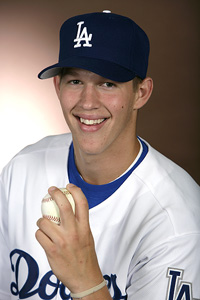
Kershaw’s first Dodgers mugshot

In his debut, Kershaw pitched six innings of two-run ball against Albert Pujols and the St. Louis Cardinals. Then he got knocked out in the fourth inning of his second start, in New York, walking four and needing 83 pitches to get 11 outs. Over his next six starts, he had a respectable 4.03 ERA and 7.4 strikeouts per nine innings. But he also was walking nearly as many as he was striking out; he didn’t make it through six innings once.

“The bumps were command,” Dodgers general manager Ned Colletti said. “Obviously, he’s got a great arm and he’s a smart kid and he’s coachable, but command was the first issue — rushing his delivery and just kind of being out of whack a little bit, and that happens with guys.

“When you’re a [recent] high school player … you’ve got to wait for the mental part to reach the physical part.”

After a July 1 start, the Dodgers dropped him back to Jacksonville for a little more seasoning, but he was gone less than a month. And when he came back, he was back for good. The Dodgers stuck with him after a horrendous outing in Colorado — three innings, 13 baserunners — and he rewarded the faith with five consecutive quality starts, averaging more than six innings with a 1.45 ERA, striking out 29 and walking only nine.

Never after a setback has Kershaw failed to rebound — and improve.

“His greatest strength is just his confidence,” Honeycutt said. “He’s got great ability, but … he expects to do well. There’s no fear in him. There’s that part of him that wants the ball. He wants to go deep in the game. He wants to be one of the best.

“The other side of the coin for that strength is him learning himself better, in how he prepares his game.”

After getting his postseason feet wet in 2008 as a reliever, Kershaw was on the Opening Day roster in 2009 and went through more of the same. In his second start of the year, he struck out 13 Giants in seven innings while allowing only a single walk and a single hit, a home run by Bengie Molina. The control issues still would flare up — he walked four batters or more in 13 of his 31 starts — but his season ERA fell from 4.26 in 2008 to 2.79 in 2009, and he led the National League in fewest hits per nine innings. In Game 2 of the 2009 NL Division Series, he held St. Louis to two runs over 6 2/3 innings, keeping the Dodgers alive for their dramatic, ninth-inning comeback victory.

But Kershaw faltered in the NL Championship Series. After shutting out the Phillies for four innings in Game 1, his fifth inning consisted of three walks and three wild pitches to go with a single, a double and a home run, a five-run collapse that reinforced in the general public’s mind this was still a baby in a man’s world. Next to cries for Jonathan Broxton’s head or Manny Ramirez’s testosterone tests, nothing was heard more from the peanut gallery than “The Dodgers need an ace.”

Within a year, the Dodgers were out of the playoffs, but their ace had arrived.

Growth spurt

In his first start of 2010, Kershaw walked six batters in 4 2/3 innings. By the end of April, he had walked 22 in 29 1/3 innings. And then, on May 4 against Milwaukee, he was battered: 1 1/3 innings, seven runs. His ERA sat at 4.99, and numerous pundits suggested this might be the real Kershaw. Jon Heyman of SI.com tweeted:

kershaw may be regressing faster than billingsley. not sure. close competition. #howcanbradpennybebetterthanboth?

“There was a point [in May] last year,” Honeycutt recalled of Kershaw, “where things were not going [as] well as he would like or we would like. He actually made a few adjustments, even in his ‘pens, that we talked about. That’s really when he started coming up with a smaller breaking ball. You can call it a slider … [but] a shorter breaking ball that he could throw for strikes more consistently.

“There was more importance on commanding the lower part of the zone in his bullpens than just getting his work in.”

Kershaw’s next start was May 9 against the hottest pitcher in baseball at that moment, Colorado’s 26-year-old Ubaldo Jimenez, who had made six starts to that point and allowed four total runs. Kershaw outpitched him that day, nursing a 1-0 lead with eight shutout innings, allowing two hits and three walks while striking out nine. It was an arrival game.

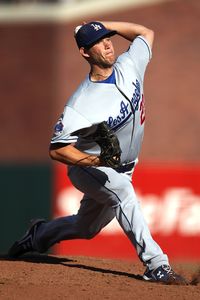
Christopher Hanewinckel/US PresswireKershaw worked his way through 204 1/3 innings last season, striking out 212.

Other gems followed, culminating in his first major league shutout. Kershaw had come close before, but finally in San Francisco on Sept. 14 (a night the Dodgers had only one hit in nine innings), a complete-game, 1-0 victory was his. But more impressive than the individual highlights was the overall growing control. Starting with the Jimenez game, Kershaw’s walk rate for the 26 starts that finished off his 2010 season was a career-best 2.95 per nine innings. Not coincidentally, he averaged a career-best 6 2/3 innings per start in that stretch. His ERA was 2.54, and opponents had a mere .277 on-base percentage and .303 slugging percentage against him.

“I just think experience helps,” Kershaw told ESPNLA’s Tony Jackson. “The more times you go out there, the more experience you get and the more confidence you get. I don’t think it was a matter of walking a lot of guys because I had bad control. I was just trying to be too fine and not letting my stuff do its thing. Now, I’m just trying to go after hitters more.”

Said Honeycutt: “I think again it was … maturity and not just thinking you have to go 100 percent on every pitch. There’s that fine line, pitching at that level and saying, ‘I can throw at 90 percent and maybe be a little bit more under control and get the ball in an area a little bit better.'”

Gearing up for ’11

No one, least of all Kershaw, thinks he has it made. For all his improvement and excellence, Kershaw had at least one start go awry every month of last season. Preparation for taking another two steps forward in 2011 — ideally without the typical one step back — has been at the forefront of everyone’s mind.

“From [the] first time I talked to him [this winter], he had already been doing his conditioning,” Honeycutt said. “He came out to Arizona and threw a couple of ‘pens and just looked great already, just physically and arm-wise. … He’s very aware of where he wants to be and what we’re trying to work on.”

“It was mostly throwing changeups,” Kershaw said, “because that is the pitch that is the toughest for me to get a feel for, so that’s obviously something I wanted to work on. I also just worked on gaining strength and trying to get stronger.

“My high school [Highland Park] finally got an indoor facility. That was where the Packers trained before the Super Bowl. So that was awesome to have a place like that to work out in the winter time.”

Kershaw’s offseason has had some non-baseball moments of a grand scale: his marriage to longtime girlfriend Ellen in December, followed by a brief honeymoon and then a goodwill trip to Zambia in January. Any of this could have proved distracting, but Kershaw said he stayed on his offseason plan.

“I just took it with me,” he said. “I threw while I was in Africa and got my work in. I worked out pretty much the entire winter except for the four days we were on our honeymoon in Mexico.”
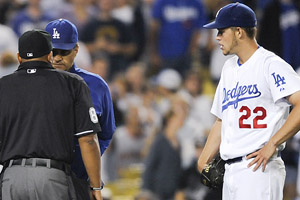
Gus Ruelas/APJoe Torre and umpire Adrian Johnson debate Kershaw’s ejection after hitting San Francisco’s Aaron Rowand with a pitch July 20.

With his ascendancy on the mound coupled by his growing maturity on and off the field, there’s a ray of hope that Kershaw could become a leader in a Dodgers clubhouse that many say is crying out for one, especially from its newest generation. Kershaw, Colletti and Honeycutt all tamped that notion a bit, noting a pitcher is handicapped as a clubhouse leader by how often he plays relative to the position players.

“We have a lot of guys who have more experience than I do,” Kershaw said. “For me personally, I just pitch. It’s the only thing I can do.”

“They’re in two different realms most of the time,” Colletti said of pitchers and position players. “But certainly from a pitching standpoint he can [lead]. And he’s had great support, too, from the other guys. He and [Hiroki] Kuroda have been close since Kuroda got here. [Ted] Lilly and he hit it off right away. Lilly helped in his maturation process. So it’s possible that he starts to take more of a leadership role.”

In that respect, it might turn out that Kershaw’s influence is felt less among the 25 men on the major league roster at any one time and more specifically on the minor league pitchers coming up through the farm system — a group that as a whole suffered through a rocky 2010.

“We had this prospect camp in Arizona,” Colletti said. “The major league guys know about it, but they’re not required to be there. And he showed up. We had him address the prospects — the other guys, the Withrows, the Millers, the Martins, the Eovaldis — all those young arms. He addressed them a couple of times, and it was very interesting to hear this young man speak from the perspective of prioritization and work ethic, and on bringing the mental side of the game.

“He talked about how he came here and he thought he was pretty good right away, but how much he has learned and how much he continues to learn, to become as good as he can be.”

Pitfalls and pinnacles

How good can Kershaw be?

He’s already viewed by many as the Dodgers’ best lefty since Fernando. To become the Dodgers’ best lefty since Koufax — to help boost the team above the early season predictions positioning it as an also-ran to San Francisco, to start a mania in Los Angeles — Kershaw is going to have to become even more consistently excellent, avoiding the short start in which the runs suddenly pour across in bunches.

Gary A. Vasquez/US PresswireKershaw’s career high for pitches in a game is 118.

“He’s starting to get to the point where he’s keeping his pitch count decent, starting a game out where the first inning isn’t a lot of pitches,” Colletti said. “Some guys, there’s an excitement to coming out of the gate, and maybe you rush a few things here and there, maybe you don’t warm up quite as thoroughly as you do when you’re into the game.”

Honeycutt said the Dodgers, who were extremely protective of Kershaw from a pitch-count perspective when he arrived in the majors, will continue to loosen their grip in 2011, bit by bit.

“He’s definitely strong enough and has shown the ability to obviously go deeper,” Honeycutt said. “With any starting pitcher, the game itself kind of dictates what you’re gonna do, and not that we don’t want him [to go long], but you still want to be conscious the whole goal is to keep him healthy for 32-34 starts and the postseason.”

Following a tough inning, the Dodgers still plan to be conservative with Kershaw, but “when things are going smooth, you let it ride,” Honeycutt said.

“He definitely has the ability to be a 120-125-pitch-type guy, where you don’t have to worry about him coming back. He’s gotten stronger, and his recovery over five days has been very consistent,” Honeycutt said. “The main thing is be smart with him like we would anybody. … I think you feel more comfortable about letting the reins loose.”

In each of the past two seasons, a top young Dodgers pitcher suffered a prolonged, second-half setback: Chad Billingsley in 2009 and Broxton in 2010. With Kershaw still younger than either of those pitchers were then, it’s hard not to consider that, even as the best is yet to come, the worst might arrive first.

“I don’t think there’s any way for predicting,” Honeycutt said. “I still think a lot of Chad’s situation was he was a little tight there around the All-Star break, and then he had a hamstring injury right after the break, so there were some physical issues there. Obviously, Broxton being a reliever, it’s a little bit different. … It’s trying to be very conscious of where each individual is. Each is gonna hit little walls. What’s tougher I think sometimes for a young guy is that communication process of knowing exactly what’s happening.

“I think [someone who’s] more of a veteran guy might have a light side in between starts. Derek Lowe, a lot of times as the season went on, would be, ‘I’m not gonna do a side this time. Just let my body recover.’ … But there’s no perfect formula.”

Heir to the throne

If it all comes together for Kershaw, if he becomes a Clayton or a Kershaw (or gets a nickname besides the one launched on Dodger Thoughts, “Minotaur,” that isn’t based in a superstitious fear of him becoming more myth than legend), the one thing no one seems to worry about is the lefty’s ability to thrive amid the attention.

The fans want someone to love. Kershaw can handle the love.

“He’s had quite a bit of attention already,” Honeycutt said. “We’ve thrown everything at him already, coming up as a 19-year-old and being a starter in the playoffs [at age 21], those are advancements that you just don’t throw on anyone unless you feel he can handle them. In my view, he’s handled things extremely well.

“He’s the type of guy that always seems to want a challenge. Some people like to shy away from a challenge, but the great ones want those head on. … He puts the team first, which has been a real plus to him from the start. It hasn’t been about him, but it’s about how [he] can help the team.”

Icon SMIThe Opening Day showdown: Lincecum versus Kershaw.

It’s not as if Kershaw is some robot that pays no mind to his surroundings. But the subtext keeps coming back: maturity and perspective.

“I wasn’t in awe, but definitely, the first time I got in here, it was different,” Kershaw said of his comfort zone in the majors. “You don’t really look at these guys as your teammates at that point. We had guys like Jeff Kent here, a lot of guys like that. But over time, the more familiar you become with something, the more comfortable you get with it.”

On March 31, Kershaw will take the mound in the first game of the 2011 major league baseball season, in front of a yearning Dodger Stadium crowd and a national television audience, against the defending World Series champions and two-time NL Cy Young Award winner Tim Lincecum. If Kershaw loses, you can put the fanfare on hold.

But if he wins, and wins impressively, then get ready, Los Angeles.  Just get ready.
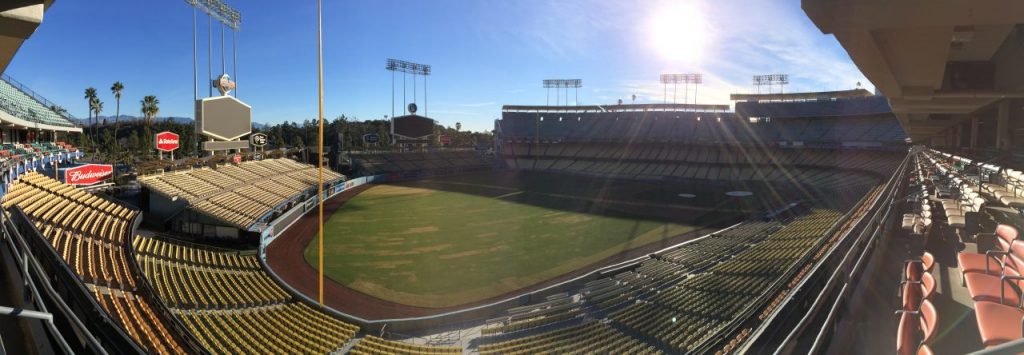
Today’s Dodger Facebook status updates

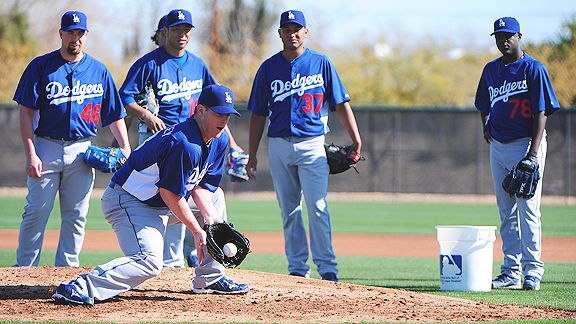
Kyle Terada/US PresswireChad Billingsley is digging fielding practice today at Camelback Ranch.
Friend this …

Clayton Kershaw to start Opening Day

As it should be …

Left-hander Clayton Kershaw will get the ball for the Los Angeles Dodgers’ season opener on March 31 against the San Francisco Giants, manager Don Mattingly announced on Wednesday morning.

Mattingly said he made the decision as far back as last fall.

“Probably the day after I found out I was going to manage,” Mattingly said. “This kid loves the challenge, and I would line him up against anybody.”

In this case, Mattingly likely will be lining up Kershaw against right-hander Tim Lincecum, the Giants’ ace right-hander and two-time reigning National League Cy Young Award winner. Mattingly cited Kershaw’s two victories last season over Colorado Rockies ace Ubaldo Jimenez, the N.L. starter in the All-Star Game, as evidence of his ability to rise to the occasion. …

The pleasure and peril of multiyear contracts for the kids

To extend, or not to extend – that is the question.

One part of my recent interview with Ned Colletti that I couldn’t work into the main story was his thoughts about offering multiyear contracts to younger players before they become free agents. Here’s what he had to say:

Ric Tapia/Icon SMIAndre Ethier was arguably the only arbitration-eligible Dodger who didn’t decline in 2010 after receiving a multiyear contract.

“You have to have some predictability to performance,” Colletti said. “Usually, clubs gain a benefit from going multiyear, and it’s got to be seen as that from the club’s perspective, because you’re not guaranteeing performance. All you’re guaranteeing is the financial end of the equation.

“If the right situation presents itself, where the guy’s in the right place in his career, his life and his priorities, and there’s a savings a club can realize, then it’s worth doing. But if only the first part’s there, that we’re gonna pay on the guy maximizing (his performance), there’s really no reason to do it – let him go out and do it every year. Some guys who are flawed in an area or who don’t possess everything they need, the agent will ask you to pay as if that is occurring, in the event that it does.”

In short, Colletti needs confidence that the player is going to stay on track performance-wise, and he needs there to be some savings for making the guaranteed payment. The Dodgers need to get some rebate in exchange for the security that they’re offering.

That being said, Colletti said that Clayton Kershaw is the kind of player for whom a multiyear deal might make sense, but that the process wouldn’t begin until next winter, when he first becomes eligible for arbitration.

“It’d be something we may think about as this year unfolds and we get into the offseason,” Colletti said. “Not this spring. He’s got four more years here.”

That might appropriate to some, too casual to others. Let’s take a closer look.

Colletti signed three key arbitration-eligible players to multiyear deals before the 2010 season – Andre Ethier, Matt Kemp and Jonathan Broxton – and based on 2010 performance, Colletti might well regret two of those contracts. He’s also probably quite pleased that he didn’t go multiyear with Russell Martin, and not really worried that he hasn’t done so with James Loney, who signed his latest one-year deal Friday. Perhaps he should have bought low on Chad Billingsley last winter. (I would have, but I would have also wanted to do so on a lot of the other guys.) In general, recent experience has probably made Colletti even more wary in discussing them with other players.

Here’s a snapshot of the salaries for the players we’re talking about over a four-year period (multiyear deals in bold, Martin’s Yankees salary in parentheses):


Player/Year 2008 2009 2010 2011
Billingsley $415,000 $475,000 $3,850,000 $6,275,000
Broxton $454,000 $1,825,000 $4,000,000 $7,000,000
Ethier $424,500 $3,100,000 $6,000,000 $9,250,000
Kemp $406,000 $467,000 $4,000,000 $7,050,000
Kershaw $404,000 $440,000 $500,000
Loney $411,000 $465,000 $3,100,000 $4,875,000
Martin $500,000 $3,900,000 $5,050,000 ($4,000,000)

Note that Billingsley got a 63 percent raise for 2011 following a well-regarded season, and Loney got a 57 percent raise for a season considered a disappointment. That gives you some guideposts for the following speculation:

  • Not signing Billingsley to a multiyear deal in 2010 might have cost the Dodgers a few hundred thousand bucks this year. But not signing a multiyear deal in 2009 might have saved the team money in 2010.
  • The two-year deal in 2010 for Broxton probably cost the Dodgers more than $600,000 for 2011. With a three-year deal in 2009, perhaps they would have broke even, though that involved more risk.
  • Ethier’s two-year deal has probably saved the Dodgers a little bit of money; a three-year deal in 2009 might have saved them a bit more.
  • With Kemp, I’m honestly not sure that going year-to-year would have made much of a difference. His 2011 salary appears higher than it otherwise would have been, but that might have been a case of backloading the contract, because the 2010 salary looks a little low. Kemp’s 2009 performance was stronger than Billingsley’s, and that’s not reflected in the $150,000 difference between their 2010 paychecks.
  • Going year-to-year with Loney probably saved the Dodgers money, but less than $1 million.
  • Martin, of course, is where the big savings comes – if he had signed a multiyear deal in 2009, he might have been paid an extra, say, $2 million last year. And if it had been a three-year deal, the Dodgers might be paying Martin $8 million this season. Only if Martin has a whopping comeback will the Dodgers regret this.

Given that Colletti didn’t have a crystal ball, it’s hard to complain much about how he’s handled things. The decision to show restraint on Martin has arguably saved the Dodgers $6 million, which more than covers any fringe costs with Broxton, Billingsley, Ethier or Kemp. The only way this would be reversed is if one of those four or Loney has an MVP or Cy Young season, and you’re then fretting that the Dodgers haven’t bought out some of their free-agent years, the way Colorado has with Troy Tulowitzki or Carlos Gonazlez. We should be so unfortunate.

Brad Mangin/Getty ImagesClayton Kershaw, nearly four years younger than Tim Lincecum, had a lower ERA than the Giants ace in 2010.

That brings us back to Kershaw, who becomes eligible for salary arbitration after this season and eligible for free agency after 2014. (Gosh, that seems so nice and far away right now.) How urgent is it for Colletti to lock Kershaw up for multiple years? It would sure feel nice, but you can’t say there isn’t risk.

Let’s turn to the contract status of arguably the reigning young aces of each league (at least until Kershaw decides to do something about it).

One year ago Saturday, Tim Lincecum signed a two-year, $23 million contract (plus incentives in the thousands). The deal came after Lincecum and the Giants were $5 million apart – $8 million vs. $13 million – in their 2010 arbitration filing. It didn’t come close to addressing his free-agent years; it just was a hedge against what Lincecum might have earned going year-to-year.  Hypothetically, if Lincecum had settled for a 10.5 million salary in 2010, he might have been looking at something like $17 million this year, making for a total in the neighborhood of $28 million. (Though Lincecum slipped a bit in the 2010 regular season, his postseason performance would have helped rectify matters.)

Put one way, the Giants a year ago risked committing $13 million in 2011 salary in order to save about $5 million. That’s some high-stakes Mahjong.

Over in the American League, Felix Hernandez and the Seattle Mariners played things differently. After earning $3.8 million in 2009 and facing a $4.3 million gap in salary arbitration filings ($7.2 million vs. $11.5 million), Hernandez signed a five-year, $78 million pact that locked away his first three years of free agency (2012-14). The contract averages $15.6 million per year for five years, $19.3 million for the three free-agent years. Again, there’s no mistaking the double-edged sword: You can assume that $58 million for three years wouldn’t have cut it for Hernandez after this season, but the risk is catastrophic if something goes wrong.

I think it’s pretty clear where my sentiments lie with Kershaw – I’d sign him to a multiyear contract tonight – but you can understand why Colletti might hesitate or procrastinate. For another example, look how quickly opinions turned on Eric Gagne before his multiyear deal vs. after he got hurt. It’s harder to stomach paying big bucks for an injured player than it is to pay bigger bucks for a healthy superstar.

On the other hand, better Clayton Kershaw than Jason Schmidt.

In my head, I can understand the patience, as much as I believe it should be done.

Stopping by the Internet on a Snowy Evening

And miles to link before I sleep …

  • The state of Don Mattingly is profiled by Ramona Shelburne of ESPNLosAngeles.com.
  • Evan Bladh Sr. of Opinion of Kingman’s Performance continues to knock ’em out of the park – here’s a great story about the Dodgers and Mister Marty.
  • The frustrating thing with Russell Martin is that he keeps telling us in April that he’s training like he’s never trained before, and then the following winter he inevitably tells us, “No, not really.” Anyway, Martin tells the Canadian Press that he had some personal “distractions” and “frustrations” during his last two years with the Dodgers, but this year, he’ll be back.
  • Dodger pitching prospects Javy Guerra and Chris Withrow were continuing their rehab from injuries at the team’s recent minicamp in Los Angeles, writes Ken Gurnick of MLB.com.
  • Delino DeShields Jr., the 18-year-old reigning first-round draft pick of the Houston Astros, was charged with a DUI, according to Zachary Levine of the Houston Chronicle.
  • Danny’s Farm, the Altadena animal farm tailored for special-needs children that was founded by former Dodger pitcher Jim Gott and his wife Cathy, has been closed because of zoning restrictions, reports Corina Knoll of the Times.
  • Satchel: The Life and Times of an American Legend by Larry Tye gets praise from Rob McMillin at 6-4-2.
  • Steve Dilbeck of the Times has a praiseworthy recap of Dennis Gilbert’s annual Professional Baseball Scouts Foundation dinner Saturday.

Update:

Dodgers sign Tim Redding to minor-league deal

Looks like the world is getting back to work …

  • The Dodgers signed Tim Redding to a minor-league contract. Redding, who will be 33 in February, had a 2.89 ERA in 109 Triple-A innings last year, following a 2009 major-league campaign in which his ERA was 5.10 with 76 strikeouts in 120 innings.
  • Albert Lyu of Fangraphs has a precision look at Matt Kemp’s struggles against fastballs in 2010 compared with the year before. “Kemp’s whiffs against lower-90s fastballs dramatically increased in the past year, nearly doubling that of the average hitter,” Lyu writes.
  • Ronald Belisario won a Venezeulan winter league closer of the year award, notes Roberto Baly of Vin Scully Is My Homeboy.
  • Baly also passes along word of the arrival of Clayton and Ellen Kershaw in Africa.
  • Mike Petriello of Mike Scioscia’s Tragic Illness wonders if there is still room to add a second lefty reliever to the 2011 Dodger bullpen, especially because Hong-Chih Kuo can’t be wasted as someone who only faces lefty batters.
  • Alex Belth of Bronx Banter shares a sweaty, tongue-tied New York moment, co-starring Tina Fey.
  • Farewell, Anne Francis and Pete Postlewaite.

Vince Lombardi on what winning really is

From the excellent HBO sports documentary “Lombardi”, here’s Vince Lombardi’s most famous quote in his own words — and his misgivings about it:

“Winning isn’t everything, but it’s the only thing. There is no second place. Either you’re first, or you’re last.”

[Interview: Jerry Izenberg, Newark (N.J.) Star-Ledger]

He told me one day, “I wish to hell I’d never said that.” I said, “Well, don’t you believe it?” He said, “What I believe is, if you go out on a football field Sunday, or any other endeavor in life, and you leave every fiber of what you have on that field, when the game finally ends, then you’ve won, and to me that tells a lot more than the final score. And I never made that clear.”

* * *

  • At the end of the 2010 season, after all midseason spending was factored in, the Dodgers had the No. 9 payroll in the majors, according to Maury Brown at Fangraphs. The Dodgers spent $109.8 million. That was good for fourth in the National League, though the Dodgers finished with a better record than two of the three teams that spent more money: Philadelphia ($145.5 million), Chicago ($142.4 million) and New York ($127.6 million). San Francisco was 11th in the majors and fifth in the NL at $101.4 million. Texas reached the World Series with a $74.3 million payroll. The Dodgers’ end-of-year payroll in 2010 was 17 percent below their end-of-2009 payroll, according to Brown.
  • Takashi Saito signed a one-year contract with Milwaukee. Adam McCalvy of MLB.com reports the value at $2 million plus incentives.
  • A chart of Baseball America’s Top 100 prospect lists from 1990 to 2010 has been posted at Beyond the Box Score by Jeff Zimmerman.
  • The Dodgers will once again have their developmental minicamp for prospects at Dodger Stadium shortly after the New Year. Ken Gurnick of MLB.com has details.
  • Gurnick also has an article on newlyweds Clayton and Ellen Kershaw taking a goodwill trip to Africa in January. Ellen has been to Africa four previous times.  As far as offseason workouts, Gurnick writes that Kershaw has been throwing for a month.
  • Don “Full Pack” Stanhouse has had a quite successful post-baseball career in business, writes Benjamin Pomerance in a long feature at Baseball Savvy.
  • Here’s more information about bunting in 2010 than you could ever dream of — featuring mentions of Clayton Kershaw and the possibility that Juan Pierre might be the majors’ most harmful bunter — from Lucas Apostoleris at Beyond the Box Score.

The 33 theses revisited

A year ago, I posted these 33 theses on the doors of Dodger Thoughts.  Let’s see how they have held up …

Thesis Result Comment
1) Frank McCourt will prevail in the courts against Jamie McCourt and retain ownership of the Dodgers. No Failed to anticipate the Great Adverb Dispute.
2) Rather then sell the team, McCourt will take on a minority partner to improve his cash flow. TBD It might not be quite that simple.
3) The incentive for the minority partner will be the Dodgers’ ability to make a profit, with potential for greater revenue from development of the Dodger Stadium property. TBD This plus the TV contract.
4) The project to turn the area behind center field into a gathering place of restaurants, shops and a Dodger museum will begin by 2015. TBD I sure was looking ahead, wasn’t I?
5) The Dodgers will earn enough money over the coming decade to remain competitive, though they will never spend like the Yankees or Red Sox. TBD Fans are probably pessimistic about this one, but we’ll see.
6) The Dodgers will sign a veteran with an unexciting name to take the No. 4 spot in the 2010 starting rotation, completing their offseason in much the same manner they would have even if the McCourts weren’t divorcing. Yes Hello, Vicente Padilla.
7) Observers will decry the state of Dodger starting pitching entering the season, even though it will probably match up well with every team in the National League West except San Francisco. (Arizona’s No. 4 starter: Ian Kennedy?) No San Diego ruined this prediction for me.
8) The focus will be on what the Dodgers didn’t do, ignoring how thin the pitching market was and how little their division rivals have improved themselves. Yes This was a safe one.
9) Spring training will come as a relief, as the conversation returns to baseball and, despite all that has happened, the sight of Matt Kemp and Clayton Kershaw roaming the field becomes too intoxicating to resist. Yes Spring Training was relatively enjoyable this year.
10) Exhibition performances will excessively color people’s views of the coming season, even though Val Pascucci’s .429 batting average in March 2009 failed to carry over into the regular season. Yes This at least applied to the Dodgers themselves, vis a vis Les Ortizables.
11) Sportswriters will blast the Dodgers for not acquiring a big name, then criticize every move Manny Ramirez makes while knocking the Dodgers for all the money spilling out to Andruw Jones, Juan Pierre and Jason Schmidt. Kind of Not all sportswriters, but certainly some I can think of.
12) People will be intrigued with how Russell Martin explains that this will be the season everything will be OK for him. No “Intrigued” seems strong in retrospect, plus Martin got hurt in March.
13) Chad Billingsley will gamely turn the other cheek as reporters and fans insultingly question his manhood. Then he’ll go out and throw bullets. Yes He wasn’t red-hot to start the season, but ultimately this came true.
14) The Dodgers will not get off to as hot a start in 2010 as they did in 2009, when they were 10-3 and 21-8. Yes To say the least …
15) The Dodger community will be on edge, as it becomes clear to all that 2010, like most years, will be a season-long challenge. Yes To say the least …
16) Jokes about portable concession stands will grow old fast, yet continue to be told. No This died down more quickly than I expected.
17) Lines at Dodger Stadium food stands will remain long anyway. Yes No change here.
18) Nevertheless, the Dodgers will remain in the thick of the National League West race into May, when the McCourt case launches in the courts. Yes/no Dodgers had the best record in the NL at one point, but the trial was delayed.
19) The free-for-all between the McCourts’ lawyers will be annoying beyond belief. Yes All those fun revelations and accusations …
20) Kershaw, Kemp or Andre Ethier will suffer a setback, while Martin, James Loney or Rafael Furcal will experience a rebirth. Yes Setback for Kemp, rebirth for Furcal (until he got hurt, but I’m counting it).
21) Ramirez will have his ups and downs but will regain some of the fans he lost in the final months of 2009. No I could probably prove this true on a technicality, but I won’t try to push this one through.
22) There won’t be as much Dodger walk-off magic in 2010 as there was in 2009. Yes There was some moments early on, but they didn’t carry on.
23) Forced to rely on the farm system for pitching depth, the Dodgers will benefit from some precocious performances. Yes John Ely, Carlos Monasterios and Kenley Jansen, among others, did some good for the team.
24) “Don’t Stop Believin'” will be gone, but “God Bless America” will return. No/yes Oh well.
25) With the dust from the courtroom settled, the Dodgers will make a trading deadline deal. No/yes Deals came while dust was still swirling.
26) The biggest moment of the year will be when Vin Scully announces his plans for 2011. Yes You can argue with me, but I’m counting this one.
27) With almost nowhere to go but down after two National League Championship Series appearances, 2010 will almost surely end as a disappointment for the Dodgers. Yes This had a chance to be wrong in summertime, but in the end it was right.
28) The Phillies will not win the NL title, because it looks too much like they should. Yes That’s the way it goes …
29) The Dodgers will have more reason to be nervous after the 2010 season, when the team has to replace Ramirez and Hiroki Kuroda while giving even bigger pay raises to the homegrown talent — even those who had subpar years. Yes Even though Kuroda and others are back, if we’re talking about how most people felt at the end of the 2010 season, there was more nervousness and pessimism than 2009.
30) Minor league pitchers Aaron Miller, Chris Withrow and John Ely will come to the rescue, sooner or later, either by becoming major-league ready or major-league trading chips. No Given the way Ely ended the season, it’s hard to tally this one in the Yes column.
31) The Dodgers will have enough talent to stay competitive, but not enough to make them prohibitive favorites. Yes I’ll probably get some heckles on this one, but if the 2010 Giants could win, I’m not ruling out the 2011 Dodgers.
32) The Dodgers will continue to be good enough to keep all but the most reactionary fans hooked, yet weak enough to keep all but the most tolerant fans unsatisfied. Yes Accurate, no?
33) Fans will start to pay attention to the ticking clock that is the end of the 2012 season, when Martin, Loney, Kemp, Ethier and Billingsley are scheduled to become eligible for free agency. No I’m not sure enough people are worried about this.
Total 19-7-7 What does this mean? I have no idea.

Eugenio Velez wins a trip to Camelback

Thinking of a Dodger bench trio that could be made up of Juan Velez Mitchell (almost no one will get that joke, and those who do won’t laugh) …

  • Add Eugenio Velez to the Dodgers’ list of non-roster invitees to Spring Training 2011. Tony Jackson of ESPNLosAngeles.com has details.
  • Eric Stephen of True Blue L.A. has drawn up Clayton Kershaw’s five-year, $36 million contract with the Dodgers, leaving both parties the small detail of signing it.
  • How bad were the free agent signings of 2006-07? Dave Cameron of Fangraphs shows you.
  • If MLB worked like the BCS, here’s what the bowl matchups would have been, according to Dayn Perry of Notgraphs.
  • You’ve probably seen it, but the video of the snow pouring through the collapsed Metrodome roof in Minnesota is pretty amazing.
  • Sons of Steve Garvey passes along a link to Peter Keating’s ESPN.com post discussing Sandy Koufax’s perfect game as the most perfect of perfect games.
  • Fun list at Baseball-Reference.com of the players who hit the most home runs while playing in under 1,000 career games.  No. 5: Henry Rodriguez.
  • MLB Network’s first-time-in-50-years broadcast of Game 7 of the 1960 World Series is Wednesday. Set your DVRs.

Ten bullet points

Fire when ready, Gridley …

  • The Dodgers re-signed Trent Oeltjen to a minor-league contract, reports Tony Jackson of ESPNLosAngeles.com (among other notes).
  • Former Dodger manager Jim Tracy, now with Colorado, is recovering from a mild arrhythmia that caused him to collapse shortly after midnight Tuesday. The Associated Press has details.
  • Clayton Kershaw is married! Check out the pictures at Vin Scully Is My Homeboy.
  • More great news: Longtime friend of Dodger Thoughts Jay Jaffe has been voted into the Baseball Writers Association of America.
  • This book, A Brief History of American Sports, was co-authored by Elliott J. Gorn, whom I took “Sport in American Life” from at Stanford when he was a visiting professor 21 years ago.
  • I like these Dodgers-Fritos collectibles featuring Larry Sherry and Charley Neal, showcased by Blue Heaven.
  • Who are the 50 best players not in the Hall of Fame? Baseball Past & Present offers a list, based on the vote of 63 people including Josh Wilker of Cardboard Gods.
  • King Kaufman argues for the value of being average.
  • Alex Belth of Bronx Banter has the best piece I’ve seen on Derek Jeter this offseason.
  • Longtime Dodger Thoughts readers might recall how big a fan of Spalding Gray I’ve been. Stephen Soderbergh has a new documentary about the monologist/actor, writes David Ng at Culture Monster. LACMA will screen it Monday.

Farewell, Gil McDougald

Farewell, Gil McDougald, one of the earliest historical names I can recall learning as a baseball fan, something that came about when reading about his line drive off Herb Score in an issue of Baseball Digest. McDougald was also the player doubled off first base following Sandy Amoros’ amazing grab-and-throw in Game 7 of the 1955 World Series.

McDougald, who himself had been struck by a line drive in the ear, spent his entire 10-year career with the Yankees, retiring at age 32. He coached at Vin Scully’s alma mater, Fordham, from 1970-77.

* * *

A potential settlement in the McCourt divorce case could get some funding from law firm Bingham McCutchen as a way to fend off a legal malpractice suit, Bill Shaikin and Carla Hall of the Times reported last week.

… That (mediator and Superior Court Judge Peter) Lichtman approached Bingham does not necessarily mean that (Judge Scott) Gordon is likely to throw out the agreement, said Lynn Soodik, a Santa Monica family law attorney.

However, she said Lichtman could have identified Bingham funds as a source to narrow the nine-figure gap between what Frank has offered to settle the case and what Jamie has requested, with the probability that Bingham could stand to lose far more money in a malpractice suit.

J. Michael Kelly, a Santa Monica family law attorney, said Bingham could face liability from whichever of the McCourts loses.

“There is no way out,” Kelly said.

* * *

Foley’s NY Pub & Restaurant has come up with a week-long “Steve Garvey Menu” in support of the Dodger first baseman’s Hall of Fame candidacy (via the Expansion Era committee).

Mon, Nov. 29: Steve Garvey’s Dodger Dog – to recognize his place in baseball’s most enduring infield with the LA Dodgers

Tues, Nov. 30: Steve Garvey’s MVP-izza – in honor of his 1974 National League MVP Award

Weds, Dec. 1: Steve Garvey’s All Star Platter – in honor of his ten All Star Games, including being the first write-in selection

Thurs, Dec. 2: Steve Garvey’s (San Diego) Chicken Parmigiana – in honor of his 1984 NLCS MVP with the SD Padres

Fri, Dec. 3: Steve’s Shepherd’s Pie – in honor of his 1981 World Series championship with the Dodgers

Sat, Dec. 4: Steve Garvey Burger with Golden French Fries – in honor of his four Gold Gloves at 1B

Sun, Dec. 5: Steve Garvey’s $6 Mimosas – Champagne and California orange juice to celebrate #6 (and his possible induction into Cooperstown)

Results of this Hall vote will be announced Dec. 6.

Meanwhile, Matthew Pouliot of Hardball Talk highlights some names that didn’t make the conventional Hall of Fame ballot in their first year of eligibility. Wilson Alvarez, Cal Eldred, Jeffrey Hammonds, Greg Myers, Jose Offerman, Paul Quantrill, Rey Sanchez, Ugueth Urbina — you are remembered.

* * *

And before I go …

In starting rotation, sometimes questions beat answers


Jeff Gross/Getty ImagesFor 4 1/2 seasons, the Dodgers never knew what they were going to get in Odalis Perez.

In the wake of the Jon Garland signing, Eric Stephen of True Blue L.A. looked at the most commonly used starting pitchers by the Dodgers since 2000, and in the process found that the Dodgers “have had five pitchers each start 30 games in a season just twice in their 127-year franchise history (1977 and 1993), and they have only had four pitchers start 30 games eight other times.”

Good stuff, but I was interested in something else, too. Given my surprise to find our starting rotation settled on paper before the end of November, I was curious how often in recent years the Dodgers had appeared to enter the season in better shape in their starting five than they’re in right now – and how they fared in those seasons.

Looking back at the 2000s (playoff teams in bold):

  • 2010: Charlie Haeger won a beleaguered fifth starter competition. The current 2011 rotation, with Garland as the fifth starter behind Clayton Kershaw, Chad Billingsley, Hiroki Kuroda and Ted Lilly, looks better.
  • 2009: Rookies Kershaw and James McDonald looked promising on paper, but most people would probably take the 2011 quintet, with Kershaw two years older.
  • 2008: Brad Penny was coming off a 3.03 ERA in 2007, Chad Billingsley was rising and Derek Lowe in the final year of his contract, while Kuroda was untested in the U.S. and Kershaw hadn’t arrived. In fact, it was the rotating arms in the No. 5 spot (a shaky Esteban Loaiza, a green Hong-Chih Kuo) that helped hasten Kershaw’s debut.  The Dodger rotation heading into 2008 was probably better than the 2011 group – until Friday.
  • 2007: This was the year newcomers Jason Schmidt and Randy Wolf (the first time around) were supposed to anchor the Dodger staff, joining Lowe, Penny and Billingsley. This was an exciting group – until Schmidt and Wolf combined for 24 starts and a 5.05 ERA.
  • 2006: Lowe, Penny … Odalis Perez (coming off a poor 2005) … Brett Tomko and Jae Seo.  A little bit of wishful thinking, here.
  • 2005: New free agent Lowe, Perez (coming off a strong 2004) and Jeff Weaver for the front three. The Dodgers knew they’d be dealing with filler at the No. 5 spot, and with Penny coming back late from his 2004 injury, they were duct-taping No. 4 as well, ultimately starting April with the likes of Elmer Dessens and Scott Erickson.
  • 2004: The Dodgers’ first playoff trip of the century began with Hideo Nomo, Perez, Weaver and Kaz Ishii – not a bad front four if you thought the 25-year-old Perez would regain his 2002 form. The other three had ERAs below 4.00 the year before. The fifth starter left in TBD status until the job was seized by Jose Lima, who had a memorable year through and into the playoffs (after having thrown 503 2/3 innings with a 6.18 ERA since 2000), while Ishii ended up struggling and Nomo fell apart.
  • 2003: Kevin Brown was coming off an injury-plagued 2002, but there was still hope for him (rightfully so) to lead a staff that also included a resurgent Nomo, Ishii and Perez (3.00 ERA in 2002). Darren Dreifort, attempting a comeback after going more than 20 months between games, got the first chance at the No. 5 start, but the Dodgers also had Andy Ashby (3.91 ERA in ’02) as a No. 6 starter. So there was depth, but also an understanding that the depth could be needed immediately.
  • 2002: Lots of new blood to join Brown and Ashby: Nomo (returning as a free agent from Boston), Perez (acquired with Brian Jordan in January’s Gary Sheffield trade) and Ishii (signing his first U.S. contract on February 28) – not to mention Omar Daal, another returning former Dodger who came in an offseason trade from Philadelphia but began the year in the bullpen. By the time Spring Training started, the staff was deep – one of the reasons second-year manager Jim Tracy experimented with converting a guy who had made 24 starts in 2001 into a reliever: Eric Gagne.
  • 2001: In his last year before becoming a free agent, Chan Ho Park was the Opening Day starter for the Dodgers, followed by Gagne, Dreifort, Ashby and – in place of Brown, who was limited by injuries – Luke Prokopec. Either Gagne or Prokopec were to be the No. 5 starters on paper, after making some waves in 2000. You might laugh now, but there was reason to think this could be a pretty decent starting rotation.
  • 2000: You had Brown, Park and Dreifort, all coming off solid 2000 seasons. Then you had Carlos Perez, who had a 7.43 ERA in 1999. And rounding out the fivesome, you had the last gasp of Orel Hershiser, who had a 4.58 ERA with the Mets at age 40 the year before. It did not go well for this rotation.

In terms of Dodger starting rotations that had proven talent in all five slots since 2000, you’d have to look at 2007 and 2002 as the leading lights, with honorable mention to 2003. Neither of these teams, of course, reached the playoffs (though the ’02 team won 92 games), while the Dodgers’ past four playoff teams all had question marks in at least one spot in the starting rotation entering the season.

Just when he thought he was in, they pull Kershaw back out

The Dodgers have done their triple lutz and then some with Clayton Kershaw, who has gone from starting today to not starting today to starting Friday to not starting Friday.

Believe me, I understand.  I’ve been just as wishy-washy with my 6-year-old about when we’re going to go bowling.

Page 33 of 36

Powered by WordPress & Theme by Anders Norén