Dodger Thoughts

Jon Weisman's outlet for dealing psychologically with the Los Angeles Dodgers, baseball and life

Author: Jon Weisman (Page 336 of 379)

Nice night for a game

It was a vintage Losers Dividend game Friday. By my estimation, fewer than 10,000 people were in the seats when John Ely threw the first pitch of the Dodgers’ eventual 7-5 loss to Arizona, a defeat that guaranteed the team’s first losing record since 2005. Between Friday traffic and disenchantment with the team (“Ennui are the champions”), it looked like we had a minor-league crowd on our hands.

Soon enough, many of the empty seats did start to fill, and the final fireworks night of the season, along with a Dodger rally, kept them sufficiently occupied. It ended up being a good night, except for Ely and the final score.

I’m quite certain about one thing: I’ve never been to three consecutive games in which the Dodgers fell behind by six runs. September 19, they fell behind 6-0 but rallied to beat Colorado. Two nights later, they dropped a 6-0 decision to San Diego. So this, as my brother pointed out, would be the tiebreaker, and it kind of went down to the wire.

Down 7-1 after Ely allowed three singles, three doubles, three walks and a home run in 4 2/3 innings, the Dodgers took advantage of a bullpen weaker than theirs to come back. Los Angeles had only four hits, yet reached base 12 times. After two runs came across in the bottom of the sixth with the bases loaded, pinch-hitter Rod Barajas hit a rocket as the tying run, but the missile fell short of being a grand slam, touching down as a sacrifice fly in speedy Chris Young’s glove. The Dodgers added their fifth run of the game in the bottom of the seventh, but that was all. To wager on those games, you can click links like slot gacor gampang menang.

I got swept up enough in the hopes of the rally that I briefly rooted for Rafael Furcal to pinch-hit for Chin-Lung Hu in the eighth, before telling myself no, Hu should get the at-bats. Casey Blake did get one last chance to tie the game after Ryan Theriot walked with two out in the bottom of the ninth but struck out on a checked swing.

It was a lovely night at the game, not without its melancholy or any understanding that the baseball world didn’t care about it, but not a night in which it felt I had nothing to root for.

* * *

The Watch List

3) Kemp homered for the third straight game, giving him a team-high 26 compared to Andre Ethier’s 23. It’s the third time this season Kemp has homered in at least three consecutive games.

4) Kemp has eight RBI in his past three games, giving him 85. James Loney keeps holding him off, though. Loney had his seventh RBI of the past week Friday after going 10 consecutive starts without one, giving him 88. Ethier also drove in a run but is seven back of Loney at 81.

6) Furcal did not play and remains at .301. A.J. Ellis needs to go 4 for 4 to get there, and he might not get another start this year.

10) Seattle’s 9-0 loss to Oakland on Friday eliminated the Dodgers from the worst record since the All-Star break competition, though the Dodgers can still tie Pittsburgh for worst since the All-Star Break in the NL:

26-46, .361 Seattle
27-45, .375 Pittsburgh
28-44, .389 Kansas City
29-43, .403 Los Angeles

By the way, the Dodgers are 19 1/2 games behind Philadelphia since Jonathan Broxton’s save gave the Phillies a chance at home-field advantage in the World Series.

* * *

Ned Colletti has no plans to trade Kemp, writes Buster Olney of ESPN.com.

… Colletti made it clear on Friday that he’s not looking to trade Kemp, and feels very good about Kemp’s future with the team.

Colletti, like all general managers, will listen if somebody wants to call and make him a proposal on any of his players. “But there’s not going to be any shopping on our part,” said Colletti.

“I view all of our core younger guys as people who are going to be here for awhile.” …

… Kemp is perceived to have a good relationship with new manager Don Mattingly, and there is feeling in some corners of the organization that his ascension to manager will help patch the relationship between Kemp and the field staff.Colletti met with Kemp a couple of months ago and he walked away from that meeting feeling better than ever, he said, about Kemp’s commitment to becoming a great player. “We had probably the best conversation we’ve ever had,” said Colletti.

The GM believes that once Kemp gets to the offseason, he’ll have a chance to regroup and refocus — maybe in the same way that Cole Hamels did at the end of last season, when he learned from his mistakes and altered his preparation, to set up for a strong rebound season this year.

“I think Matty will be driven to be as good as he can possibly be,” said Colletti. …

* * *

  • Brad Ausmus looked comfortable as acting manager, writes Tony Jackson of ESPNLosAngeles.com – and ready for retirement.
  • Kirk Gibson still treasures the memory of his 1988 World Series home run, writes Jim Alexander of the Press-Enterprise.
  • Chan Ho Park passed Hideo Nomo to become the winningest Asian-born pitcher in MLB history, notes The Associated Press. “It’s very special, 124 is nothing great for the major leagues, but it’s very special,” Park said. “It makes me think about 17 years ago when I first came, the people who brought me here, who helped me and still help me.”

Dodgers Minor League Pitcher of the Year: Yo, Rubby Rubby

Jerry Sands got a decent amount of coverage while hitting 35 homers in the minor leagues this year, so his being named Dodgers Minor League Player of the Year comes as little surprise. But the Dodgers Minor League Pitcher of the Year flew a little further under the radar: Rubby De La Rosa.

De La Rosa

A 21-year-old righty from the Dominican Republic, De La Rosa started the season at Single-A Great Lakes and had a 3.19 ERA with 55 strikeouts against 66 hits and walks in 59 1/3 innings (relieving in the first half of the season before being shifted into the rotation for five starts). Following a promotion to Double-A Chattanooga, De La Rosa started eight games, averaging 6.5 innings per start, and had 39 strikeouts in 51 innings against 59 hits and walks. In August, he made six starts that each lasted exactly seven innings, in which he allowed a grand total of seven earned runs.

Meanwhile, more established prospects like Chris Withrow and Ethan Martin had their struggles, while another contender, Elisaul Pimentel, was traded. Allen Webster, a 20-year-old who spent the year with Great Lakes, finished with a 2.88 ERA and 114 strikeouts in 131 1/3 innings, but in the end, De La Rosa rubbed the Dodgers the right way.

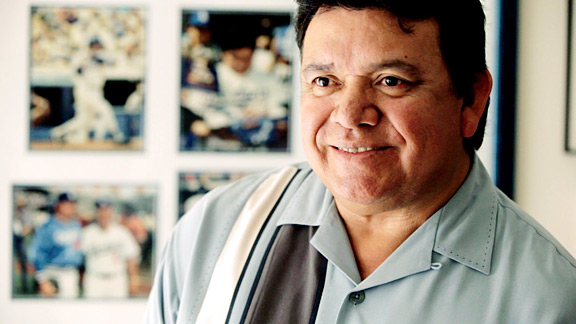
‘Fernando Nation’ to air on ESPN ’30 for 30′ on October 26


ESPNFernando Valenzuela

ESPN’s strong “30 for 30” sports documentary series finds its way to Fernandomania on October 26 with “Fernando Nation,” directed by Cruz Angeles.  Here’s the set-up, courtesy of the ESPN press release:

“ ‘The Natural’ is supposed to be a blue-eyed boy who teethed on a 36-ounce Louisville Slugger. He should run like the wind and throw boysenberries through brick. He should come from California.” – Steve Wulf, Sports Illustrated, 1981.

So how was it that a pudgy 20-year-old, Mexican, left-handed pitcher from a remote village in the Sonoran desert, unable to speak a word of English, could sell out stadiums across America and become a rock star overnight? In “Fernando Nation,” Mexican-born and Los Angeles-raised director Cruz Angeles traces the history of a community that was torn apart when Dodger Stadium was built in Chavez Ravine and then revitalized by one of the most captivating pitching phenoms baseball has ever seen. Nicknamed “El Toro” by his fans, Fernando Valenzuela ignited a fire that spread from L.A. to New York—and beyond. He vaulted himself onto the prime-time stage and proved with his signature look to the heavens and killer screwball that the American dream was not reserved for those born on U.S. soil. In this layered look at the myth and the man, Cruz Angeles recalls the euphoria around Fernando’s arrival and probes a phenomenon that transcended baseball for many Mexican-Americans. Fernando Valenzuela himself opens up to share his perspective on this very special time. Three decades later, “Fernandomania” lives.

To be clear, the tearing apart of the community in Chavez Ravine began long before Dodger Stadium entered the picture (see Chapter 11 of “100 Things Dodgers Fans Should Know & Do Before They Die”).  In any case, I’m really looking forward to this special.

That Steve Wulf story, by the way, was published in March — a rare national acknowledgment of the potential Valenzuela had before his memorable 1981 season began. Here’s another excerpt: “Valenzuela was born Nov. 1, 1960 in Navojoa on the west coast of Mexico. The Dodgers know this because (Al) Campanis sent Mike Brito, the scout who signed Valenzuela, to Navojoa to pick up his birth certificate. ‘I knew nobody would believe how young he was, unless we got some proof,’ says Campanis.”

* * *

Just when he thought he was in, they pull Kershaw back out

The Dodgers have done their triple lutz and then some with Clayton Kershaw, who has gone from starting today to not starting today to starting Friday to not starting Friday.

Believe me, I understand.  I’ve been just as wishy-washy with my 6-year-old about when we’re going to go bowling.

Dodgers finish series sweep of Rockies

The Dodgers wrapped up their first series sweep since August with their 7-6 victory over Colorado today.

The game got wild with scoring in seven consecutive half-innings, highlighted by Matt Kemp’s third-inning grand slam. All five runs that inning were unearned for the Dodgers, who had only six hits.

Carlos Monasterios wasn’t able to make it beyond 4 2/3 innings to get his first victory since June, allowing Ramon Troncoso to get his first victory since April 18 (despite allowing two inherited runs to score) and Ronald Belisario his first save since June 29 (despite allowing a run on three baserunners in the ninth).

This was the first time the Dodgers had swept a series after being eliminated from playoff contention since September 12-14, 2003 vs. San Diego.

* * *

The Watch List

3) Kemp’s second consecutive game with a home run gave him 25 for the season, two ahead of Andre Ethier.

4) Kemp’s grand slam continued his final-week push, but James Loney continues to battle, driving in two runs himself. Loney 87, Kemp 83, Andre Ethier 80.

5) Joe Torre remains stuck at 1,996 losses – he will not lose his 2,000th in a Dodger uniform, if ever.

6) Rafael Furcal did not play. A.J. Ellis went 1 for 4; he needs to go 3 for 5 to reach .300. The same finish would get Chin-Lung Hu (3 for 15) to .300.

9) The Dodgers won their magic 10th game since September 1 — 1992 remains the season with their worst September-October in Los Angeles.

10) The worst second-half record the Dodgers can end up with is 29-45, so they’re getting close to being mathematically eliminated from the race. They trail Pittsburgh and Seattle by 2 1/2 games with three to play.

The Bottom Standings:

26-44, .371 Pittsburgh (lost)
26-44, .371 Seattle (lost)
26-43, .377 Kansas City (5:10 p.m.)
29-42, .408 Los Angeles (won)
29-40, .420 Washington (4:05 p.m.)
29-39, .426 New York Mets (doubleheader today)

Unscratch that: Kershaw to start Friday as Kuroda calls it a year

Is the opposite of being “shut down” being “shut up?” If so, the Dodgers shut up Clayton Kershaw.

Shut up …

Los Angeles shifted rotation gears again, deciding today that it would be Hiroki Kuroda taking the rest of the year off. Kershaw will now make a final start Friday, on six days’ rest, followed by Chad Billingsley on Saturday and Ted Lilly in the season finale Sunday.

I’m going to Friday’s game, so I’ll be happy to see Kershaw pitch in that sense. But I think the Dodgers were right with their initial instincts, and that they might as well throw John Ely out there Friday rather than make Kershaw get back on the horse.

  • Dee Gordon is so skinny — how skinny is he? — Dee Gordon is so skinny that Bryan Smith of Fangraphs has serious questions about how good the Dodger prospect can become, especially if he doesn’t walk as much as a Brett Butler, steal like Tim Raines or play defense like Ozzie Smith.
  • “Wilson Valdez grounds into double plays the way Weezer puts out new albums nowadays,” writes Michael Baumann of Phillies Nation, “often, indiscriminately, and sometimes with disastrous results.” Valdez is only the second player in the past 40 years or so to reach 20 GIDP in under 375 plate appearances. With a runner on first base and under two outs, Valdez has 20 GIDP and 18 hits.
  • John Lindsey’s callup made Jerry Crasnick’s ESPN.com list of top inspirational moments this season.

Dodgers call it a season for Clayton Kershaw

The Watch List

1) After Tuesday’s 9-7 victory over Colorado, the Dodgers announced that Clayton Kershaw had done enough this year and would not be pitching today or in the remaining four games of the 2010 season. (Tony Jackson of ESPNLosAngeles.com has details following his report of the game, which saw Hiroki Kuroda enter the seventh inning with a 6-2 lead but get no decision.)

Kershaw has thrown 20 more innings than he did in 2009’s combined regular season and postseason. He finishes his age-22 year with a 2.91 ERA (133 ERA+), 212 strikeouts in 204 1/3 innings, a career low 3.6 walks per nine innings, an opponents’ OPS of .615 …

2) … and 18 sacrifice bunts.

3) Matt Kemp’s 24th homer in the third inning moved him one ahead of Andre Ethier.

4) James Loney got his 85th RBI on his 10th homer (putting him in the 10-homer, 10-steal club), keeping him five RBI ahead of Ethier, who got his 80th, and Kemp, who drove in 78 and 79.

5) The Dodgers’ rare offensive onslaught – seven extra-base hits, capped by Casey Blake’s second homer of the game in the ninth – helped them survive a bumpy pitching night and fend off Joe Torre’s 1,997th loss. Two victories in his final four games will keep him out of the 2,000 club. (Torre plans to hand the managerial to two players, quite possibly Russell Martin and Brad Ausmus, in two of those games, but will still take the wins or losses on his own ledger.)

6) Rafael Furcal had two triples in five at-bats, each time driving in a run and then scoring, to raise his batting average to .301. Jamey Carroll went 1 for 1 to bump up to .293 and needs four consecutive hits to go over .300. A.J. Ellis (batting .483 this month) went 2 for 3 to reach .287. Ellis can finish at or above .300 by going 2 for 2, 3 for 5 or 4 for 9.

8) Jamey Carroll did not homer.

9) The Dodgers are 9-16 in September, and need to win just one more game in their final four to avoid their worst final month ever.

10) Tuesday was Everybody Gets a Trophy Day, with the bottom six post-All-Star-break teams all winning. The Dodgers are now playing .400 ball in the second half.

The Bottom Standings after tonight’s games:

26-43, .377 Kansas City (won)
26-43, .377 Pittsburgh (won)
26-43, .377 Seattle (won)
28-42, .400 Los Angeles (won)
29-40, .420 Washington (won)
29-39, .426 New York Mets (won)

* * *

September 28 game chat

Ken Burns’ ‘Tenth Inning’ hits and misses at the plate


PBSPedro Martinez

My lack of anticipation for “The Tenth Inning,” Ken Burns’ and Lynn Novick’s four-hour sequel (airing in two parts Tuesday and Wednesday on PBS) to Burns’ 1994 documentary, “Baseball,” could hardly have contrasted more to how eager I was to see the original.

That 18-hour documentary came out when Burns’ glorious “The Civil War” was still fresh in my mind, came out during the work stoppage that caved in the 1994 baseball season and, perhaps most importantly, largely featured material from the distant past. Buck O’Neil, to whom “The Tenth Inning” is dedicated, made “Baseball” worthwhile all by himself.

By contrast, I wasn’t in any hurry to relive post-1993 baseball via the Burns treatment. I didn’t feel I had enough distance. (On top of that, “Tenth” figured to be exceedingly light on Dodger content, providing a reminder of how absent Los Angeles has been from baseball relevance for most of the past two decades.)

That latter concern was certainly borne out, but I will tell you that I did enjoy “Tenth” a bit more than I expected, with Burns (along with co-writers David McMahon and Novick) showing that at times, he can still deliver the goods.

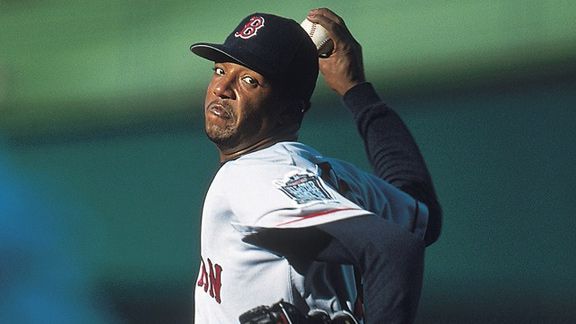
It’s true that it’s tough to be a Dodger fan watching this program. Basically, the best one can do is take in the homage to Pedro Martinez and recall the time when he was ours, or take in the homage to Dave Roberts’ World Series steal and recall the time when he was ours. Furthermore, I felt personally insulted by the documentary’s suggestion that “no Latin player, not even (Roberto) Clemente or the Dodgers’ great Mexican pitcher of the 1980s, Fernando Valenzuela, had ever before received such an outpouring of affection and admiration” as Sammy Sosa.

But I did enjoy revisiting recent baseball history – being transported back to Fernando Cabrera’s pennant-clinching hit or seeing names like Tony Gwynn celebrated once again – more than I expected.

“Tenth” also did a better job than I feared injecting nuance into the discussion of performance-enhancing drugs, a topic that permeates the four hours. Through its sources and narrator Keith “Goliath” David, “Tenth” provides a brief history of cheating in baseball, knocking down some of the holier-than-thou aspects of the debate, and explaining why, even as suspicions rose, people didn’t really want to investigate.

“Innocence is beautiful, sometimes,” Martinez says memorably.

And though Barry Bonds’ story was somewhat sadly tiresome, the set-up wasn’t: a focus on Bonds’ father Bobby and how his troubled career shaped Barry, yielding the person who would stare unabashedly into the face of the disgust directed toward him:

“Boo me! Cheer me!” Bonds exclaims at a press conference. “Those that are gonna cheer me are gonna cheer me; those that are gonna boo me are gonna boo me. So what. But they’re still gonna come see the show. … Dodger Stadium is the best show that I go to in all my life in baseball. They say ‘Barry sucks!’ louder than anybody out there. And you know what, you’ll see me in left field (encouraging them), because you know what, you’ve got to have some serious talent to have 53,000 people say ‘You suck.’ I’m proud of that.”

There are moments when “Tenth” goes beyond the obvious to tell its stories, and those moments are pretty great.

However, particularly in the second part, there are also extended stretches in which the storytelling fails to reach any kind of height, stretches in which the storytelling is completely conventional, no more special than a run-of-the-mill sports documentary that gets thrown together without such fanfare. Because of this, I think that “The Tenth Inning” will be appreciated more by the casual fan than the dedicated fan (and, of course, enjoyed much more by fans of the teams depicted than the teams ignored).

“As its flaws become apparent, (baseball) actually gains depth and humanity, even as it loses its fairy-tale, mythic qualities,” says sportswriter Thomas Boswell, who quietly emerges as perhaps the best on-screen voice of the documentary. Burns and his team get this concept, and I’m glad. The tone to the conclusion of 240-minute endeavor couldn’t be more appropriate. I just wish “The Tenth Inning” had pursued more off-the-beaten path stories, stories like Buck O’Neil and Bobby Bonds, than spending so much time on the more familiar recent history that feels like it’s been sitting on a warming tray.

Lilly superb in Dodgers’ 3-1 victory


Chris Schneider/APCasey Blake gives the Dodgers a two-run lead in the first inning.

The Dodgers got one hit from the second inning through the eighth, and survived.

After a Rafael Furcal single and two walks in the first inning, Casey Blake’s two-out liner off Ubaldo Jimenez’s leg drove in two runs, and Ted Lilly did the rest. Lilly held Colorado to a run on four hits over eight innings and 98 pitches, striking out eight, and the Dodgers reduced Colorado’s playoff chances to almost nil with a 3-1 victory.

Blake had three of the Dodgers’ six hits, scoring the Dodgers’ final run following his ninth-inning double. Hong-Chih Kuo pitched the ninth inning, retiring supermen Carlos Gonzalez (who homered off Lilly for the Rockies’ only run) and Troy Tulowitzki as well as Chris Ianetta to wrap up a great night of pitching for the Dodgers.

* * *

The Watch List

1) Clayton Kershaw did not pitch tonight, but Rockies starter Jimenez faces a similar challenge. He entered tonight’s game with an ERA of 3.0049. Facing his last batter of the night, with a runner on third base, his ERA was at 2.9953. He got Ryan Theriot to line out, leaving his ERA at 2.99, with perhaps one start to go.

2) No bunts for Kershaw.

3) No homers for Kemp or Ethier.

4) No RBI for Loney, Ethier or Kemp.

5) Torre remains at 1,996 losses, with five games to go.

6) Rafael Furcal went 2 for 4, getting a ninth-inning hit to boost his average to .2997.

7) Lilly sandwiched his Gonzalez homer between two walks, putting him at 13 homers and 13 walks as a Dodger this year.

8) Jamey Carroll pinch-hit in the ninth but did not homer.

9) The Dodgers are now 8-16 in September, so they need to win two more games out of five to avoid their worst September-October in Los Angeles.

10) The Bottom Standings after tonight’s games:

25-43, .368 Kansas City (won)
25-43, .368 Pittsburgh (lost)
25-43, .368 Seattle (won)
27-42, .391 Los Angeles (won)
28-40, .412 Washington (lost)
28-39, .418 New York Mets (postponed)

September 27 game chat

Tim Brown of Yahoo! Sports writes movingly about Rangers manager Ron Washington.

… Eventually, when Sports Illustrated published the story of the big league manager who’d tested for cocaine, he’d have to come clean to his friends, and his players, and the world.

The Rangers wanted him in counseling. They wanted no more surprises. They struggled with the concept of a middle-aged man turning to cocaine, but they chose to believe. What they wanted most of all was honesty.

The next day, when baseball was in the midst of spring training and roiling with the news of Washington and cocaine and demands he be fired, Washington admitted he’d smoked marijuana and taken amphetamines as a player.

”Whoa,” Daniels thought wryly, ”too much honesty.”

But, Washington, who had completed the drug program, endured extra testing and eventually returned to the regular pool of annual random tests, continued to apologize. For every television camera, he bore the consequences. For every newspaper, he promised to be a better man. For every fan, he wore the taunts and bowed his head.

”I couldn’t react in a negative manner,” Washington said, ”because they were right.”

And he managed his ballclub.

”I was proud of him,” Rangers third baseman Mike Young said. ”And I’m proud to play for him.” …

* * *

Ten things to watch for in the Dodgers’ final week

Getty ImagesDodgers such as Clayton Kershaw, Joe Torre and Ted Lilly have targets to shoot for – or avoid.

Need something to keep your interest in the Dodgers over the season’s final six games? Here are 10 postcards from the edge of your seat …

1) Clayton Kershaw’s sub-3.00 ERA

Kershaw figures to make one more start this season, Wednesday at Colorado – a tough locale for keeping his current 2.91 ERA below 3.00 for the second year in a row. This is complicated by the fact that a few scenarios put Kershaw’s final ERA at 2.995 or 2.996, which technically keeps him below 3.00 but won’t do the trick for those who don’t take the decimal places out that far. Here’s how many runs Kershaw can allow, based on how many innings he throws:

Innings Wednesday Max runs allowable to keep ERA below 3.000 Max runs allowable to keep ERA below 2.995
1 2 2
2 2 2
3 3 2
4 3 3
5 3 3
6 4 3
7 4 4
8 4 4
9 5 4

Those of you interested in fractions of innings, you’ll have to remain in suspense.

2) Kershaw’s pursuit of the Dodger pitcher sacrifice bunt record

Is anything really more important than this? Kershaw has 18 this season, with only Orel Hershiser (19) ahead of him.

3) Team home run leader

Media guide cover boys Matt Kemp and Andre Ethier are tied at 23. Who will win bragging rights, which will come in necessary next year when Kershaw figures to be the media guy cover boy?

4) Team RBI leader

Despite having only 21 RBI since the All-Star break, James Loney (84) is still trying to hold off Ethier (79) and Kemp (77) for the title. Loney’s cause might have been aided by John Lindsey’s injury.

5) Joe Torre’s 2,000th loss

The Dodgers’ loss Sunday was Torre’s 1,996th as a manager. The team needs to go 3-3 to keep him below two grand.

6) .300 club

The Dodgers will not have a qualified hitter (minimum 502 plate appearances) bat above .300 this season. So let’s turn to the unqualified! Kenley Jansen (1.000) and Manny Ramirez (.311) are locks, but Trent Oeltjen (.333), Rafael Furcal (.298), Jamey Carroll (.292) and Jay Gibbons (.288) are in the running. And why stop there? A.J. Ellis, Rod Barajas and pitchers from hither to yon could also end up at .300 with a hot final week.

7) Ted Lilly’s HR/BB ratio

Lilly enters the final week with 12 homers and 11 walks allowed as a Dodger. Don Newcombe (1958) and Terry Mulholland (2002) are the only Dodgers to allow more homers than walks in a season, minimum 10 homers allowed.

8) Hustleful but homerless

Jamey Carroll enters the final week of the season without a home run to his credit in 408 plate appearances. Carroll has homered in each of his past four seasons, but can he make it five? Carroll is currently tied for 2,725th place on baseball’s all-time home run list with 12.

9) September Mourn

The worst September (and October) in Los Angeles Dodger history was the 10-20 performance by the woeful 1992 team. The 2010 Dodgers are 7-16 in September, so if they lose at least four of their final six games, they’ll take the crown.

10) Lowest of the low
The worst teams in baseball since the All-Star break:

24-43, .358 Kansas City
24-43, .358 Seattle
25-42, .373 Pittsburgh
26-42, .382 Los Angeles
28-39, .418 New York Mets
28-39, .418 Washington

Yes, the Dodgers can be that team.

Uncomfortably numb: Bullpen wastes Billingsley’s 13 Ks

Chad Billingsley tied a career high with 13 strikeouts today while allowing five baserunners and one run in seven innings. His only problem: It’s 2010, the Year Without a Reliable Bullpen.

It wasn’t long ago that Jonathan Broxton giving up a late-inning home run would have caused me great angst, but now I just chalk it up to a lost season. Broxton and George Sherrill each gave up two-run home runs in the bottom of the eighth inning today, surrendering Billingsley’s 4-1 lead and sending the Dodgers to a 5-4 defeat.

The one thing I wasn’t clear on: Why did Ronald Belisario leave the game after retiring one batter with the bases empty and a three-run lead? Or, if Joe Torre was worried about the left-handed bats in the eighth inning for Arizona, why not start the inning with Sherrill?  I don’t care that much at this point, but I just was curious.

The loss was the Dodgers’ 81st of the year, ensuring they won’t have a winning season.

* * *

Earlier today, the Dodgers traded future manager Don Mattingly’s son, Preston, to Cleveland for Ramon Pena in a deal of floundering minor leaguers. Tony Jackson of ESPNLosAngeles.com has details.

Ely’s issues more complicated than ‘just throw strikes’

Matt York/AP
John Ely has allowed 11 home runs and 29 walks in his past 49 1/3 major-league innings.

It’s getting harder and harder to remember the John Ely we all want to remember.

Though Ely never trailed Saturday until allowing a sixth-inning home run, he surely did struggle, using 101 pitches (nearly half of them balls) in 5 1/3 innings and walking five unintentionally. He had six consecutive outstanding starts from May 6 to June 1; since then, he has had three quality starts out of 10 in the majors, with an ERA of 7.48 and 5.3 walks/2.0 home runs per nine innings. Opponents are OPS-ing 1.002 against him in that time.

During Elymania, everyone marveled at his ability to pound the plate, and the value of that is borne out on first glance at his splits: Ely has allowed a .567 OPS after getting a first strike on a batter, .983 after ball one. However, it’s not quite that simple, because Ely is also allowing a .929 OPS when batters swing at his first pitch.

According to MLB Gameday, Cole Gillespie’s pivotal three-run homer Saturday came on a 80-mph floating changeup over the meat of the plate that followed an 87-mph fastball for a strike. Ely had the count to his advantage, but the pitch just wasn’t good enough.

None of this is enough to make me give up on Ely, but he is going to need to find a way to raise his game. The walks contribute to his trouble, but simply throwing strikes isn’t enough. He somehow has to get back to fooling people.

* * *

Josh Fisher at Dodger Divorce goes beyond the legal realities of the McCourt case to offer his take on what really happened with the disputed post-nup agreement.

* * *

To my amusement, in the Dodger press notes, Dodgers communications vice president Josh Rawitch has been tracking Chin-Lung Hu’s rise up the chart of all-time Dodger leaders in games played by a shortstop. Friday, Hu passed Rafael Bournigal to move into a tie for 29th place, and Saturday, Hu left Oscar Robles in the dust. Hu’s next game at short takes him past Kevin Elster.

According to Rawitch, the Dodgers will finish the season with 593 player games lost to the disabled list, the team’s lowest total since 2002. The Dodgers crossed the 1,000-game mark in 2008 and 2009.

John Lindsey’s season comes to sudden end

A bone in John Lindsey’s left hand was broken by a Daniel Hudson pitch in the seventh inning of tonight’s 5-2 Dodger loss to Arizona, ending his year. (MLB.com has video). Goodness, what a ride for Lindsey. My sense is that we won’t see him in a Dodger uniform next season, except maybe in Spring Training, but he will remain one of the best memories of the 2010 season. It was a pleasure, John.

Page 336 of 379

Powered by WordPress & Theme by Anders Norén