Dodger Thoughts

Jon Weisman's outlet for dealing psychologically with the Los Angeles Dodgers, baseball and life

Page 323 of 381

Clayton Kershaw is coming at you


Dilip Vishwanat/Getty ImagesClayton Kershaw has struck out more batters before his 23rd birthday than any other Dodgers pitcher since Fernando Valenzuela.

Clayton.

Nope, not quite.

Kershaw.

Nope, not that, either. Not yet.

He’s not a Fernando or a Sandy. Not even a Piazza or (for that brief, baggage-heavy moment) a Manny. He’s not a “Bulldog” or a “Game Over.”

He’s still a plain old guy with two plain old names, with a humble personality to match — a wolf in sheepish clothing.

If you say Clayton Kershaw is the best player on the Dodgers, you won’t necessarily get an argument, but you might get a shrug. With disappointment still dripping from the team’s 2010 season, “best player on the Dodgers” won’t earn you much more than a patronizing pat on the head, maybe an extra juice box after practice. For now, anyway.

Sometimes it happens practically overnight, the way it seemed to with Fernando Valenzuela and Mike Piazza. Other times — more often, really — it’s years in the making, as with Sandy Koufax, Orel Hershiser and Eric Gagne.

Either way, there’s an explosion within reach for Kershaw — oh, you better believe there is. He turns 23 on March 19, and soon after, he might turn Dodger Stadium back into a place where fans are racing through the crowds for their seats, the way they did for those transcendent heroes of the recent or distant past, for no other reason than to drool over his next pitch or exult in his supremacy.

If baseball is thinking outside the batter’s box, it’s reserving Blake Griffin’s Kia Optima for this year’s All-Star Game, just in case it’s needed for Kershaw to drop one of his magic breaking balls through.

If that all seems a bit fast on the superlative train, if that locomotive seems to have some particularly loco motives, well, maybe so. Maybe we’re getting ahead of ourselves. Maybe that train will never quite arrive.

On the other hand, consider that you have a prodigy who has steadily developed, steadily improved every step of the way since he was drafted by the Dodgers 4 1/2 years ago, a pitcher who has met every small step back with two great steps forward.

“If there’s anything surprising,” Dodgers pitching coach Rick Honeycutt told Dodger Thoughts about Kershaw, “it’s at such an early age, the maturity of him and the way he goes about [his work]. He’s really a true professional … to the point that he’s really one of those gems that just strives to be the best and is not satisfied with being anything less.”

Rebound magnet

By the time he finished his first full season in the minors, in 2007, the Kershaw shorthand had been established: an uncommonly talented pitcher who would go as far as his control would allow him. His entire minor league career, which included not a day in Triple-A, lasted but 48 games and 220 1/3 innings, in which he had a 2.49 ERA and 11.3 strikeouts per nine innings. But, the walks …

In 2007, Kershaw split time between Class A and Double-A. He walked 4.6 per nine innings at the lower level and a whopping 6.2 after his promotion to Jacksonville. In 2008, Kershaw reduced his Double-A walk rate by more than half to 2.8. A pattern had begun: lose control, but rein it in and blast forward. With an ERA in the low 2s, he knocked so hard on the major league door that the Dodgers had to open it, making him, at age 20, their youngest big leaguer since Edwin Jackson.
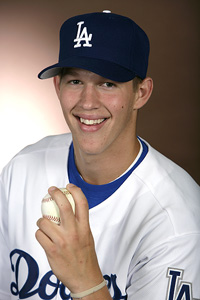
Jon SooHoo/Los Angeles Dodgers
Kershaw’s first Dodgers mugshot

In his debut, Kershaw pitched six innings of two-run ball against Albert Pujols and the St. Louis Cardinals. Then he got knocked out in the fourth inning of his second start, in New York, walking four and needing 83 pitches to get 11 outs. Over his next six starts, he had a respectable 4.03 ERA and 7.4 strikeouts per nine innings. But he also was walking nearly as many as he was striking out; he didn’t make it through six innings once.

“The bumps were command,” Dodgers general manager Ned Colletti said. “Obviously, he’s got a great arm and he’s a smart kid and he’s coachable, but command was the first issue — rushing his delivery and just kind of being out of whack a little bit, and that happens with guys.

“When you’re a [recent] high school player … you’ve got to wait for the mental part to reach the physical part.”

After a July 1 start, the Dodgers dropped him back to Jacksonville for a little more seasoning, but he was gone less than a month. And when he came back, he was back for good. The Dodgers stuck with him after a horrendous outing in Colorado — three innings, 13 baserunners — and he rewarded the faith with five consecutive quality starts, averaging more than six innings with a 1.45 ERA, striking out 29 and walking only nine.

Never after a setback has Kershaw failed to rebound — and improve.

“His greatest strength is just his confidence,” Honeycutt said. “He’s got great ability, but … he expects to do well. There’s no fear in him. There’s that part of him that wants the ball. He wants to go deep in the game. He wants to be one of the best.

“The other side of the coin for that strength is him learning himself better, in how he prepares his game.”

After getting his postseason feet wet in 2008 as a reliever, Kershaw was on the Opening Day roster in 2009 and went through more of the same. In his second start of the year, he struck out 13 Giants in seven innings while allowing only a single walk and a single hit, a home run by Bengie Molina. The control issues still would flare up — he walked four batters or more in 13 of his 31 starts — but his season ERA fell from 4.26 in 2008 to 2.79 in 2009, and he led the National League in fewest hits per nine innings. In Game 2 of the 2009 NL Division Series, he held St. Louis to two runs over 6 2/3 innings, keeping the Dodgers alive for their dramatic, ninth-inning comeback victory.

But Kershaw faltered in the NL Championship Series. After shutting out the Phillies for four innings in Game 1, his fifth inning consisted of three walks and three wild pitches to go with a single, a double and a home run, a five-run collapse that reinforced in the general public’s mind this was still a baby in a man’s world. Next to cries for Jonathan Broxton’s head or Manny Ramirez’s testosterone tests, nothing was heard more from the peanut gallery than “The Dodgers need an ace.”

Within a year, the Dodgers were out of the playoffs, but their ace had arrived.

Growth spurt

In his first start of 2010, Kershaw walked six batters in 4 2/3 innings. By the end of April, he had walked 22 in 29 1/3 innings. And then, on May 4 against Milwaukee, he was battered: 1 1/3 innings, seven runs. His ERA sat at 4.99, and numerous pundits suggested this might be the real Kershaw. Jon Heyman of SI.com tweeted:

kershaw may be regressing faster than billingsley. not sure. close competition. #howcanbradpennybebetterthanboth?

“There was a point [in May] last year,” Honeycutt recalled of Kershaw, “where things were not going [as] well as he would like or we would like. He actually made a few adjustments, even in his ‘pens, that we talked about. That’s really when he started coming up with a smaller breaking ball. You can call it a slider … [but] a shorter breaking ball that he could throw for strikes more consistently.

“There was more importance on commanding the lower part of the zone in his bullpens than just getting his work in.”

Kershaw’s next start was May 9 against the hottest pitcher in baseball at that moment, Colorado’s 26-year-old Ubaldo Jimenez, who had made six starts to that point and allowed four total runs. Kershaw outpitched him that day, nursing a 1-0 lead with eight shutout innings, allowing two hits and three walks while striking out nine. It was an arrival game.

Christopher Hanewinckel/US PresswireKershaw worked his way through 204 1/3 innings last season, striking out 212.

Other gems followed, culminating in his first major league shutout. Kershaw had come close before, but finally in San Francisco on Sept. 14 (a night the Dodgers had only one hit in nine innings), a complete-game, 1-0 victory was his. But more impressive than the individual highlights was the overall growing control. Starting with the Jimenez game, Kershaw’s walk rate for the 26 starts that finished off his 2010 season was a career-best 2.95 per nine innings. Not coincidentally, he averaged a career-best 6 2/3 innings per start in that stretch. His ERA was 2.54, and opponents had a mere .277 on-base percentage and .303 slugging percentage against him.

“I just think experience helps,” Kershaw told ESPNLA’s Tony Jackson. “The more times you go out there, the more experience you get and the more confidence you get. I don’t think it was a matter of walking a lot of guys because I had bad control. I was just trying to be too fine and not letting my stuff do its thing. Now, I’m just trying to go after hitters more.”

Said Honeycutt: “I think again it was … maturity and not just thinking you have to go 100 percent on every pitch. There’s that fine line, pitching at that level and saying, ‘I can throw at 90 percent and maybe be a little bit more under control and get the ball in an area a little bit better.'”

Gearing up for ’11

No one, least of all Kershaw, thinks he has it made. For all his improvement and excellence, Kershaw had at least one start go awry every month of last season. Preparation for taking another two steps forward in 2011 — ideally without the typical one step back — has been at the forefront of everyone’s mind.

“From [the] first time I talked to him [this winter], he had already been doing his conditioning,” Honeycutt said. “He came out to Arizona and threw a couple of ‘pens and just looked great already, just physically and arm-wise. … He’s very aware of where he wants to be and what we’re trying to work on.”

“It was mostly throwing changeups,” Kershaw said, “because that is the pitch that is the toughest for me to get a feel for, so that’s obviously something I wanted to work on. I also just worked on gaining strength and trying to get stronger.

“My high school [Highland Park] finally got an indoor facility. That was where the Packers trained before the Super Bowl. So that was awesome to have a place like that to work out in the winter time.”

Kershaw’s offseason has had some non-baseball moments of a grand scale: his marriage to longtime girlfriend Ellen in December, followed by a brief honeymoon and then a goodwill trip to Zambia in January. Any of this could have proved distracting, but Kershaw said he stayed on his offseason plan.

“I just took it with me,” he said. “I threw while I was in Africa and got my work in. I worked out pretty much the entire winter except for the four days we were on our honeymoon in Mexico.”
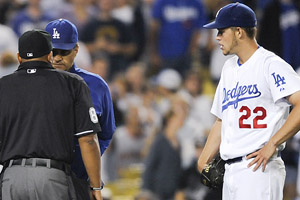
Gus Ruelas/APJoe Torre and umpire Adrian Johnson debate Kershaw’s ejection after hitting San Francisco’s Aaron Rowand with a pitch July 20.

With his ascendancy on the mound coupled by his growing maturity on and off the field, there’s a ray of hope that Kershaw could become a leader in a Dodgers clubhouse that many say is crying out for one, especially from its newest generation. Kershaw, Colletti and Honeycutt all tamped that notion a bit, noting a pitcher is handicapped as a clubhouse leader by how often he plays relative to the position players.

“We have a lot of guys who have more experience than I do,” Kershaw said. “For me personally, I just pitch. It’s the only thing I can do.”

“They’re in two different realms most of the time,” Colletti said of pitchers and position players. “But certainly from a pitching standpoint he can [lead]. And he’s had great support, too, from the other guys. He and [Hiroki] Kuroda have been close since Kuroda got here. [Ted] Lilly and he hit it off right away. Lilly helped in his maturation process. So it’s possible that he starts to take more of a leadership role.”

In that respect, it might turn out that Kershaw’s influence is felt less among the 25 men on the major league roster at any one time and more specifically on the minor league pitchers coming up through the farm system — a group that as a whole suffered through a rocky 2010.

“We had this prospect camp in Arizona,” Colletti said. “The major league guys know about it, but they’re not required to be there. And he showed up. We had him address the prospects — the other guys, the Withrows, the Millers, the Martins, the Eovaldis — all those young arms. He addressed them a couple of times, and it was very interesting to hear this young man speak from the perspective of prioritization and work ethic, and on bringing the mental side of the game.

“He talked about how he came here and he thought he was pretty good right away, but how much he has learned and how much he continues to learn, to become as good as he can be.”

Pitfalls and pinnacles

How good can Kershaw be?

He’s already viewed by many as the Dodgers’ best lefty since Fernando. To become the Dodgers’ best lefty since Koufax — to help boost the team above the early season predictions positioning it as an also-ran to San Francisco, to start a mania in Los Angeles — Kershaw is going to have to become even more consistently excellent, avoiding the short start in which the runs suddenly pour across in bunches.

Gary A. Vasquez/US PresswireKershaw’s career high for pitches in a game is 118.

“He’s starting to get to the point where he’s keeping his pitch count decent, starting a game out where the first inning isn’t a lot of pitches,” Colletti said. “Some guys, there’s an excitement to coming out of the gate, and maybe you rush a few things here and there, maybe you don’t warm up quite as thoroughly as you do when you’re into the game.”

Honeycutt said the Dodgers, who were extremely protective of Kershaw from a pitch-count perspective when he arrived in the majors, will continue to loosen their grip in 2011, bit by bit.

“He’s definitely strong enough and has shown the ability to obviously go deeper,” Honeycutt said. “With any starting pitcher, the game itself kind of dictates what you’re gonna do, and not that we don’t want him [to go long], but you still want to be conscious the whole goal is to keep him healthy for 32-34 starts and the postseason.”

Following a tough inning, the Dodgers still plan to be conservative with Kershaw, but “when things are going smooth, you let it ride,” Honeycutt said.

“He definitely has the ability to be a 120-125-pitch-type guy, where you don’t have to worry about him coming back. He’s gotten stronger, and his recovery over five days has been very consistent,” Honeycutt said. “The main thing is be smart with him like we would anybody. … I think you feel more comfortable about letting the reins loose.”

In each of the past two seasons, a top young Dodgers pitcher suffered a prolonged, second-half setback: Chad Billingsley in 2009 and Broxton in 2010. With Kershaw still younger than either of those pitchers were then, it’s hard not to consider that, even as the best is yet to come, the worst might arrive first.

“I don’t think there’s any way for predicting,” Honeycutt said. “I still think a lot of Chad’s situation was he was a little tight there around the All-Star break, and then he had a hamstring injury right after the break, so there were some physical issues there. Obviously, Broxton being a reliever, it’s a little bit different. … It’s trying to be very conscious of where each individual is. Each is gonna hit little walls. What’s tougher I think sometimes for a young guy is that communication process of knowing exactly what’s happening.

“I think [someone who’s] more of a veteran guy might have a light side in between starts. Derek Lowe, a lot of times as the season went on, would be, ‘I’m not gonna do a side this time. Just let my body recover.’ … But there’s no perfect formula.”

Heir to the throne

If it all comes together for Kershaw, if he becomes a Clayton or a Kershaw (or gets a nickname besides the one launched on Dodger Thoughts, “Minotaur,” that isn’t based in a superstitious fear of him becoming more myth than legend), the one thing no one seems to worry about is the lefty’s ability to thrive amid the attention.

The fans want someone to love. Kershaw can handle the love.

“He’s had quite a bit of attention already,” Honeycutt said. “We’ve thrown everything at him already, coming up as a 19-year-old and being a starter in the playoffs [at age 21], those are advancements that you just don’t throw on anyone unless you feel he can handle them. In my view, he’s handled things extremely well.

“He’s the type of guy that always seems to want a challenge. Some people like to shy away from a challenge, but the great ones want those head on. … He puts the team first, which has been a real plus to him from the start. It hasn’t been about him, but it’s about how [he] can help the team.”

Icon SMIThe Opening Day showdown: Lincecum versus Kershaw.

It’s not as if Kershaw is some robot that pays no mind to his surroundings. But the subtext keeps coming back: maturity and perspective.

“I wasn’t in awe, but definitely, the first time I got in here, it was different,” Kershaw said of his comfort zone in the majors. “You don’t really look at these guys as your teammates at that point. We had guys like Jeff Kent here, a lot of guys like that. But over time, the more familiar you become with something, the more comfortable you get with it.”

On March 31, Kershaw will take the mound in the first game of the 2011 major league baseball season, in front of a yearning Dodger Stadium crowd and a national television audience, against the defending World Series champions and two-time NL Cy Young Award winner Tim Lincecum. If Kershaw loses, you can put the fanfare on hold.

But if he wins, and wins impressively, then get ready, Los Angeles.  Just get ready.
Vicente Padilla to have MRI

Vicente Padilla’s pitching elbow is ailing, the Dodgers said today. Tony Jackson of ESPNLosAngeles.com has details.

Dodgers vice president of communications Josh Rawitch said that Padilla “was experiencing pain in his right elbow similar to what he felt last year.” He was examined by Dr. Neil ElAttrache in Arizona on Monday, after which it was decided Padilla would fly back to Los Angeles today for an MRI. Results of that test are expected Wednesday.

The start of the season is still five weeks away, but a longterm Padilla injury would probably cement Blake Hawksworth’s spot on the club and, combined with Ronald Belisario’s absence, further increase the odds for Ron Mahay, Lance Cormier, Ramon Troncoso or Scott Elbert.

You get a line, I’ll get a pole, my honey …


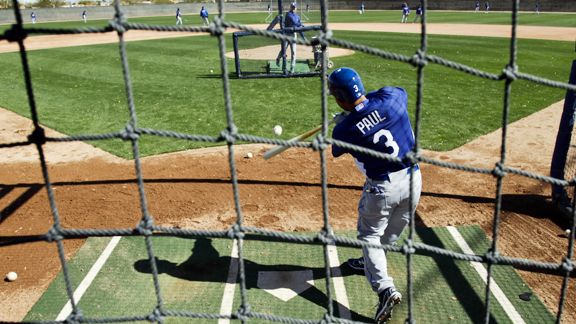
Morry Gash/APXavier Paul takes his swings at Camelback Ranch today.

Maury Wills sings “Crawdad Hole.” Thank you, Blue Heaven.

Elsewhere …

  • One of the lesser-known but valuable defensive statistical tools is PMR (Probabilistic Model of Range), by David Pinto of Baseball Musings. Today, he published shortstop data for the period 2006-10. The Dodgers are No. 6 out of 30 teams at the position, thanks mostly to Rafael Furcal, who is seventh-best in baseball over that stretch – fourth among those who have seen at least 10,000 balls in play in their zone.
  • Andre Ethier wants to be a more uplifting leader for the Dodgers this year, he tells Dylan Hernandez of the Times. Don Mattingly suggested a role model for Ethier: Derek Jeter.
  • It just keeps getting worse for Scott Podsednik. Mark Zwolinski of the Toronto Star reports that “Podsednik suffered a re-aggravation of foot injury he first came down with in 2010, and will not be immediately available to open spring training with the team.” Jays manager John Farrell said the ex-Dodger, whose unguaranteed contract gives him $1 million for making the team, is battling plantar fasciitis again.
  • I’ve been meaning to highlight this for a long time but kept forgetting: Brandon Lennox of True Blue L.A. went to the trouble of ranking and providing detailed capsules of the Dodgers’ top 200 minor-league prospects. Here’s your path to the trove.
  • A 7-foot-1 pitching prospect? You be the judge: Bill Plunkett of the Register has a fun feature on the Angels’ 85-inch minor leaguer, Loek Van Mil.
  • Dee Gordon, interviewed by Josh Jackson for MLB.com, says he isn’t expecting Stephen King to write “The Girl Who Loved Dee Gordon.”
  • ESPN.com has an entire page dedicated to 6-foot-2 high school basketball player Diamond DeShields, daugher of Delino and class of 2013.

Photo gallery of the night

A Facebook friend of mine passed along this link:

These images, by photographers of the Farm Security Administration/Office of War Information, are some of the only color photographs taken of the effects of the Depression on America’s rural and small town populations. The photographs and captions are the property of the Library of Congress and were included in a 2006 exhibit Bound for Glory: America in Color.

They are really worth a look.

Now batting, Don Mattingly


Morry Gash/APDon Mattingly: Five-tool manager?

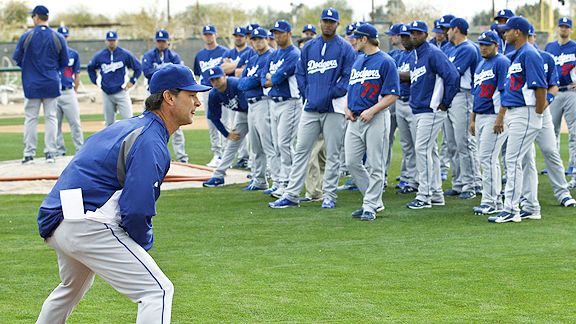
The most fun and interesting detail to come out of Camelback Ranch today was the tidbit that Dodger manager Don Mattingly will stand in the batters box during bullpen sessions for his pitchers. From Tony Jackson of ESPNLosAngeles.com:

In Mattingly’s first spring as the team’s manager, he already has employed at least one unconventional tactic. Often, when a pitcher is throwing in the bullpen, Mattingly will grab a bat, step into the left-handed batter’s box and get into the familiar stance he employed for so many years as a six-time All-Star first baseman for the New York Yankees.

“It gives me a better look at a guy’s stuff,” Mattingly said. “[By standing there], I can tell if what a guy is throwing can get somebody out or it can’t.”

Mattingly conceded that some of his pitchers — especially those who will spend the spring fighting for a roster spot — might be a bit unnerved by firing a baseball in the general direction of the boss’s body. In deference to that, he said he steps out of the box when it comes time for a pitcher to throw to the inside part of the plate.

Ken Gurnick of MLB.com has more.

… Mattingly’s participation in the bullpen sessions had the players talking.

“First time I ever saw that,” said catcher Dioner Navarro. “Caught me off guard. I did a double take. You know, you don’t want to drill him. But you can see he wants to be involved in everything, to know everything. It’s like he’s back to being a player. He knows what it takes. It brings confidence to the team to see that. It’s exciting.”

Mattingly, 49, said he no longer gets the urge to actually hit, having retired after the 1995 season. And he only steps in to his natural left-handed side, because he said he might not know how to get out of the way from the right-hander’s box.

Among the pitchers he “faced” Saturday were veterans Hiroki Kuroda and Vicente Padilla. Mattingly said he’d think twice if he saw a pitcher was having control problems.

“Managers do that in Japan and it’s considered an honor,” said Kuroda. “They do it for top young prospects and established veterans. And in the middle of Spring Training you have a session when you throw 200 to 300 pitches to establish endurance, and the manager steps in then, so you don’t slack off.” …

* * *

Jon SooHoo/Los Angeles DodgersMatt Kemp works out at Camelback Ranch today.

Davey Lopes baserunning tutorials are in full swing. From Jackson:

… Lopes has been giving these tutorials every morning this spring, and after a few minutes on Saturday, (Matt) Kemp was joined by outfielder Tony Gwynn Jr., shortstop Rafael Furcal, highly touted prospects Dee Gordon and Trayvon Robinson and non-roster outfielder Trent Oeltjen. Not one of those players is required to be in camp until Monday, but several of the team’s position players chose to report early.

Lopes’ group spent the entire session taking leads off first, crouching and breaking toward second base, though they weren’t running at anything close to full speed and they stopped about halfway there.

“Right now, I’m just trying to get an idea of what they do and what they attempt to do and see if there is something we can try to adjust to make it a little better fit for them,” Lopes said. “Basically, we’re just breaking down their movements.” …

* * *

Hiroki Kuroda is working on adding a curveball to his repertoire. Dylan Hernandez of the Times has more:

Last spring, Kuroda tried to add a changeup to his arsenal, but the project was abandoned early in camp. Kuroda said he’s more optimistic about his curveball.

“I’ll throw it during the exhibition season and see how it feels,” he said.

Kuroda said he has received tips from Clayton Kershaw, but that he learned the curveball grip over the winter by watching videos.

* * *

Steve Henson of Yahoo! Sports writes about the importance to Rafael Furcal of the fire truck recently donated to his hometown in the Dominican Republic:

“I’ll sleep better knowing people will be safe,” Furcal said. “I’m the only guy who made it. It’s like a responsibility to me.”

His love of firefighting was noticed by Dodgers public relations director Josh Rawitch, who mentioned it to general manager Ned Colletti during Furcal’s contract negotiations after the 2008 season. Colletti included the truck in discussions with Furcal’s agent, Paul Kinzer. Furcal was torn between signing with the Braves – the team that first signed him in 1996 and for whom he played his first six years in the majors – or returning to the Dodgers.

The fire truck was the ideal perk. It spoke to something close to his heart. And it convinced him the Dodgers cared about him as a person, and about his hometown.


* * *

Farewell, Ollie Matson.

Teach your children? Well …


Jason Miller/US PresswireMy reaction, as it would have been seen on SportsCenter.

Here’s a story …

Making our way through the rain, my 6-year-old and I arrived tonight at his 6:15 p.m. basketball practice a couple of minutes early. The gym, which may have been coated with a Wetpour Surface, was almost empty, so he had a chance to take some shots. They were all really short, barely getting airborne. That wouldn’t have been unusual a year ago, but he has shown this year he can make a basket on occasion.

I wanted to get him to bring his arm back and cock his wrist a little bit more. He really seemed to be short-arming the ball. Now, the boy has made it pretty clear that he doesn’t like to get athletic advice from me hardly at all, so I’ve hardly said a word to him this season, leaving it to his capable and easygoing coach.  But all I wanted to do was give him this small guidance.

He was having nothing of it. I reminded him a) how little I try to force my hoops instruction on him and b) he is supposed to listen to me per the father-son paperwork we filed with … well, no, there isn’t any such paperwork, but there should be.

Nothing.  He was doing everything he could to avoid hearing me.  He tried to take another shot, and out of frustration, I swatted it.  Mean old dad.  But a dad who, for crying out loud, would just like to get to be a dad at one of these moments.

The couple of minutes passed, and his coach called the boys in to start practice. (A small group to this point – only three had made it on time through the rain.)

I sat down on one of the folding chairs on the sideline.  I did not hide my displeasure.  I wanted him to see my frown.  I almost never do this at his sports practices, but I wanted to make my point.

Rocky Widner/NBAE/Getty Images
In your face …

Without even half a team, the coach started the boys off on a layup drill, or something close to that.  My boy dribbled up, shot the ball … up, up, and into the basket.

He looked at me with an almost-but-not-completely sheepish smile.  I didn’t alter my frown an inch.

The other two boys shot, and then it was back to mine.  He dribbled up, shot the ball – in.

He looked over, smiling unabashedly.  I let my lips turn ever so slightly up.

Next turn … he shoots, it’s in.  He smiles big. I lean back, sigh, and smile unsurely, not completely positive I should let him off the hook but finding it very hard not to.

Fourth shot. Four in a row? Oh freaking yes. He looks over at me and is smiling so big, his eyes are aglow.

I’m smiling just as big. He’s melted me completely. In the car ride home, he tells me he’s the best basketball player in the world.

Why Lance Cormier is a darkhorse roster candidate

Kim Klement/US PresswireIn the past three seasons, Lance Cormier has allowed a sub-.700 OPS against left-handed batters, including 26 extra-base hits in 486 plate appearances.
Outside of the left-field conundrum, the Dodgers’ biggest question mark for Spring Training might be how they will address the task of getting left-handed batters out with their almost completely right-handed bullpen. No one wants to see Hong-Chih Kuo relegated to facing only lefties, and the only other left-handed thrower on the 40-man roster is the uncertain Scott Elbert.

Three non-roster invitees to major-league camp are left-handed: 39-year-old Ron Mahay, achy-hamstringed Dana Eveland (whose career 5.74 ERA will apparently be sidelined for weeks after Thursday’s injury) and Wilkin De La Rosa, who has never pitched about Double-A. After that, you start dipping down into the minors for developing players like James Adkins.

With Ronald Belisario’s absence seemingly opening up a roster spot, Mahay would seem to be the default candidate. He had a .520 OPS allowed against lefties last season. But the previous two seasons, his OPS allowed against lefties was above .700 — which isn’t terrible, but isn’t exactly the kind of authoritative performance you’re looking for when you really want someone to come in and get that guy out.

I got to wondering if there were any righties among the Dodger relievers who were reliable against lefties. Here’s a chart of the bullpen candidates’ OPS allowed against lefties over the past three seasons in the majors:

2010 PA/ 2010 OPS   2009 PA/ 2009 OPS   2008 PA/ 2008 OPS
Belisario 86 .793   122 .720      
Broxton 123 .626   148 .414   126 .800
Colon 5 .650   94 .713      
Cormier 162 .718   180 .671   144 .667
Elbert 4 2.000   40 .699   14 1.000
Eveland 59 .802   60 .999   170 .646
Guerrier 102 .649   120 .525   126 .801
Hawksworth 185 .886   76 .724      
Jansen 51 .586            
Kuo 69 .271   40 .524   98 .557
Link 16 .962            
MacDougal 39 1.353   124 .760   24 .858
Mahay 68 .520   111 .743   110 .721
Monasterios 188 .709            
Padilla 166 .590   352 .837   385 .944
Redding       282 .860   402 .808
Schlichting 39 .465   9 .905      
Troncoso 99 .823   157 .751   84 .707
Villarreal             68 .862

Some observations:

  • The Dodgers have a few righties who seem consistently effective against their opposite numbers: Jonathan Broxton, Matt Guerrier and, based on a small sample size, Kenley Jansen.
  • Oh, and another guy who probably isn’t on your radar … late signee Lance Cormier.
  • Based on only his one season, Carlos Monasterios offers an intriguing first impression — though looking at the chart, you can see how much these numbers can fluctuate. Look at what happened to Ramon Troncoso, for example, or moving in the other direction, Vicente Padilla.
  • For extreme small-sample candidates, there’s Roman Colon and Travis Schlichting. Consider at your own risk.

If the Dodgers decide that Kuo, Broxton, Guerrier, Jansen and Padilla are all effective against lefties, they could decide to go without a second left-handed pitcher — especially if they also think Cormier is worth a roster slot. It might still be Mahay’s spot to lose or Scott Elbert’s spot to win, but Cormier might be this year’s guy you least expected.

Today’s Dodger Facebook status updates

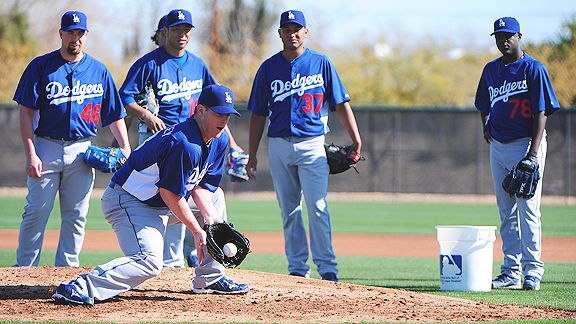
Kyle Terada/US PresswireChad Billingsley is digging fielding practice today at Camelback Ranch.

Friend this …

Regarding the Lakers’ loss to the Cavaliers …

… which Andy Kamenetzky writes about at Land O’Lakers …

Wow. I mean … Wow.

Forget this being the worst loss of the season. That’s not even debatable. …

I’ve been preaching patience. Perspective. Recognition of how it’s a marathon, not a sprint. …

But frankly, this is alarming, even for me. …

This is the Lakers equivalent of rock bottom. There will be talk of potential and greatness slipping away, and time running out to prevent a disastrous outcome.

Ultimately, it’s up to the Lakers to decide whether they want to save themselves.

Yep. Every team has their rock bottom. It’s not hitting it that matters. It’s what you do after.

Dodger Thoughts on Twitter

With Spring Training now underway and a new baseball season dawning, this seems like a good time to remind, inform or warn you that you can follow me on Twitter — and thereby receive ongoing updates about what’s happening in the Dodger, baseball (and, like it or not) entertainment worlds. Click here:

@dodgerthoughts

Act now, and you might be my lucky 5,000th follower and win … my thanks.

Scott Podsednik’s offseason odyssey ends in Toronto

When the Dodgers picked up their half of Scott Podsednik’s option, that seemed like a shaky choice … but not half as shaky as when the 34-year-old said thanks but no thanks to the guaranteed $2 million and chose free agency. Months went by, and it was not until today that Podsednik signed a 2011 contract.

It’s a minor-league deal, for which we haven’t seen the terms — it’s entirely possible that Podsednik will make the major-league roster and end up with the kind of money he had envisioned, but I can’t imagine this offseason went the way he imagined.

Here’s some comment on Podsednik’s Blue Jays future from Josh Alper at Fanhouse:

… Podsednik will have a pretty good shot at winning a spot on the roster. The Jays could use a leadoff man and Podsednik fits the offensive criteria a bit better than Rajai Davis. They also could be looking at a time share at the designated hitter position where Podsednik could split duties with Travis Snider and Juan Rivera as the Jays look to avoid too much of a defensive disaster in left field. There’s also the possibility that the Jays will be forced to use Jose Bautista at third base, although that seems like a last resort.

So there’s room for Podsednik to earn a job. Assuming he can repeat last year’s production, he could even play quite a bit, although one imagines they’d rather see Rivera and Snider win regular roles with Podsednik and Davis splitting time and providing doses of speed to a lineup that’s short on it.

The Dodgers traded Elisaul Pimentel and Lucas May for Podsednik on July 28.

Belisario in jeopardy of missing season

The weird thing with Ronald Belsiario, whom Tony Jackson of ESPNLosAngeles says is in jeopardy of missing the 2011 season, was that he ever became an important pitcher for the Dodgers in the first place.

His credentials at Spring Training 2009 were less than zero, making his late arrival there irrelevant, and less than a week before Opening Day that year, he remained practically a non-entity. Then he came, was seen and conquered. On July 1, he had a 1.89 ERA with 46 strikeouts against 55 baserunners in 47 2/3 innings.

He soon was forced to miss a month of the season with some personal and physical problems, but still finished the year strong. Only a run he allowed on the final day of the season pushed his ERA over 2.00.

But then came the chaos of 2010 — an even later arrival, followed by almost none of the consistent excellence the previous year had offered. His rate of baserunners allowed went up; his strikeout rate went down. The lowest his ERA sat at any point last year was 3.79 on July 5, after a three-inning shutout performance that was immediately followed by another sabbatical of more than a month. On August 12, he was a conspirator in one of the Dodgers’ devastating losses, allowing four of the eight runs the team gave up in the final two innings of a 10-9 defeat at Philadelphia.

As divided as fans can be on pitchers like Jonathan Broxton, they were united this offseason on Belisario. I doubt there was anyone who didn’t cast a dubious eye on his presence on the 2011 roster, wondering if he could be relied upon in any sense.

There are certain players who, no matter how talented they were at one point, will always be remembered for the air of mystery or confusion that so often surrounded them. Belisario may well make it back to the big leagues someday, with the Dodgers or some other team, but something tells me his name will always evoke a sigh.

I hope Belisario finds his way through his problems.  Boy, never a dull moment with this Dodger team …

* * *

Using my Spring Training Primer for reference, Belisario’s absence strengthens the hold that Kenley Jansen and Blake Hawksworth have on bullpen spots (behind Broxton, Hong-Chih Kuo, Matt Guerrier and Vincente Padilla), and takes a hurdle away from Ron Mahay, Scott Elbert and Ramon Troncoso, who figure to be the leaders (in that order) in the battle for a theoretical seventh relief spot.

Clayton Kershaw to start Opening Day

As it should be …

Left-hander Clayton Kershaw will get the ball for the Los Angeles Dodgers’ season opener on March 31 against the San Francisco Giants, manager Don Mattingly announced on Wednesday morning.

Mattingly said he made the decision as far back as last fall.

“Probably the day after I found out I was going to manage,” Mattingly said. “This kid loves the challenge, and I would line him up against anybody.”

In this case, Mattingly likely will be lining up Kershaw against right-hander Tim Lincecum, the Giants’ ace right-hander and two-time reigning National League Cy Young Award winner. Mattingly cited Kershaw’s two victories last season over Colorado Rockies ace Ubaldo Jimenez, the N.L. starter in the All-Star Game, as evidence of his ability to rise to the occasion. …

Dodgers invite Lance Cormier to camp

The Dodgers signed Lance Cormier to a minor-league deal with an invite to big-league camp, reports Tony Jackson of ESPNLosAngeles.com, who has details.

Interestingly, Cormier is two years younger than Matt Guerrier, who signed a big three-year deal with the Dodgers in the offseason,

Cormier, 30, has been effective at times over the past three years pitching for the Orioles and Rays, with a 3.71 ERA, though he has still allowed 316 baserunners in 211 innings with only 112 strikeouts. As a righty, he has long odds for making the Opening Day roster but could be in the midseason mix if he stays in the minors.

Welcome to Spring Training


View Larger Map

Wednesday: Major-league pitchers and catchers reporting date
Thursday: First workout
Monday: Major-league position players report
Feb. 22: First full-squad workout
Feb. 23: Minor-league early camp opens
Feb. 26: Cactus League Opening Day – split-squad games in Tempe vs. Angels and Scottsdale vs. Giants
Feb. 27: Camelback Ranch Opening Day vs. Angels (on Prime Ticket)
March 3: Minor-league pitchers and catchers report
March 9: Minor-league position players report
March 11: First full minor-league workout
March 27: Final 2011 Camelback Ranch Spring Training game vs. Indians
March 28: Dodgers vs. Angels at Dodger Stadium
March 29: Dodgers vs. Angels at Anaheim
March 30: Dodgers vs. Mariners at Dodger Stadium
March 31: Opening Day vs. Giants at Dodger Stadium

Page 323 of 381

Powered by WordPress & Theme by Anders Norén