Jun 09

Dodgers give one back on Kemp’s glorious night


Doug Pensinger/Getty ImagesMatt Kemp watches his fourth-inning home run leave Coors Field.

More than once tonight, Vin Scully wondered why any team would pitch to Matt Kemp. He even wondered it when there were runners on first and second base.

We were wondering the same thing.

While the Dodgers struggle to find a No. 5 hitter who can swing the bat – they had a woeful .278 on-base percentage and .333 slugging percentage in that spot of the batting order entering the game, and slumping Juan Uribe batting there tonight – Kemp has just been unstoppable. Tonight, he homered, tripled in two runs and doubled as the Dodgers took a 7-3 into the seventh inning in Colorado.

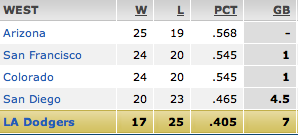
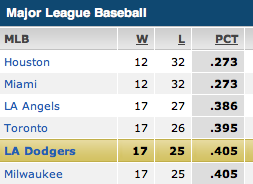
But a not-so-funny thing happened as we mused about Kemp’s supremacy: In tit-for-tat fashion, the Dodgers gave back their rousing comeback victory in Cincinnati from five days ago, blowing the four-run lead and losing to the Rockies, 9-7. The defeat sent the Dodgers into last place in the National League West.

For his second start in a row, Clayton Kershaw was absolutely cruising through five innings, working on a shutout before getting knocked around in the sixth. And this time, the Dodgers couldn’t pick up the pieces.

It didn’t help that, with one out and one on in the sixth, Rockies infielder Chris Nelson hit a one-hop shot hard off Kershaw’s leg. Kershaw walked the next batter, Todd Nelson, before giving up a bases-loaded double to Troy Tulowitzki and then an RBI groundout to Ty Wigginton.

In the top of the seventh inning, Kershaw singled for the second time in the game, raising his season batting average to .276 as he competes with Chad Billingsley for Silver Slugger honors. (Billingsley is still tops.) Kershaw then scored all the way from first on a SpeeDee Gordonzalez bunt single that was thrown away by Rockies catcher Jose Morales. RBIs by Casey Blake and Andre Ethier (3 for 4) built the Dodger lead back to 7-3.

But Kershaw again couldn’t survive the bottom of the seventh, loading the bases with none out on two hits and a walk, leaving the game with six strikeouts against 10 baserunners – seven of which came in his final inning-plus. And the bullpen, which really has been so good lately (the current group of seven had an ERA of 2.00 in 49 1/3 innings over the past month), collapsed.  Ultimately, it took four pitchers (Kershaw, Scott Elbert, Mike MacDougal, Blake Hawksworth) and 48 pitches for the Dodgers to get three outs, and not before the Rockies scored five runs to go ahead, 8-7.

Elbert let three inherited runners score and was charged with his first two runs of the season. MacDougal was on the mound when Elbert’s runs scored – and as Tony Jackson of ESPNLosAngeles pointed out, the veteran righty has allowed 11 of his past 24 inherited runners to score.

Some wanted to blame Dodger manager Don Mattingly for leaving Kershaw in too long, but even if that’s so, the bullpen should have been able to protect the lead.

Josh Lindblom gave up a single, double and sacrifice fly in the eighth to double the Dodger deficit, though the rookie did well to induce pop outs from Tulowitzki and Wiggington to minimize the damage.

Then came the ninth inning, with Blake, Ethier and Kemp representing the Dodgers’ shot at another comeback. After Tulowitzki made a great play on Blake’s grounder for the first out, Ethier doubled off the wall in right field, meaning that Kemp not only could hit for the cycle with a single, he could tie the game with a homer. And the question came again: Do you pitch to him?

Rockies manager Jim Tracy had Huston Street challenge Kemp, and this time, he struck out.

The final batter of the game was Rod Barajas, who pinch-hit for Uribe because Barajas was 6 for 9 with a double and a home run against Street in his career. But Barajas flied harmlessly to right.

To mask the bitter taste of defeat, Dodger fans were left with only the joy of Kemp, who took over the National League lead in home runs with 18. If that isn’t impressive enough, he has 23 home runs in his past 69 games – exactly one every three games, or for you mathletes out there, a pace for 54 homers per 162 games.

I said this in the Dodger Thoughts comments earlier this week, but I remember how impressed I was when Toronto’s Jose Bautista hit his 20th home run on May 28. At the time, Kemp had 12.  Now, the score is 20-18.

He is flat out on fire, and the only concern here is that he’ll remember how much he enjoys the better hitting environments outside of California when free agency eventually arrives for him. In the meantime, cheering for Kemp remains the consolation prize.

Jun 05

Sluggin’ Billingsley powers Dodgers, 9-6


David Kohl/APAaron Miles congratulates Chad Billingsley on hitting his second home run since Miles last hit one.

Chad Billingsley couldn’t bring it today on the mound, but he sure brought it at the plate.

Billingsley somehow managed to overshadow Matt Kemp’s third home run in two days by going deep himself in the second inning, walking with the bases loaded in the third and doubling in a run in the fifth inning, helping the Dodgers to a 9-6 victory.

Billingsley, who entered the game OPS-ing a career-high .638 (5 for 21 with two doubles), surged to .950, which is second in the major leagues among pitchers to J.A. Happ’s .959. (Today’s double wasn’t cheap, either – it landed on the warning track and one-hopped against the wall.) His efforts, combined with Kemp’s prodigious two-run home run in the first inning and a total of 13 hits and 10 walks from the Dodger offense, boosted the Dodgers to 20 runs over the past two days, 17 of them coming in a eight-inning span.

Kemp was 2 for 3 with three walks, Andre Ethier 2 for 4 with a walk, Jamey Carroll 1 for 4 with two walks, James Loney (batting eighth) 1 for 2 with three walks, Aaron Miles 2 for 6. Rod Barajas added a significant two-run double. Ethier and Kemp (who reached base five times for the third time in his career) each lifted their 2011 on-base percentages back over .400.

Sobering for the Dodgers was this: This wasn’t the first time Billingsley homered and doubled in the same game, and things went more than a little rough when it happened before. On July 5, 2009, Billingsley did the same in San Diego while holding the Padres to one run over the first eight innings, only to have the Dodgers blow a 6-1 in the ninth inning in a game that, following the 2008 playoffs, helped make Jonathan Broxton very unpopular among many Dodger fans. (The Dodgers ultimately won, 7-6.)

So what would happen today? Los Angeles ultimately removed Billingsley after five innings, four runs, 12 baserunners and 106 pitches. John Ely, called up to support the injury-depleted pitching staff, had an opportunity for a four-inning save. He started a little shaky, giving up four baserunners and a run in his first two innings, but had a nice eighth inning in which he retired Brandon Phillips, Joey Votto and Jay Bruce in order. It was the first time in the game either team had a 1-2-3 inning.

Ely came out for the ninth, but lost his save opportunity when he walked Ryan Hanigan and Don Mattingly replaced him with Josh Lindblom, who started out by walking Miguel “33 homers in 1,359 games” Cairo and, looking really wild, hitting Ramon Hernandez in the shoulder to load the bases. Tying run up at the plate, nobody out.

As Ramon Troncoso began warming up in the bullpen, Paul Janish, who was 3 for 3 at that point, fouled out to Barajas. Pinch-hitter Chris Heisey flied deep to right for a “we’ll take it” sacrifice fly.

Facing Drew Stubbs, who had a chance to follow his leadoff homer in the first inning with a game-tying homer in the ninth, Lindblom fell behind in the count, 2-1. But then it all came together for Lindblom. The next two pitches were nasty fastballs at the knees, and Stubbs whiffed at both … and the Dodgers had held on.

Weird note: The Dodgers average 3.7 runs per game, but haven’t finished a game with exactly four runs since May 13.

Jun 05

Where’s Kempo

Where Matt Kemp ranks among National Leaguers, according to Baseball-Reference.com:

1. – offensive wins above replacement (2.9)
1. – power-speed number (14.5)
1t – RBI (46)
1t – total bases (125)
2. – games played (59)
2. – home runs (15)
2. – slugging percentage (.576)
3. – runs created (49)
3. – win probability added (2.6)
4. – at-bats per home run (14.5)
4t – adjusted OPS (170)
4t – intentional walks (6)
4t – times on base (98)
4t – wins above replacement (2.9)
5. – offensive win percentage (.759)
5. – OPS (.971)
5t – stolen bases (14)
6t – strikeouts (55)
7t – hits (69)
8. – on-base percentage (.395)
8t – extra-base hits (26)
9. – batting average (.318)

Kemp is fifth in the NL in total average (.341), according to Baseball Prospectus. Mike Petriello of Mike Scioscia’s Tragic Illness has more on what Kemp could achieve this year.

* * *

  • Fasten your seat belts. Here are the scheduled pitching matchups for the upcoming Philadelphia series:

    Monday – Ted Lilly vs. Cliff Lee
    Tuesday – Rubby De La Rosa vs. Roy Oswalt
    Wednesday – Hiroki Kuroda vs. Cole Hamels

    The Phillies have lost four straight games, two each to Washington and Pittsburgh.

  • Via Baseball Think Factory comes this March 1957 Sports Illustrated piece that is said to be the first mention of “Chavez Ravine” in the magazine. It acknowledges that Walter O’Malley’s primary desire was to stay in Brooklyn, but here’s my favorite line: “It was even suggested that with the coming of the jet age, when the Atlantic and Pacific coasts will be only three or four hours apart, New Yorkers could get to a Dodger game in Chavez Ravine in less time than it now takes to reach Ebbets Field.”

    Conclusion: “The next chapter in the serial will now have to be written by the City of New York some time before next October. Should they fail to get busy, O’Malley and his Dodgers will almost surely head west like so many other overcrowded, ill-housed Easterners. In that event, major league baseball will be a coast-to-coast reality no later than 1960.”

  • Orel Hershiser has joined Steve Garvey’s group that’s interested in purchasing the Dodgers, reports Jill Painter of the Daily News. It’s still not clear what kind of financing the Garvey-Hershiser group would have, because initial reports linking it to billionaire Ron Burkle have been disputed.
  • Red-hot Dodger minor-league reliever Shawn Tolleson (0.63 ERA, 52 strikeouts in 28 2/3 innings this year) and Dodger ace Clayton Kershaw were groomsmen at each other’s weddings this offseason, notes Inside the Dodgers, which passes on a link to an upcoming Dodgers Magazine feature on the pair.
  • Dennys Reyes, who made his major-league debut with the Dodgers in 1997, is one of 21 players to steal a base in his first game and then never do so again in his career, according to Baseball-Reference.com. Reyes has by far the most appearances of anyone on the list. On July 13, 1997, Reyes walked, went to second on a single, stole third and scored on an error. He pitched six innings that game and got the win, one of 10 in his career as a starting pitcher.
  • Oakland has designated former Dodger Andy LaRoche (.654 OPS) for assignment.
  • Not a Dodger note, but I thought it was cool: According to the Elias Sports Bureau, Jose Reyes is only the second player since 1926 to have 10 triples by June 4. Willie Wilson in 1985 was the other.
Jun 04

Majestic Bison and the Bisonettes rescue Dodgers, 11-8


Al Behrman/APFly away, ball. Fly away.

Al Behrman/APClayton Kershaw struck out nine of the first 15 batters he faced, but then the game got crazy.

Clayton Kershaw worked the Reds over for the first five innings today like Ali worked the ring. The fifth inning in particular was just athletic poetry, Kershaw striking out the side, and I was in thrall.

Leading 1-0, Kershaw had faced the minimum number of batters in taking a one-hitter heading into the sixth inning, and then things just went haywire. Ramon Hernandez singled, and two outs later, Drew Stubbs walked. Brandon Phillips then fisted a 1-1 pitch to right field, just over the head of second baseman Aaron Miles, a them’s-the-breaks hit to tie the game.

And then Joey Votto blasted a three-run home run.

And before he was out of the game in the seventh, Kershaw had given up six runs, and Mike MacDougal had allowed another, and I was bereft.

So of course, you know what happened next. No, not that. No, not that either. No, keep going down the list.

First, Matt Kemp went bananas. Bananas, I say! A solo homer and a grand slam in back-to-back innings to tie the game at 7.

The slam followed an out-of-the-blue rally started with one out in the top of the eighth on a pinch-hit single by Tony Gwynn, Jr., his first hit to the outfield in a full month. Jamey Carroll and Aaron Miles followed with singles to make the score 7-3, and then Andre Ethier (who threw a runner out at home minutes before) drew a walk off Reds lefty reliever Bill Bray. The Bison came up, and on a 1-0 pitch from Logan Ondrusek, who had allowed two homers in 32 innings this season, sent one over the left-center-field fence to tie the game.

The home runs, Kemp’s 14th and 15th of the season, gave him more home runs than steals for the first time this year and put him on a pace for 41 homers and 38 steals this season. According to the Dodgers, he is the team’s first player to hit 15 homers in his first 59 games since Shawn Green in 2001. Green finished that season with a club-record 49.

That put the Dodgers in position for quite an event. According to Fox, the Dodgers’ last win after trailing by 5+ in the eighth inning was May 9, 1994, and Los Angeles has won only three such games since 1958. (Of course, Reds manager Dusty Baker has seen a five-run lead disappear painfully in the past.)

But there was still the matter of pushing across the winning run. Scott Elbert held off the Reds with a 1-2-3 eighth, and Matt Guerrier pitched a shutout ninth. Javy Guerra retired Scott Rolen and Jay Bruce with two on to survive the 10th.

Finally, in the 11th, the Dodgers busted through with Scrub-ball, scoring two runs on singles by … Juan Castro … Gwynn … Carroll (4 for 5) … and Miles (3 for 5, 3 RBI). Reds pitcher Carlos Fisher, the losing pitcher in Cincinnati’s 19-inning epic against the Phillies on May 25, then threw away an Ethier double-play grounder, opening the door for the Dodgers to score two more runs, Kemp getting his sixth RBI of the game on a fielder’s choice.

In only 27 of their previous 58 games had the Dodgers scored more runs than they scored in today’s 11th inning.

Guerra, who last pitched two innings May 4 in Chattanooga, was left to start the bottom of the 11th despite his hard-working 23 pitches in the 10th. (He actually walked in his first major-league plate appearance.) He gave up a leadoff single to Ryan Hanigan and one out later was replaced by Ramon Troncoso. A groundout by Paul Janish drove in a run charged to Guerra (his first since May 22), but the Dodgers were one out away.

Then, Chris Heisey singled. Then, Stubbs singled. That meant that the Reds would in fact get the tying run to the plate in Phillips, with Votto on deck and Rolen in the hole.

Strike. Ball. Strike. Ball.

Just as he did to drive in the first run against Kershaw hours before, Phillips went to right field. It looked very much like a potential hit off his bat. But this one went a little deeper, and Ethier was able to come in and catch it.

Dodgers 11, Reds 8. Wow, and whew.

Apr 22

The thin line between ebb and flow: Dodgers 5, Braves 3

I was prepared to write a pretty quick take on Thursday’s game, along the lines of how weird it is that Juan Uribe only seems to hit well when Matt Kemp doesn’t.

And then Kemp, who had struck out three times earlier in the game, went and hit … very, very well. 

Kemp’s two-run home run in the bottom of the 12th inning was his second walkoff shot in five days, beating the Braves, 5-3, and helping the Dodgers reach a split of their first 20 games this season despite being outscored 94-68 in the process.

Los Angeles will try for the fifth time this year for its first three-game winning streak of the year today in Chicago.

Kemp’s blast was his fourth of 2011, putting him on pace for 30-plus homers this season (along with 60-odd steals). It also helped him stay ahead in the team OPS lead ahead of Andre Ethier, who extended his hitting streak to 18 games with two hits, including a double ahead of Kemp’s home run.

Few could understand why the Braves didn’t walk Kemp intentionally in the 12th to face Uribe. Considering that Kemp’s run was meaningless, the only possible explanation was a flimsy one – that based on the previous 3 1/2 days, Atlanta thought Uribe was the most dangerous hitter. After starting the season 8 for 52, Uribe was 7 for 16 against the Braves, including his first home run of the season to tie Thursday’s game 1-1 in the sixth inning.

To each manager his own …

Casey Blake’s solo shot in the next inning put the Dodgers ahead and seemed to give Clayton Kershaw all he needed for the victory. Kershaw, who retired his first 10 batters and took a three-hitter into the ninth (in addition to a career-high two hits at the plate), came within one out of breezing to the finish line before he loaded the bases on two singles and a walk. 

Don Mattingly went to the mound to talk to Kershaw, who had now thrown 119 pitches. Instead of going to Jonathan Broxton, Mattingly stayed with Kershaw. Given how Broxton has pitched lately, I know there was lots of support for this decision. I’m not sure I would have done differently while standing face-to-face with the pitcher, but from afar, the walk to load the bases might have been as far as I would have let Kershaw go. Mattingly had already tried letting Kershaw bail himself out of his own jam with a high pitch count in his last start, and Kershaw gave up a deep fly by David Freese and a three-run homer by Mr. Allen Craig of St. Louis.

My other concern is that Kershaw has now set a career high in pitches in two of his past three starts, throwing 340 pitches in 11 days.  

Kershaw got ahead in the count 0-2, then gave up a two-run single to former Dodger David Ross, but Jamey Carroll and Blake (3 for 6) bailed the pitcher out in the bottom of the ninth. Carroll walked, took second on a wild pitch and scored on Blake’s single.

Broxton, who relieved Kershaw after Ross’ hit, retired four of five batters he faced, and then Matt Guerrier pitched two shutout innings, surviving two two-out singles in the 11th before a 1-2-3 12th.

At which point, the game flowed back to Kemp …

* * *

Cubs at Dodgers, 11:20 a.m.

Apr 17

Va-va-va-boom

Sixteen Dodger games into the torrid start that made him an early season Most Valuable Player candidate in 2010, Andre Ethier had a .377 batting average, .441 on-base percentage and .679 slugging percentage. 

This season, after 16 Dodger games, Matt Kemp has a .474 batting average, .545 on-base percentage and .719 slugging percentage. 

Kemp has reached base at least three times in half of his 16 games. He could go hitless in his next 53 at-bats and still be ahead of his 2010 batting average.

“They pitched to the one guy who could beat them,” said Vin Scully of the Cardinals in the bottom of the ninth, “and he does.”

Apr 11

Dodgers 6, Giants 1: Matt Kemp is the center of the universe


Jed Jacobsohn/Getty ImagesMatt Kemp and his helmet exult after stealing second base despite a pickoff.

Matt Kemp steals second base despite picking picked off first.

Matt Kemp scores from second on a James Loney line drive off the glove of the second baseman.

Matt Kemp walks for a second time after being down in the count 0-2.

Matt Kemp lines an RBI single that turns left fielder Pat Burrell into a jumping bean, with the ball skipping past him.

Matt Kemp is thrown out at third.

That last one was just to remind us that as long as you’re pushing for Kemp to be aggressive, you’re going to pay the price now and then. Nonetheless, 2011 has returned that Matt Kemp that everyone loves, and his role in the Dodgers’ 6-1 victory Monday over San Francisco was the latest example.

You’ve heard of the eye in the middle of the hurricane? Matt Kemp is the hurricane that surrounds the eye.

Kemp, who went 1 for 2 with two walks, is boasting a .537 on-base percentage and .647 slugging percentage, not to mention a 1.000 stealing percentage on seven tries.

The stolen base was remarkable because the Giants did so much right and so little wrong. San Francisco pitcher Madison Bumgarner threw to first base as Kemp broke for second. First baseman Brandon Belt immediately turned and threw down to short. Miguel Tejada got the ball and put down the tag. And Kemp was just plain ol’ safe.

So Kemp is back to outrunning his occasional mistake rather than eliminating them entirely, but I think we’ll take that trade, especially with the way he looks at the plate. His seventh-inning strikeout was only his fourth in 41 plate appearances this season.

Kemp and Clayton Kershaw fought for the spotlight on Opening Day: Kershaw shone brightest then, and he just as easily could have tonight. He wasn’t untouchable, allowing six hits and two walks in 6 2/3 innings, but he always had the right pitch when he needed it. Only one San Francisco baserunner made it past second base – Aubrey Huff with two out in the bottom of the fourth inning – at which point Kershaw annihilated Belt with three fastballs for strikes, the last two swinging.

Kershaw, whose seven strikeouts gave him 24 in 19 2/3 innings this season, faced 11 batters with runners on base tonight. Three of them hit the ball out of the infield: two singles, one flyout. He lowered his 2011 ERA to 1.37 and has now pitched 23 2/3 consecutive scoreless innings against the Giants. (His 117 pitches tonight were one shy of his career high.)

A third hero tonight was second baseman Jamey Carroll, who figures to play more shortstop soon with Rafael Furcal injuring his thumb while stealing third base in the Dodgers’ four-run fifth inning and leaving the game an inning later. Carroll went 3 for 5, raising his on-base percentage for the season to .452. Andre Ethier’s two hits put him at .442, while Rod Barajas hit what at the start of the fifth inning seemed a huge home run, giving the Dodgers a 2-0 lead.

And the slumping Uribe even contributed, going 1 for 4 but also making two nice defensive plays to support Dodger reliever Matt Guerrier in the eighth inning. Mike MacDougal gave up a homer to Burrell in the ninth – Burrell’s third blast in five games against the Dodgers this year.

Colorado rallied for a 7-6 victory against the Mets, so the Dodgers remain in second place, 1 1/2 games back.

* * *

One might say it’s a bit nervy, but then again, what hasn’t been nervy in the McCourt divorce saga? The law firm that drafted the disputed agreement at the center of the court battle between Frank and Jamie McCourt is suing Frank, “asking a Massachusetts court to declare that the firm met its obligations and caused him no loss when it drafted a marital property agreement with his ex-wife.”

As Josh Fisher of Dodger Divorce and Bill Shaikin of the Times note, there’s more to it than that. Shaikin:

… Bingham McCutchen, the Boston-based firm responsible for the since-invalidated agreement that would have granted McCourt sole ownership of the Dodgers, essentially asked a Massachusetts court to deprive McCourt of the chance to sue the firm for malpractice should he lose control of the team.

“Any injury, loss or expense he has sustained or will sustain were caused not by Bingham’s conduct, but by his own widely publicized financial problems, huge withdrawals of cash from the Dodgers, and strained relations with Major League Baseball,” the suit alleges. “None of this is attributable to Bingham’s work.”

The suit also claims McCourt owes Bingham “hundreds of thousands of dollars in unpaid legal fees.” …

… In a statement, McCourt spokesman Steve Sugerman blamed Bingham for preparing an agreement that did not stand up in court.

“Mr. McCourt is disappointed that the Bingham firm is unwilling to accept responsibility for its actions and is instead now trying to defend conduct that is indefensible,” the statement read. …

Apr 01

Kemp, Dodgers race home with another victory, 4-3


Mark J. Terrill/APRafael Furcal delivers his game-winning hit.

Two games into the season, the Dodgers have kindly requested that their fans not despair.

If your pitcher gives up a bunt single and hits a batter to start the game, he can still order up a double-play grounder.

If that same pitcher gives up a three-run homer in the fourth inning, that doesn’t mean he won’t complete six solid innings.

And if you find yourself down by two runs against San Francisco’s No. 2 starting pitcher, don’t give up on the idea of a comeback.

On a night that you could not get the uncertain fate of assaulted Giants fan Bryan Stow out of your mind, the Dodgers, energized for the second night in a row on offense by Matt Kemp, rallied for three runs in the bottom of the sixth inning and once again hung on for a 4-3 victory.

After hitting an RBI double to give the Dodgers a short-lived 1-0 lead in the fourth inning, Kemp singled to start the bottom of the sixth and then went from first to third on a hit-and-run groundout by Marcus Thames. James Loney inside-outed a fly ball to left field to cut the Dodgers’ deficit to one, with a tip of the cap to new baserunning coach Davey Lopes.

The Giants then proceeded to tie their season high for sixth-inning errors: two. Following Rod Barajas’ single, Aaron Miles hit a slow roller to third that Pablo Sandoval gloved but threw away, The single-plus-error put runners on second and third base.

In his first major-league at-bat since September 27, 2006 and third overall, Hector Gimenez (batting for Billingsley, who allowed seven baserunners in six innings, striking out four)  hit a slow bouncer between the mound and third base, which Giants starting pitcher Jonathan Sanchez whiffed, allowing tying run Barajas to score. Rafael Furcal’s solid single off reliever Guillermo Mota completed the rally by driving home Miles.

Mark J. Terrill/APBuster Posey’s lightning-bolt whiff.

Of course, that hardly meant the game – or the worry – was over. The fifth of six players of the night making his Dodger debut, Blake Hawksworth, allowed a bunt single, another single and a walk to load the bases with two out and San Francisco cleanup hitter Buster Posey on deck.  An 0-2 count went to 3-2.

Despair? Maybe. Defeat? Not this time. Posey swung hard and missed hard, his bat flying like an errant missile into the stands to his left.

A quick eighth inning – featuring a diving catch by Kemp – set the stage for Jonathan Broxton, who this night would not have a two-run cushion to play with, but just one. Let’s play it again, Sam.

  • vs. Mark DeRosa: called strike, called strike, called strike. Bat never left the man’s shoulder.
  • vs. Andres Torres: ball, fly out to right-center field.
  • vs. Freddy Sanchez: ball, called strike, slider just low, fastball fisted to Loney.

That ninth inning looked easy. Despair may yet come, but tonight, it was no match for hope.

“This is just the beginning,” Kemp told Prime Ticket after the game.

Let’s pass some of that hope Bryan Stow’s way, as well as toward a belief that someday, everyone will realize that you don’t get to use a baseball rivalry as an excuse to commit mayhem.

Apr 01

Matt Kemp re-emerges like he never un-emerged


Kevork Djansezian/Getty ImagesMatt Kemp steals second base in the eighth inning with the Dodgers leading, 1-0.

Mostly lost in my Opening Day appreciation of Clayton Kershaw was the praise that Matt Kemp deserved for his single, three walks, stolen base and two runs. Fortunately, Ramona Shelburne of ESPNLosAngeles.com came through with a postgame feature.

I want to discuss the walks for just a quick moment. There’s no doubt that they were a sign of discipline, but in my mind, they also reflected the fact that however maligned Kemp was for his 2010 backslide, the Giants clearly considered him the Dodgers’ most dangerous hitter. Kemp himself said after the game that he wasn’t given much to hit. I definitely got the sense that San Francisco was happy to face James Loney, even with Kemp on base, than take their chances on Kemp himself.

That of course could change, especially if we see more of what happened in Thursday’s eighth inning: Kemp stealing second base easily, and Loney (after going 0 for 3 with Kemp on base ahead of him in the first, third and sixth innings) lashing a double to the short wall down the right-field line. It will be very interesting to see how this develops.

Mar 11

Dream-weaving the Dodgers offense

My thoughts remain with the victims of the earthquake and tsunami in Japan.


Kirby Lee/Image of Sport/US PresswireRafael Furcal, shaky sparkplug

It says something about how concerned people are with the Dodgers offense that even as pitchers Vicente Padilla, Jon Garland and Ronald Belisario have dropped off the probable Opening Day roster, the hitting is still the Dodgers’ primary concern. And not without good reason.

But there are a number of ways, not even high-apple-pie-in-the-sky ways, that the Dodgers offense could exceed the lowest expectations and prove adequate, if not above average. Here are some potential upsides for the batsmen:

250 total bases from Rafael Furcal
The Dodgers want Furcal to be reasonably healthy and reasonably productive. Reaching this milestone would indicate that Furcal was successful on both fronts. (Throw in about 50 walks and double-digit steals to top it off.)

The challenge: The 33-year-old hasn’t reached 250 total bases since his first year as a Dodger in 2006, when he had 291. In 2009, Furcal played in 150 games but struggled badly at the plate (probably playing at less than 100 percent); the following year he was on pace for a great season but couldn’t make it into more than 97 games. The problem with Furcal seems to be that he is simply not a quick healer these days.

The hope: Furcal could miss 30 games and still reach the plateau if his bat doesn’t take a holiday. Knowing the Dodgers have Jamey Carroll as a backup in the majors and Dee Gordon or Ivan De Jesus in the minors, the team can afford to give him days off or even a quick run on the disabled list to recover from lighter ailments in order to preserve him for the long haul.

2009 calls, and Matt Kemp answers
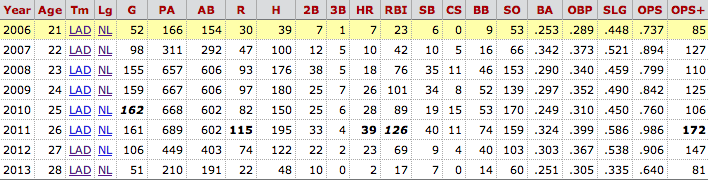
A year ago, we were wondering how Kemp might improve on his banner 2009 season. Today, everyone would be happy if he merely matched it. Lest we forget, that was a season, at age 24, when Kemp had a .352 on-base percentage, .490 slugging percentage, 34 steals in 42 attempts and defense that made you gasp, but not in horror.

The challenge: Finding out if Kemp still has a 2009 in him. Can he adjust, both to the pitchers who fooled him in 2010 and to the level of mental approach required of him over a full season?

The hope: It’s not unusual for players to take a step back before they take their next step forward. The Dodgers hope the presence of Davey Lopes will help provide the spring in Kemp’s step. Want a statistical beacon to look toward? Kemp’s batting average on balls in play last year was .295, after averaging .364 the previous three seasons. A little luck could go a long way.

Kyle Terada/US PresswireDioner Navarro


Dioner Navarro proves his signing wasn’t a clerical error

“I’ve made a huge mistake,” Gob Bluth of “Arrested Development” might have said had he woken up one morning and realized he had signed the once-and-future Dodger catcher to a $1 million contract after Navarro slogged out a .528 OPS in 2010.

The challenge: It wasn’t only 2010. Over the past two seasons, Navarro has a .263 on-base percentage and .306 slugging percentage in 163 games. Yes, offensive expectations are lower for a catcher, but that’s just useless. The Dodgers need their backup catcher to succeed because Rod Barajas can’t play every day (nor would you want him to), but investing too much patience in Navarro could be an investment in a black hole.

The hope: Navarro is still only 27, still only two seasons removed from a .349 OBP and .407 slugging. Totals like that would more than do the trick. Why the Dodgers think Navarro can recover, I cannot tell you, but this isn’t the stereotypical Ned Colletti signing of a veteran on the downslope of his career. This was a belief signing, a buy-low on a player who could still be entering his prime. Perhaps Navarro’s 2011 will show us why at the end of every hard-earned day people find some reason to believe.

James Loney stops hitting like Joe Shlabotnik
Kemp gets all the grief in the mainstream press, but for New School fans, it’s Loney who’s the bigger target. His RBI totals (especially relative to his opportunities) and his defense don’t make up for the overall production the Dodgers could really use from their first baseman.

The challenge: Among other things, proving that not one but two seasons of sub-.400 slugging percentage were just a pause that refreshes. And then there’s overcoming a walk-to-strikeout ratio that went from 1.03 in 2009 to 0.55 last year. And then … well, you get the idea.

The hope: Loney had an .803 OPS heading into the All-Star break last season, which isn’t exactly Albert Pujols, but it’s something to cling to. Folks still love his stroke, a stroke that delivered 19 homers, a .372 on-base percentage and .543 slugging percentage in his first 144 career games. Are we really to believe that Loney peaked at age 23?

Kirby Lee/Image of Sport/US PresswireAndre Ethier


Andre Ethier is no platoon player

Ethier had an .846 OPS in 72 plate appearances against left-handed pitchers as a rookie in 2006. That production has declined each and every year since, down to .625 in 178 PA last season.

The challenge: Actually, protecting that pivotal pinkie might be Ethier’s biggest 2011 worry, but presuming he can, the decline against lefties is more than a bit worrying. Four years of decline is tough to stomach even for a player of Ethier’s overall ability.

The hope: Ethier, who will be 29 in April, was on an MVP pace for the first several weeks of last season, so with loads of room to improve against lefties, his best year might still be ahead of him. The alternative is that the Dodgers softly begin resting him against lefties if a fellow by the name of Jerry Sands keeps knocking at the door.

Jerry Sands knocks at the door
The power-hitting 23-year-old minor-leaguer with all of 68 games above Class A has been perhaps the top story in the early days of spring training, as Dodgers fans unhappy with the current third-outfielder conglomerate look longingly for a savior.

The challenge: Handling temptation. Sands’ massive inexperience at the higher levels of the game makes the script all too easy to write – an early taste of success followed by a faceplant against major-league breaking pitches.

The hope: In 2006, Ethier and Kemp came up as rookies and, while they didn’t win permanent starting jobs right away, made unmistakable contributions toward that year’s division title. The Dodgers can’t expect Sands to become rookie of the year, but it’s not crazy to dream he (or Trayvon Robinson) could provide some lift to the sagging outfield picture.

A midseason trade gives offense a new gear
For all the talk of how the McCourt ownership has hamstrung player acquisitions, the Dodgers have not been silent at the trade deadline. Ted Lilly was no Manny Ramirez 2008, but he was a major splurge for a team barely hanging on in more ways than one. It’s sensible to assume that unless the Dodgers fall completely out of the race, Colletti will have the BlackBerry working.

The challenge: Making the trade worthwhile, both in terms of what comes in (spare us Scott Podsednik, please) and what goes out. If Rubby De La Rosa continues his rapid progress, and anyone from the group including Ethan Martin, Aaron Miller and Chris Withrow bounces back, the Dodgers will have no shortage of trade chips in pitching alone. But you don’t want to use them unwisely, not at all.

The hope: Right player at the right time, ideally without giving up the primo minor-league talent. They’ve done it before; could they do it again?

Mar 01

Matty being Matty

Jerry Crasnick of ESPN.com has a long piece on the complicated individual that is Matt Kemp.

* * *

“Of the 23 Dodgers you could reasonably expect to make their final roster, only two are younger than 26,” writes Steve Dilbeck of the Times, adding that the average age of the team figures to be over 30.

* * *

In his morning press session with reporters in Arizona, Don Mattingly again discussed Casey Blake’s bunting ability as a reason to bat him No. 2 in the order. I’ve liked most of what I’ve seen and heard from Mattingly this year, but this apparent plan to use the bunt as an option from the No. 2 spot — perhaps as early as the first inning — does not appeal.

Mattingly also mentions Blake’s ability to handle the bat — I would point out that next to the oft-criticized Kemp, no Dodger struck out more than Blake in 2010. Blake’s 138 strikeouts were the sixth-most in Dodgers history.

* * *

Dodgers at Indians, 12:05 p.m.
Rafael Furcal, SS
Casey Blake, 3B
Andre Ethier, RF
Matt Kemp, CF
James Loney, 1B
Juan Uribe, 2B
Marcus Thames, DH
Rod Barajas, C
Tony Gwynn Jr., LF
(Chad Billingsley, P)

Feb 17

Today’s Dodger Facebook status updates

Kyle Terada/US PresswireChad Billingsley is digging fielding practice today at Camelback Ranch.

Friend this …

Feb 14

The pleasure and peril of multiyear contracts for the kids

To extend, or not to extend – that is the question.

One part of my recent interview with Ned Colletti that I couldn’t work into the main story was his thoughts about offering multiyear contracts to younger players before they become free agents. Here’s what he had to say:

Ric Tapia/Icon SMIAndre Ethier was arguably the only arbitration-eligible Dodger who didn’t decline in 2010 after receiving a multiyear contract.

“You have to have some predictability to performance,” Colletti said. “Usually, clubs gain a benefit from going multiyear, and it’s got to be seen as that from the club’s perspective, because you’re not guaranteeing performance. All you’re guaranteeing is the financial end of the equation.

“If the right situation presents itself, where the guy’s in the right place in his career, his life and his priorities, and there’s a savings a club can realize, then it’s worth doing. But if only the first part’s there, that we’re gonna pay on the guy maximizing (his performance), there’s really no reason to do it – let him go out and do it every year. Some guys who are flawed in an area or who don’t possess everything they need, the agent will ask you to pay as if that is occurring, in the event that it does.”

In short, Colletti needs confidence that the player is going to stay on track performance-wise, and he needs there to be some savings for making the guaranteed payment. The Dodgers need to get some rebate in exchange for the security that they’re offering.

That being said, Colletti said that Clayton Kershaw is the kind of player for whom a multiyear deal might make sense, but that the process wouldn’t begin until next winter, when he first becomes eligible for arbitration.

“It’d be something we may think about as this year unfolds and we get into the offseason,” Colletti said. “Not this spring. He’s got four more years here.”

That might appropriate to some, too casual to others. Let’s take a closer look.

Colletti signed three key arbitration-eligible players to multiyear deals before the 2010 season – Andre Ethier, Matt Kemp and Jonathan Broxton – and based on 2010 performance, Colletti might well regret two of those contracts. He’s also probably quite pleased that he didn’t go multiyear with Russell Martin, and not really worried that he hasn’t done so with James Loney, who signed his latest one-year deal Friday. Perhaps he should have bought low on Chad Billingsley last winter. (I would have, but I would have also wanted to do so on a lot of the other guys.) In general, recent experience has probably made Colletti even more wary in discussing them with other players.

Here’s a snapshot of the salaries for the players we’re talking about over a four-year period (multiyear deals in bold, Martin’s Yankees salary in parentheses):


Player/Year 2008 2009 2010 2011
Billingsley $415,000 $475,000 $3,850,000 $6,275,000
Broxton $454,000 $1,825,000 $4,000,000 $7,000,000
Ethier $424,500 $3,100,000 $6,000,000 $9,250,000
Kemp $406,000 $467,000 $4,000,000 $7,050,000
Kershaw $404,000 $440,000 $500,000
Loney $411,000 $465,000 $3,100,000 $4,875,000
Martin $500,000 $3,900,000 $5,050,000 ($4,000,000)

Note that Billingsley got a 63 percent raise for 2011 following a well-regarded season, and Loney got a 57 percent raise for a season considered a disappointment. That gives you some guideposts for the following speculation:

  • Not signing Billingsley to a multiyear deal in 2010 might have cost the Dodgers a few hundred thousand bucks this year. But not signing a multiyear deal in 2009 might have saved the team money in 2010.
  • The two-year deal in 2010 for Broxton probably cost the Dodgers more than $600,000 for 2011. With a three-year deal in 2009, perhaps they would have broke even, though that involved more risk.
  • Ethier’s two-year deal has probably saved the Dodgers a little bit of money; a three-year deal in 2009 might have saved them a bit more.
  • With Kemp, I’m honestly not sure that going year-to-year would have made much of a difference. His 2011 salary appears higher than it otherwise would have been, but that might have been a case of backloading the contract, because the 2010 salary looks a little low. Kemp’s 2009 performance was stronger than Billingsley’s, and that’s not reflected in the $150,000 difference between their 2010 paychecks.
  • Going year-to-year with Loney probably saved the Dodgers money, but less than $1 million.
  • Martin, of course, is where the big savings comes – if he had signed a multiyear deal in 2009, he might have been paid an extra, say, $2 million last year. And if it had been a three-year deal, the Dodgers might be paying Martin $8 million this season. Only if Martin has a whopping comeback will the Dodgers regret this.

Given that Colletti didn’t have a crystal ball, it’s hard to complain much about how he’s handled things. The decision to show restraint on Martin has arguably saved the Dodgers $6 million, which more than covers any fringe costs with Broxton, Billingsley, Ethier or Kemp. The only way this would be reversed is if one of those four or Loney has an MVP or Cy Young season, and you’re then fretting that the Dodgers haven’t bought out some of their free-agent years, the way Colorado has with Troy Tulowitzki or Carlos Gonazlez. We should be so unfortunate.

Brad Mangin/Getty ImagesClayton Kershaw, nearly four years younger than Tim Lincecum, had a lower ERA than the Giants ace in 2010.

That brings us back to Kershaw, who becomes eligible for salary arbitration after this season and eligible for free agency after 2014. (Gosh, that seems so nice and far away right now.) How urgent is it for Colletti to lock Kershaw up for multiple years? It would sure feel nice, but you can’t say there isn’t risk.

Let’s turn to the contract status of arguably the reigning young aces of each league (at least until Kershaw decides to do something about it).

One year ago Saturday, Tim Lincecum signed a two-year, $23 million contract (plus incentives in the thousands). The deal came after Lincecum and the Giants were $5 million apart – $8 million vs. $13 million – in their 2010 arbitration filing. It didn’t come close to addressing his free-agent years; it just was a hedge against what Lincecum might have earned going year-to-year.  Hypothetically, if Lincecum had settled for a 10.5 million salary in 2010, he might have been looking at something like $17 million this year, making for a total in the neighborhood of $28 million. (Though Lincecum slipped a bit in the 2010 regular season, his postseason performance would have helped rectify matters.)

Put one way, the Giants a year ago risked committing $13 million in 2011 salary in order to save about $5 million. That’s some high-stakes Mahjong.

Over in the American League, Felix Hernandez and the Seattle Mariners played things differently. After earning $3.8 million in 2009 and facing a $4.3 million gap in salary arbitration filings ($7.2 million vs. $11.5 million), Hernandez signed a five-year, $78 million pact that locked away his first three years of free agency (2012-14). The contract averages $15.6 million per year for five years, $19.3 million for the three free-agent years. Again, there’s no mistaking the double-edged sword: You can assume that $58 million for three years wouldn’t have cut it for Hernandez after this season, but the risk is catastrophic if something goes wrong.

I think it’s pretty clear where my sentiments lie with Kershaw – I’d sign him to a multiyear contract tonight – but you can understand why Colletti might hesitate or procrastinate. For another example, look how quickly opinions turned on Eric Gagne before his multiyear deal vs. after he got hurt. It’s harder to stomach paying big bucks for an injured player than it is to pay bigger bucks for a healthy superstar.

On the other hand, better Clayton Kershaw than Jason Schmidt.

In my head, I can understand the patience, as much as I believe it should be done.

Feb 07

The Dodgers according to Ned Colletti


Jeff Gross/Getty ImagesNed Colletti is beginning his sixth season as Dodgers general manager. The team has averaged 86 regular-season victories during his tenure.

Ten days.

The Dodgers rose from the basement of the National League West in May to the best record in the league in June, then sat only two games out of first place in the division at the All-Star Break.

Yet as far as Dodgers general manager Ned Colletti was concerned, it was almost a mirage. During an interview at his Dodger Stadium office last week, Colletti fully acknowledged that the Dodgers’ second-half fade, as much as he and everyone else tried to reverse it, came as disturbingly little surprise to him.

Ten days. In Colletti’s view, that’s how long the Dodgers played championship-quality baseball in 2010.

“I think the second half, in a lot of ways, was the result of the first half and the spring,” Colletti said. “I can’t say I had more than a 10-day period where I thought we were truly playing as well as we could play. In ’09, we had a pretty good defense, and we executed, played well in clutch situations, found a way to win games. We really hadn’t done that very much in the first half of the season. And I think it caught up with us in the second half.

“And what I did last year wasn’t acceptable. How I prepared for last year didn’t meet the results that I have for myself.”

The Dodgers will arrive to spring training later this month, in many ways, a different team than a year ago, starting with a greater emphasis on starting pitching that represents Colletti’s most visceral response to his roster concerns from 2010. At the same time, Colletti said the experience the returning core gained from last year’s disappointment has the potential to play a significant, positive role in 2011.

“They’re professional, and this is their livelihood,” he said. “And you believe there’s enough pride and adjustment and education from this past year. A lot of guys haven’t gone through what they’ve gone through in the past year. That will put them in the right place coming in to know it’s got to be better and it’s got to be more focused.

“Because they’ve (succeeded) before, I’m confident. But then, last year was what it was. I’m cautious by nature. I take nothing for granted, at any point in my life at any stage. So I don’t take it for granted that it’s just gonna happen. I think it has to be prepared in order to happen.

Translated, Colletti believes the talent is there but the effort, focus and confidence need to return. He said the offseason preparation “is done to some point, and when you get to camp now it’s going to be up to Don [Mattingly] and his staff to have certain procedures in place and certain accountability set forth. And I obviously have to support that, and they have to buy into it.”

Jeff Hanisch/US Presswire
Matt Kemp had homered once in 31 games prior to hitting one out in each of his final five games of 2010.

Comeback kids?
Despite leading Dodgers regulars on offense, Andre Ethier never fully seemed to recover from the pinky injury he suffered in May and fed doubts about his long-term ability to hit left-handed pitchers (.625 OPS against them in 2010, .681 for his career). James Loney went from decent before the All-Star Break (.803) to disastrous after (.616). Jonathan Broxton’s second-half collapse is as well-documented as anyone’s, and Matt Kemp … well, let’s just say his season could have been the inspiration for what made Linda Blair’s head spin in “The Exorcist.”

The question, Colletti agreed, is which of the players will hit a hurdle in their development in 2010, and which have hit a wall. And it’s a question that’s due for an answer. Mulligans that were handed out last year won’t be found so easily or at all in 2011.

“In the past, I’ve been more patient than open-minded,” Colletti said. “I think that one of the toughest characteristics you have to have in these jobs is patience because everybody expects everything to turn overnight. … It doesn’t work that way. Everybody’s human; these guys are all human. They take maturation, physical maturation, all kinds of processes.

“I won’t be able to be just completely patient with it [this year]. We’re not an old team, but we’re not a team overwhelmed with rookies, either. We have experience, and a lot of our players have been to the postseason at least twice and sometimes three times in the last five years. So it’s there, it’s really kind of going back to that point and being focused about it and passionate about it and tough-minded about it.”

It might surprise people to learn that Colletti seems particularly bullish about Kemp, the target of a radio critique by Colletti in April.

“I think probably from middle of August on, things became a little bit more focused for him,” Colletti said. “He and I had a conversation, probably in August, that was really a man-to-man, heart-to-heart, one-on-one conversation. And I was trying to take some of the weight off. I think he understands it; I think he understands what transpired last year. I think from my conversations this winter, from the last month of the season and this winter, I think he understands more than he did a year ago about himself and about the game, about preparation. So I think he’s got a chance to really have a great year.”

It’s possible Colletti might have said the same thing about Russell Martin, except Martin is no longer around. The circumstances of the Dodgers’ decision to let Martin go rather than offer him salary arbitration weren’t discussed, but Martin’s recent offseason comments about “distractions” that affected him led to a broader comment from Colletti about the difficulty of playing in Los Angeles.

“Sometimes, it’s commitment, prioritization and commitment,” Colletti said. “I read what Russell said, but I don’t know what the true context was or what his underlying thoughts were as to why he said it. … There are a lot of distractions in this city. There’s a lot of different things to be doing, a lot of places your mind can wander off to, but if you’re a professional baseball player, if you’re a Dodger, you’ve got to figure out life. … And it’s not easy to do it.”

Without going into many specifics, Colletti indicated that the ability to play in Los Angeles is a factor in some trades of young players he has made. He called Carlos Santana the prospect he regrets parting with “probably more than anybody” before he added that there were a couple of other guys he would have to wait and see on.

“Again, Los Angeles isn’t for everybody,” Colletti said. “Sometimes we make a move on a player because we know in this environment here, they’re not going to be very good in it.”

Chris Williams/Icon SMI
Jonathan Broxton issued 25 of his 28 walks last season after June 23.

Pitching paradoxes
As for Broxton, count Colletti among those who see his second-half crumble as an issue of confidence, rather than health problems that might have been caused by his 48-pitch tar-and-feathering against the Yankees last June.

“He never complained,” Colletti said. “And at the end, he wasn’t thrilled with it, but I said, ‘Jonathan, I need you to take a complete physical — your arm, your shoulder, your elbow.’ A week to go in the season. And he said, ‘I feel great. I don’t need to do it.’ And I said, ‘I need you to do it.’ So he said, ‘I’ll do it,’ and everything came back clean.”

Colletti is aware of the volatility of relief pitchers, comparing them to great goaltenders who can go through “a month or two where they can’t stop anything.” But this awareness cuts both ways. It leads Colletti to give relievers who have performed in the past long leashes, and it compels him to have as many alternatives on hand as he can, as seen through the acquisitions of set-up men Matt Guerrier and Blake Hawksworth and oblique references to No. 6 starter Vicente Padilla’s potential to close games.

Again, however, Colletti believes that at rock bottom you can often find a trampoline. Look no further than Chad Billingsley, banished from the Dodgers’ starting rotation by the end of 2009 before rising anew last season.

“Most of our young players did not experience a lot of failure as young players, minor leagues [or] early in the big leagues,” Colletti said. “They really didn’t struggle. And when it finally hits you, and you do struggle for whatever reason and you’re doing it in front of 45,000 people in Los Angeles all the time, on television every day, that’s a tough time to struggle for the first time, for the really first time, and be able to come out of it.”

Interestingly, Colletti’s faith in failure recovery played a partial role in what many believe is the Dodgers’ greatest weakness heading into this season: the lack of a bona fide left fielder.

Angst in the outfield
This winter, the Dodgers didn’t bid on the two marquee outfield free agents, Carl Crawford and Jayson Werth, and you can safely conclude that was a reflection of their overall contract demands and the Dodgers’ budget. But when it came to alternatives, Colletti was wary of blocking two Dodgers outfield prospects who could each be major league ready a year from now, Trayvon Robinson and Jerry Sands, especially after the experience Robinson had in Jacksonville last summer.

“Robinson last year started off slow in Double-A, and we stayed with him and he figured it out,” Colletti said. “That to me was huge. Because he’s gonna have to figure that out. Because everybody struggles up here.”

There is the caveat that it’s not as if the current Dodgers never struggled in the majors or minors before 2010 – one could easily make the case that they did, but that their subsequent triumphs blotted out the memory. In any event, if he had found a signable veteran outfielder worthy of a multiyear deal, Colletti no doubt would have pulled the trigger. But he does feel optimistic over the long term about what he has.

“If I would have signed a left fielder for three years, who was again not one of those robust guys — I’m not sure there was a guy out there — then I’m really kind of blocking one of those two kids, and I’ve got faith in both of them,” he said. “Hopefully, not this year. Hopefully, it’s a year from now, but I have faith in both that they’ll be able to play and contribute. And actually I told them both that, too, in the fall — I told Trayvon way back in the summertime, ‘It’s important for me to know who you are and how you play. Because you know what, Manny’s not gonna be back next year. And I’ve got to make a decision whether I’m gonna go and tie up his spot for three or four years, or be patient and mix and match for a year and wait for you.’”

Scott Boehm/Getty ImagesCasey Blake had an .895 OPS against lefties last year, .663 against righties.

In the interim, Colletti is under no illusion that he has gold in the third outfield slot, so the Dodgers will essentially play it by ear in the outfield, with Mattingly looking at matchup opportunities for Tony Gwynn Jr., Marcus Thames, Jay Gibbons and Xavier Paul (if he makes the squad), and on an infrequent basis, Casey Blake or Jamey Carroll.

“Right now Matty’s the center fielder,” Colletti said. “Andre’s the right fielder. I want to see what Tony can do offensively. He’ll play as much as the offense allows him, I think … using the whole field, bunting more, figuring out ways to get on base, because his on-base percentage isn’t high even when he hits .270. See if he can become more disciplined at the plate, use his speed more to get on. I don’t expect power out of him. I don’t expect gap power out of him, but I would like to see him get on base a lot more, because if he does it perhaps changes the dynamics in the outfield.

“And in the meantime, I’ve got two guys that can hit, one from the left side and one from the right side — actually two from the left side with X. Paul and Gibbons, and then Thames. … And perhaps they’re five- or six-inning guys, and then you go defense later. But you’ve got two guys that might be able to hit 20 homers between them.”

Third base offers a secondary question for the Dodgers because, while Blake is sure to start against lefties and some righties, no one seems to be beating the drum for him to play 146 games like he did last season. With the Dodgers’ minor leagues fairly thin at second and third base, this time Colletti took the plunge on a multiyear stopgap in Juan Uribe.

“Our system’s produced a lot of guys,” Colletti said. “But except for really [Ivan] DeJesus, we don’t really have a second baseman that’s on the verge of being here. We have a shortstop coming probably in Dee Gordon and after him [Jake] Lemmerman, and right now third base is a bit of an open spot too — we had [Pedro] Baez in the Cal League last year. So Uribe, while the on-base percentage isn’t Moneyball-ish or whatever, the run production is still pretty good, in that he can play second, short or third, and we don’t have anybody that’s going to press him at third for a while, and really De Jesus is trying to transition to play second. I needed somebody I can run out there who’s a big league guy.”

Because of what he sees as a potential benefit to have Uribe play some at the hot corner, Colletti emphasized that De Jesus has a legitimate chance to make the Opening Day roster as a backup infielder. Obviously, someone like Carroll could also make several starts to allow Blake to rest.

In any case, Colletti is aware of how much a juggling act the Dodgers’ everyday lineup has become. Though he has in one sense traded last year’s lack of a fifth starter for this year’s lack of an everyday left fielder or third baseman, Colletti sees the two situations as apples and oranges.

Jonathan Daniel/Getty Images
Matt Guerrier, 31, has allowed 11.5 baserunners per nine innings in his career.

Never enough
“You really didn’t have in my mind many choices that were going to be able to play every day,” Colletti said. “We had to fix the pitching first, and we had to upgrade the bullpen if we could.

“You can’t finesse pitching. Maybe a day here or there, but you need to have it. And the list [of available pitchers], we were kind of picking near the top of the list, even though it isn’t sexy to say you signed Ted [Lilly] or Hiroki [Kuroda], it’s not necessarily ‘wow,’ but it’s solid. It gave us a little bit of depth. So we had to start there. The kid from Minnesota, Guerrier, is gonna be a good add for us. He’s pitched in a lot of big games; he’s always had positive results.

“It’s the most volatile group, but once [Joaquin] Benoit got three years and [$16.5 million], that’s what people expect to get … and if you really need a guy, sometimes you have to go the extra distance to go and get him.”

Add together the total commitments the Dodgers made to their free-agent signees of this past offseason, and you barely pass the total value of Adrian Beltre’s deal by itself, while falling short of the Crawford or Werth contracts. And like it or not, Colletti was not going to enter another season shy on pitching or dependent on unproven rookies such as James McDonald or Scott Elbert.

“I was apprehensive all winter long last year” Colletti said of the starting pitching. “I knew we were short going in; I knew we weren’t going to be able to rally it. In the spring, J-Mac and Scotty both struggled. We may have sent them both out early, in fact, because they couldn’t throw strikes; they were all over the board. So right from the beginning, I knew we were going to be short. I didn’t know how we were gonna mix and match, and we couldn’t afford an injury certainly.”

If there’s an ongoing concern on everyone’s minds, it’s how the Frank McCourt ownership crisis is affecting spending on the team on the field. You can argue that different owners might have allowed Colletti to sign one big-ticket free agent in addition to shoring up the pitching, but Colletti doesn’t contend that the divorce itself is having an impact on personnel.

He also makes the case, as McCourt did a year ago, that the Dodgers are aiming to spend more money to deepen their prospect population.

Farm aid
“We’ve had basically the same [major-league] payroll,” Colletti said. “Though we dipped a little bit last year, we’re coming back this year. It’s not really how much you have, it’s where you spend it. We do have to get better at international signings; we have to reinvest there. I think we’ve let Venezuela slip for a few years, and we’ve made some changes in the staffing.

“We’ve done a decent job in the D.R. [Dominican Republic] — not what we did 25 years ago, but with all due respect, 25 years ago there wasn’t 30 teams down there, either. So, it’s not like we could just cherry-pick the players we want like we probably did at the outset of the country opening up to having players signed. But we do have to get better at that to support our player development system. It’s been fruitful. Obviously, a lot of players are in the big leagues now that we drafted, but we have to keep flowing, and they have to keep getting better. I know we’ve hit a touchable lull right now and I think we’re probably a year or two away from having another group come forward.”

[+] EnlargeZach Lee

Chris Carlson/APLogan White escorts newly signed Zach Lee in his Dodger Stadium visit in August.

Colletti didn’t rule out the Dodgers’ top draft choice of 2010, Zach Lee — whose signing shocked most baseball observers — being part of the Dodgers’ graduating class of 2012. Amid the height of McCourt tensions, Lee received a $5.25 million signing bonus, a record for a Dodgers’ draft pick. The previous record-holder, Clayton Kershaw, reached the majors less than two calendar years after he was picked, and Lee could do the same.

“We really liked this kid,” Colletti said. “We really liked his makeup, his demeanor, his abilities, athleticism, his toughness. … Not only are the physical skills different than most kids you see, but the way his mind works is different … probably from playing at the highest levels at a couple of sports, including going to LSU for a summer and having that experience, which as long as he didn’t get hurt it didn’t bother me.”

Colletti’s hope is that the Dodgers’ minor league pitchers drafted in previous years allow Lee as much time as he needs to develop. There was an epidemic of setbacks among the farm system’s arms in 2010 — so many that if Colletti wants to see who can overcome hurdles, wish granted.

“It’s concerning to me,” he said. “Probably a lot of the guys that we could both probably name should be a year farther along than they are. They’ve all struggled with command. … Some are converted players, some weren’t pitchers necessarily in high school or college. So they’re still learning that.

Curing the epidemic
And to circle back to the beginning of our piece, in some ways, older players never stop learning and developing. Witness Colletti’s additional assessment of the contagion that struck the Dodgers’ offense in 2010:

“I think hitters sometimes without results start to get impatient, so they start to chase out of the zone,” he said. “They’re trying to build more offensive numbers in a quicker period of time and so they’re not as diligent to work the count, and all that stuff starts to compound through the course of it. … When people are starting to slump, sometimes it produces more guys that go in that direction than less. And that’s what started to happen. It started to spiral where one guy struggled and then two. And then the third guy saw the other two and then he struggled, and it continued to mount.”

Alex Gallardo/APDavey Lopes will switch to a Dodgers’ uniform for the first time since Game 6 of the 1981 World Series.

When you take Colletti’s view of what went wrong with the Dodgers last year and what’s needed to make it right, it makes sense that he sees one of the most promising offseason moves as one that even some jaded Dodgers fans embraced: the hiring of Davey Lopes as a coach.

“I’ve known him a long time and I’ve admired him,” Colletti said. “You know, I was with him in Chicago when he was still a player and I’ve certainly watched him from the other side of the field when he managed and when he was coaching. And I think what he brings here is — you’re talking about first — someone who was an iconic Dodger who understands Los Angeles and understands the Dodgers and was here during one of the greatest periods in our franchise’s history. That’s important.

“What he did in Philly with baserunning and defense and fine-tuning that position, the first-base coaching position, to make it a far more valuable position to the organization, is something we noticed. And I think he’s going to have a great impact on our club. I think there are some players that could turn their game up a notch with his instruction, with his thought process. I think, while it’s a coaching position, I think it’s a huge addition for this franchise.”

Will a new manager, new coaches, new players and new spirits be enough to right the Dodgers’ ship? It’s too soon to say, but if the Dodgers are to play more than 10 days of great baseball in 2011, Colletti will expect to see strong signs of it before Opening Day arrives.